My Canadian ski bum tour’s next stop after RED Mountain was Revelstoke. It’s a four hour drive north. On drive day, it was snowy and icy all the way. Twice I had to stop and knock off ice in my wheel wells. There isn’t much in the way of food options in January along the route. It’s beautiful, meandering along 142 mile long Arrow Lakes, which have steep hillsides. Luckily I like driving in the snow!
An added twist was that at the end of the lakes, the road ends and one must take a ferry to reach the road on the other side! This seemed so bizarre to me. For the first time in my life I was taking a ferry to go skiing.
I reached the town about 2:30 p.m., and checked in at Monashee Lodge. Just before town there’s a recommended restaurant called the Big Eddy Pub. Everyone loves it. I paid a visit. As soon as I opened the car door at the lodge, the sound of big mountain skiing came to my ears! A helicopter’s thump thump thump!
Someone’s heli skiing!
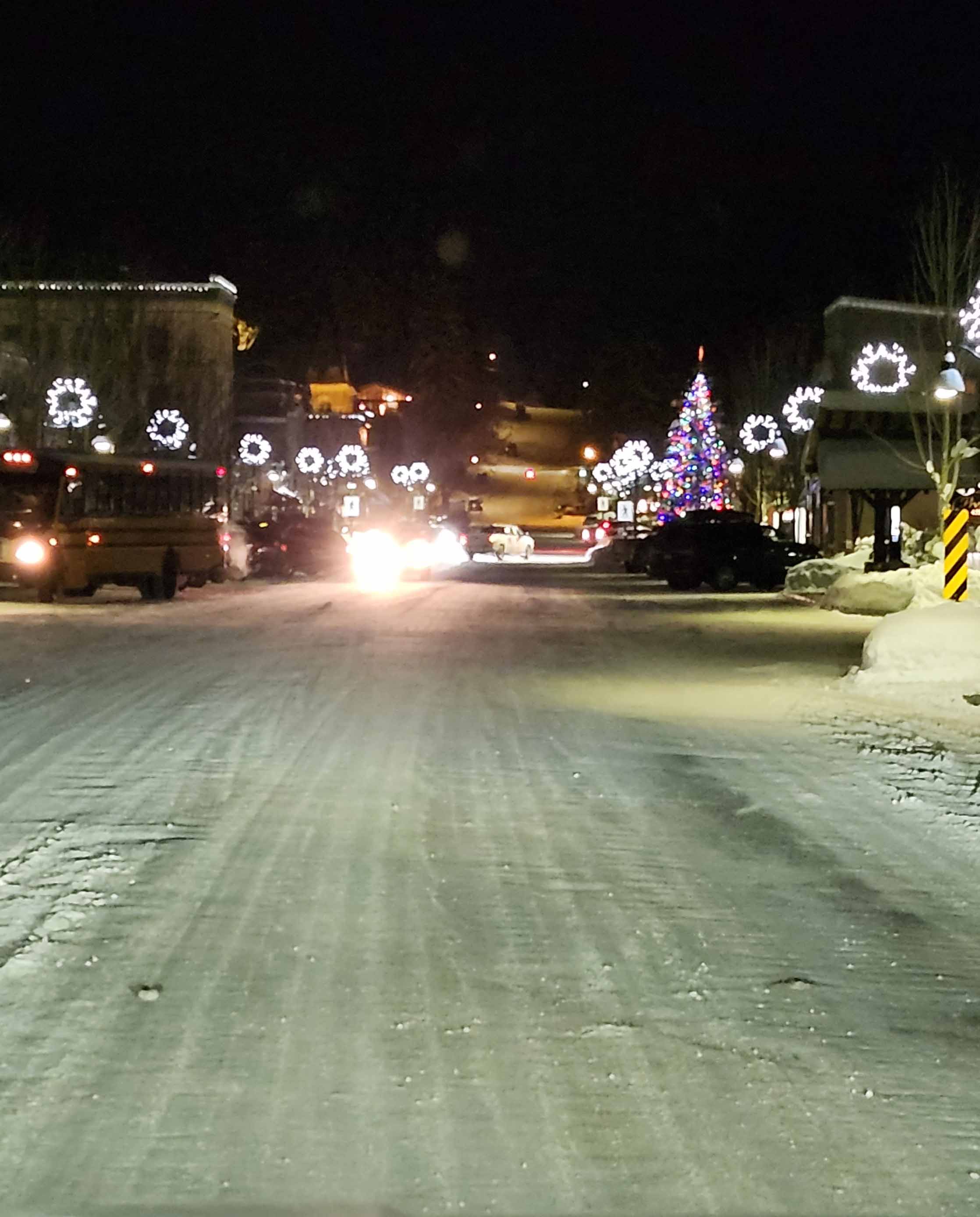
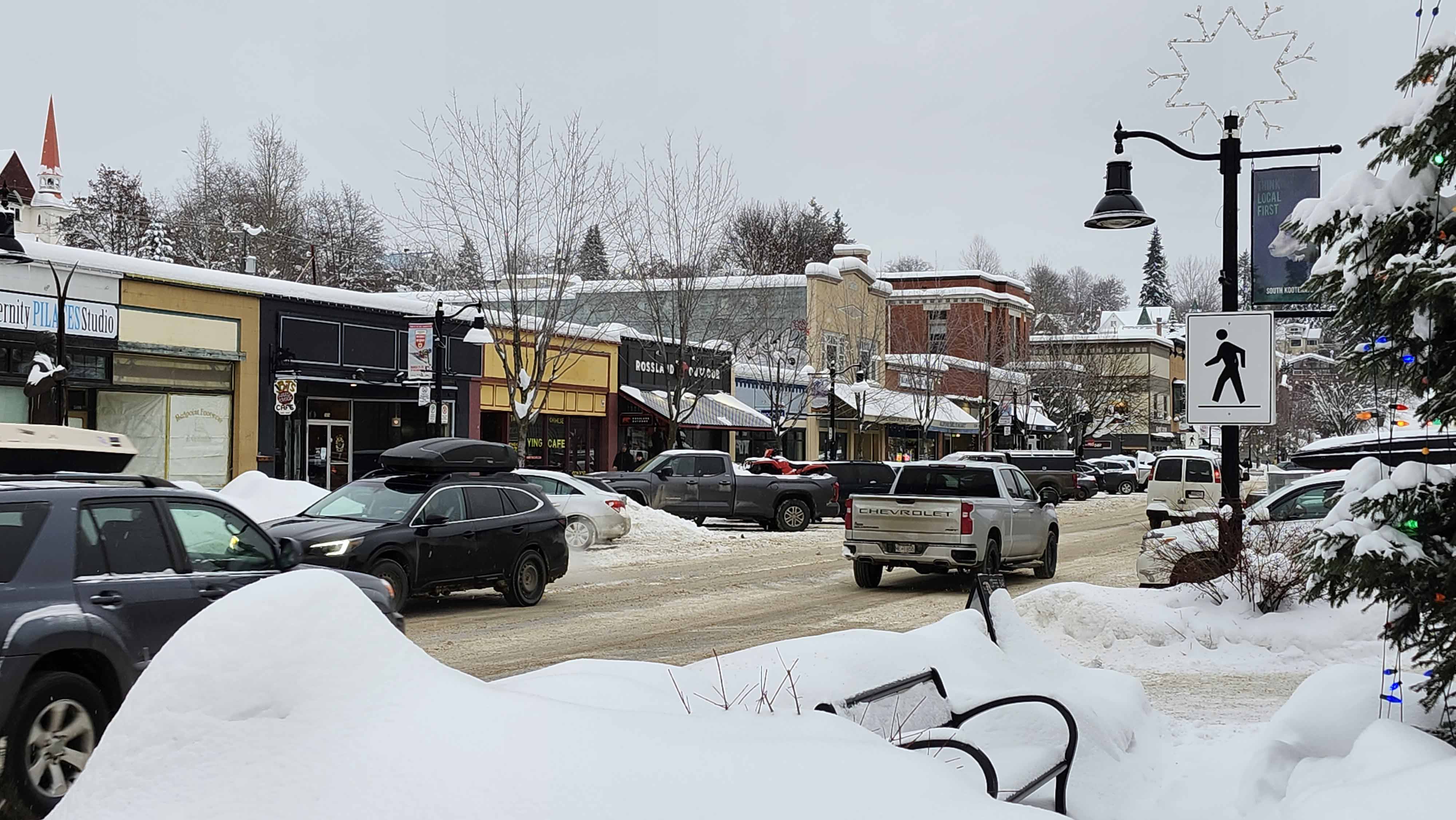
The town of Revelstoke has lots of late 19th Century architecture character plus hotels, restaurants and stores. It is a fully three-season outdoor recreation powerhouse. The Columbia River and Upper Arrowhead Lake, plus numerous creeks and streams, offer swimming, fishing, sailboarding, kayaking and powerboating. The mountains, which reach over 11,000ft, contain a few national parks such as Revelstoke and Glacier. So there is hiking, backpacking, camping, alpine and Nordic skiing, snowboarding, sky diving and paragliding. The town also has an active arts and music scene. Something for everybody! They even have a local curling club.
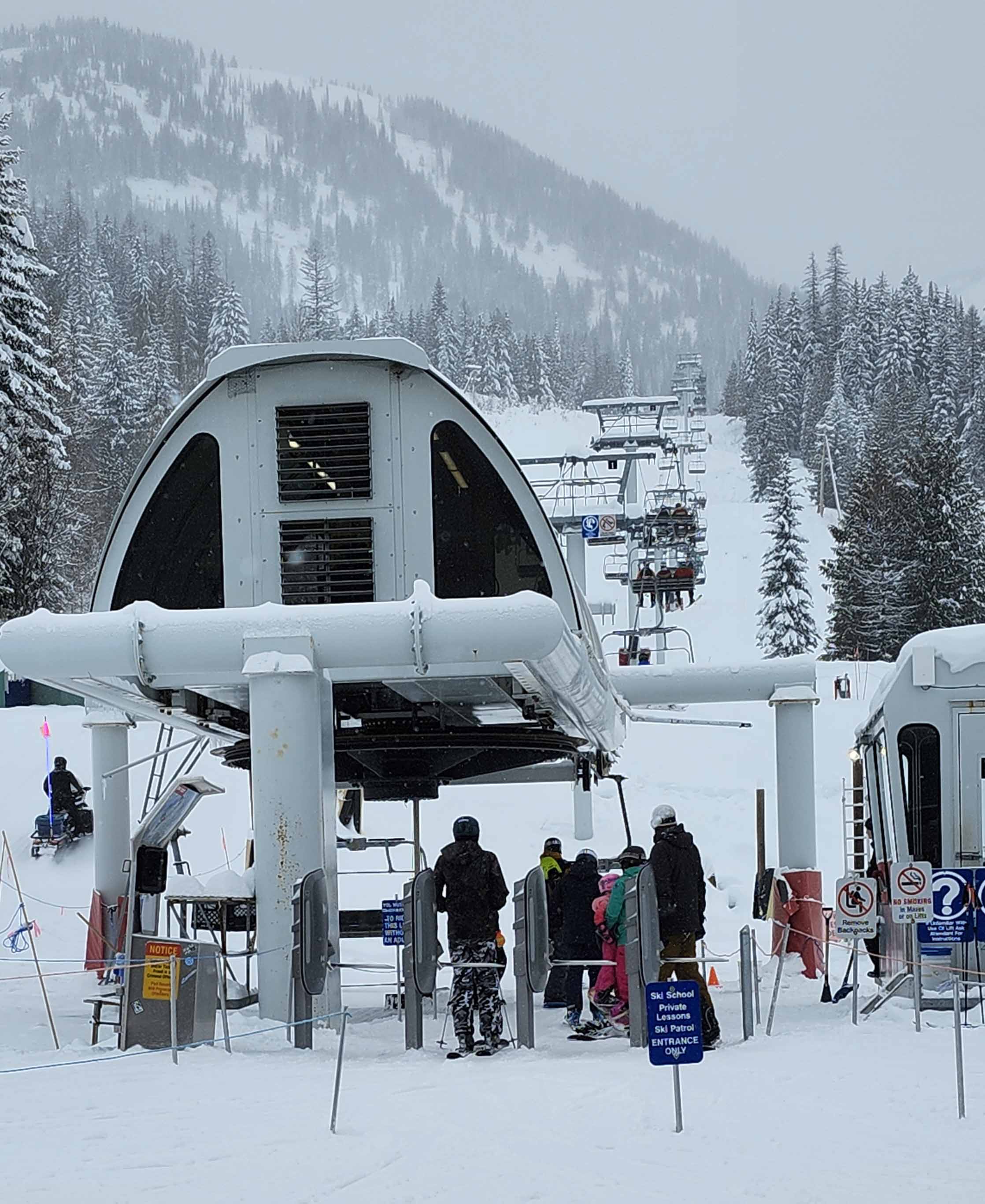
I came for the skiing at the infamous Revelstoke Mountain Resort, with the largest vertical drop in North America. In fact, I never could ski all the way down. I opted to ride the lower Revelation Gondola back to the base. The base is just outside of downtown, 10-15 minutes from town center. The legendary terrain did not disappoint. And I got lucky with plenty of fresh snow! It was so snowy and sometimes foggy that I never saw the views! Revelstoke has plenty of bowls and tree skiing. My advice is never ski in those areas alone! They might never find you, if you get lost!
The base is pretty spartan. It’s got a lodge and essential services, like a coffee shop, ski retail, ski repair and rentals. It was snowing magically. I met a lot of people from all over – France, Switzerland, New Zealand, Quebec, Belgium, and more – but no Americans. I even encountered people on the lift who know my sailboat racing friends in Marblehead, Massachusetts!
In January 2024 I did my 3rd annual ski bum road trip! This time, Anthony Lakes, OR, Schweitzer, ID, RED Mountain, BC, Revelstoke, BC, and Sun Peaks, BC! I planned to go to Crystal Mountain, WA, but a warm up cut that out. I loved RED Mountain! It’s in the Kootenay, about 12 miles north of the Washington border, in lovely Rossland. All towns had their positives, but for me Rossland is the most charming of all.
RED Mountain is only 12 minutes from downtown. It has a very local feel to it. No high speed quads here. Regulars say that keeps the crowds away. I was fortunate to have nice conditions in this El Nino winter, which has been cruel to Pacific NW resorts. It snowed 3-4″ each night, leaving comfy conditions.
RED Mountain offers complementary guided skiing twice a day. You can choose skill levels from novice to advanced/expert. I chose intermediate, with my knee still recovering. It turned out that I had a one-on-one guided experience with Abigail! She showed me all the lifts, and we did groomed blues and also a tree run with tight turns.
Like almost every day on this trip, it was cloudy and I never saw the tops of the mountains surrounding. The bright side? SNOW. Lots and lots of fresh fluffy snow! Back at my Lone Star Hotel, which sits in the forest at the bottom of the access road, intoxicating calm-wind snow showers came and went. RED mountain offers terrain for all skill levels. And even on a Saturday with fresh snow, lift lines were insignificant.
It is easy to be spoiled there. One starts to just take for granted that you can get an easy parking spot. No reservations necessary. People are very laid back and friendly. It’s so uncrowded that it is ranked #1 acres per skier in North America! What’s not to like? I also met quite a few Kiwis either skiing or working at the lodge. When asked about skiing in New Zealand, they said, “Not very good. That’s why we’re all here!”
As an IKON pass holder, I follow the IKON user group. Day after day, members post images of enormous lines at California, Colorado and Utah resorts. It’s a wonder BC is still so relatively undiscovered!
RED Mountain boasts one more signficant asset, and that is the so cute you can hug it town of Rossland! Its small, it’s welcoming, it’s got lots of late 19th Century architecture, a bevy of nice restaurants, shops, and outdoor gear outfitters. At the grocery store, Ferraros, you find all that you need, and folks recruiting volunteers for the upcoming music festival.
After visiting some other ski towns infested with corporate resorts catering to the very rich, Rossland is very refreshing. I will definitely return. Here, childhood really is filled with healthy outdoorsy activities rather than cell phone video games.
Summertime activities include river running, hiking, backpacking, fishing,
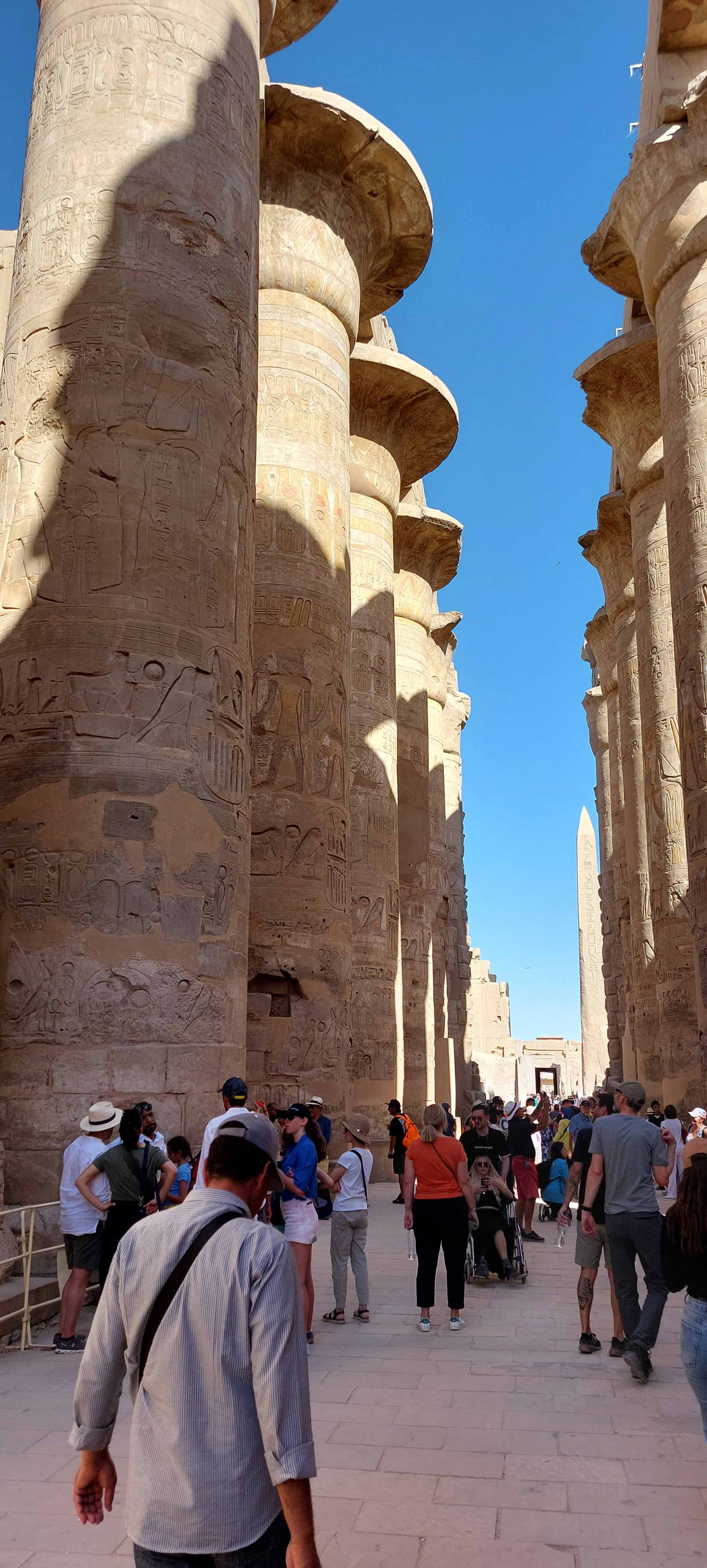
Our final visit in the Luxor region was the Karnak Temple Complex. Taken together with its connection to the Luxor Temple, is said to be the largest in the world. It is dedicated to the King of ancient Egyptian gods, Amun. Over several thousand years, it was expanded by pharaohs Thutmoses I, Queen Hatshepsut, Amenhotep III, Ramses II, and the Ptolemys. It is generally thought that it was started during the Middle Kingdom, about 2040 BCE. Its construction continued through the centuries into the Ptolemaic era which ended 30 BCE. It is estimated that during the New Kingdom 80,000 priests worked at Karnak.
The ancient Egyptians referred to this place as “the select place,” “the origin,” etc. They believed this was the place where the world emerged from the chaotic soup that was, in effect, the Big Bang, and the creator god Atum started the work of creation. They also believed this was the place they could communicate with Amun. Egyptian mythology says that Atum and Ra merged to create the supreme Amun.
Each year the ancient Egyptians held the Opet Festival here. They’d carry statues of Amun, Mut and Khonsu in a barque to Luxor Temple, celebrating the god’s guiding the souls of pharaohs to renewed life.
It was believed Amun was a protector of pharaohs. Here, this is specifically spelled out with the ram-headed sphinxes, which can be seen guarding pharaohs under their chins.
Karnak is so iconic that a number of films and film scenes were shot here. Death on the Nile, The Spy Who Loved Me, Valley of the Kings, Poirot, an episode of The Love Boat, and more.
The interior galleries and chapels are full of heiroglyphs. There are 134 columns 65 feet high.
There’s also a number of obelisks. Historically there were hundreds around Egypt but many fell over and many more were taken to places like New York, Paris, Rome, the Vatican, and London. Today there are more obelisks in Rome than Egypt.
Egypt is without question the world’s most archeological rich region. It was one of mankind’s first civilizations, and due to the desert weather, it’s incredibly well preserved. Karnak is a pinnacle of the sites.
After Luxor, the next morning we were out the door very early to experience the Valley of the Kings and the Mortuary temple of Queen Hatshepsut. We left early to avoid mid-day heat – the area is known as one of the hottest places on earth. It lies in a valley to the west of Luxor.
The Valley of the Kings includes at least 65 royal tombs. They were dug into the mountainsides, and can be quite extensive. They are noted for the remarkable condition of the painted reliefs – which have never been exposed to direct sunlight.
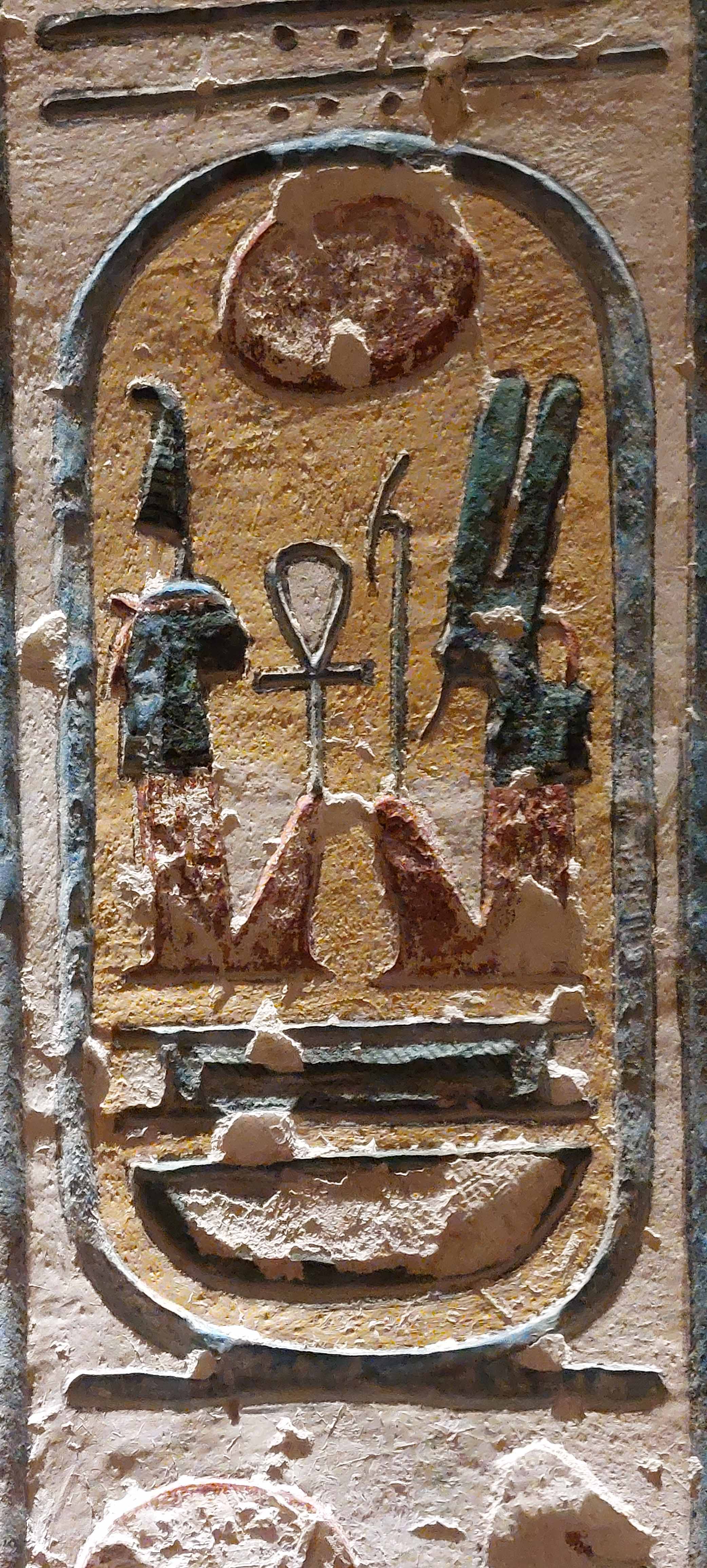
CartoucheMa’at
The tombs are intended to help the soul of the pharaoh complete the journey from this life to the next. The walls and ceilings are completely filled with memories of his life, and after life myths and traditions all ancient Egyptians knew as essential to successfully make the transition to the next life.
Ancient Egyptians believed that their Earthly existence was merely a transitional phase. They believed that if they lived this life following the principles of ma’at, they might make it past this phase. The goddess Ma’at put forth 42 commandments by which all lived. These were more extensive than the 10 Commandments of Moses, and existed for thousands of years prior. Today, it is worth reflecting that most societies and laws still align with many of these values.
When an ancient Egyptian died, its soul awoke in the Duat. The Duat was the underworld – a place inhabited by the deities Osiris, Nekhbet, Ma’at, Anubis, and Hathor, as well as the souls of others undertaking the journey to the next life. This journey often took place on a raft. Osiris granted or denied entry to the next life. Anubis and Afu Ra helped the soul on its way. It was also a difficult realm, filled with demons and serpents who’d challenge the soul. After making it past all these challenges, the soul made it to a place where it would face judgment by Osiris. There, countless other souls waited their turn. Ordinary Egyptians hoped to ascend to the “Field of Rushes,” where they’d sow and harvest abundant crops into eternity. But the pharaoh, his spirit would unite with the Sun god Ra, ascend into the sky and take its place amongst the stars. Everyone was guided across the duat by the ram headed duat form of Ra – Afu Ra. If they made it to the other side of the duat, the deceased faced a “tribunal” over which Osiris presided. It would have to recite 42 “negative confessions,” meaning they’d say “I did not” engage in each of the 42 rules – e.g. “I have not been an evesdropper.” Then, a scale of worth is presented. This scale has on one side the ostrich feather of Ma’at. The feather of truth. On the other side is placed the heart of the deceased. The ancient Egyptians did not know Hell as Jews, Christians and Muslims know Hell. Instead, the worst would be to cease to exist at all. Once the heart was placed on the scale, if it was lighter than the feather, the soul could go to the afterlife. If not, if heavier, the soul’s heart was fed to a crocodile/hippo monster and extinguished for eternity.
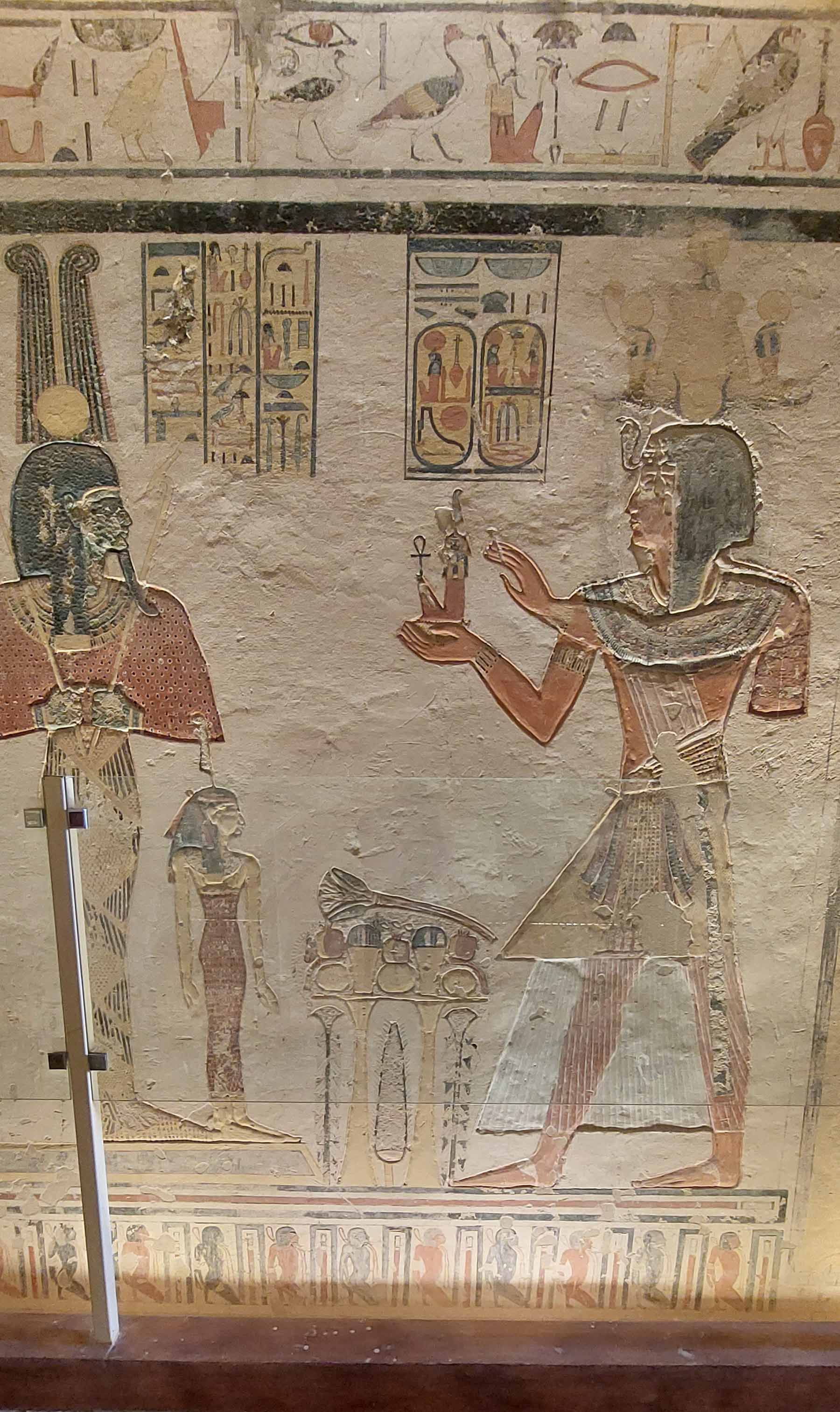
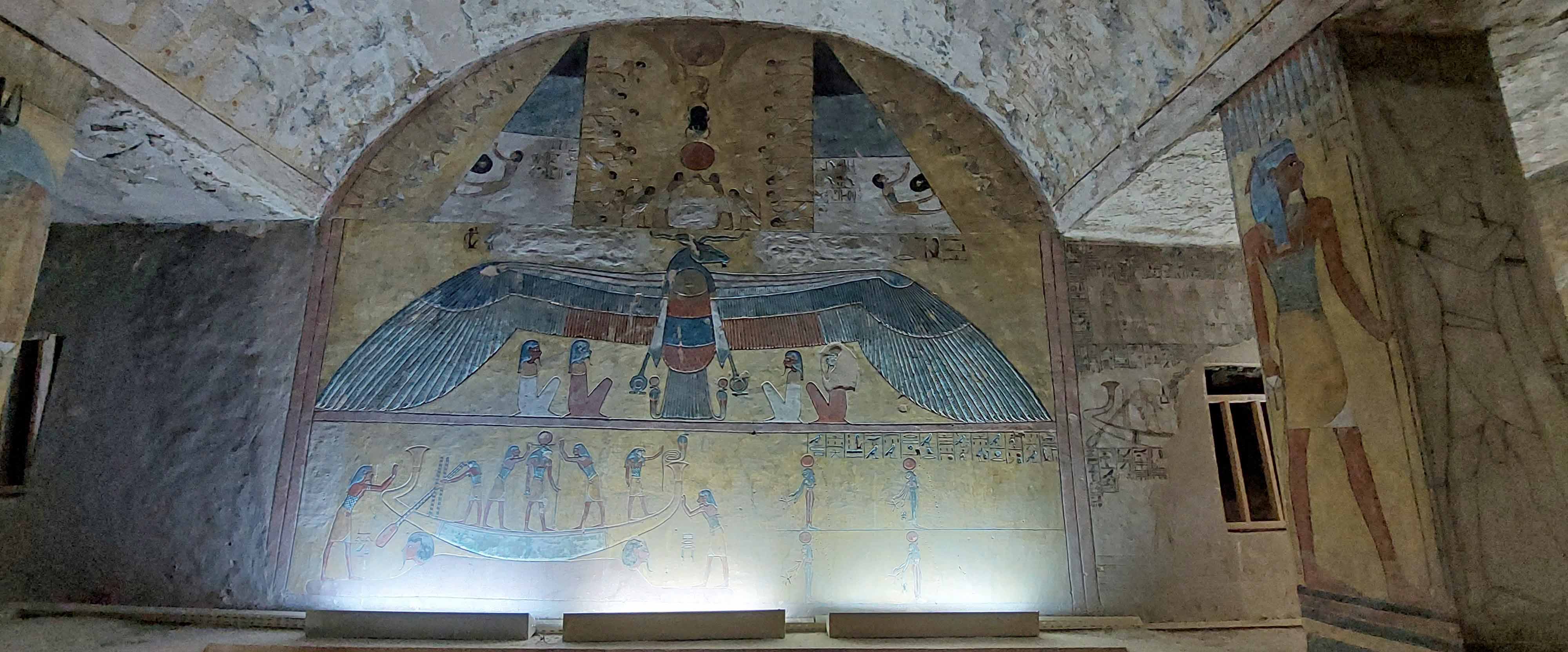
Upon awakening after death, prior to journeying the duat, the soul might not know its identity. To help out, Egyptians decorated the tomb walls with scenes from its Earthly life. We visited the tomb of Ramses IX. This image is such a scene of his life. When pharaohs were crowned, they presented an image of Ma’at to the highest god Amun – assuring him that the pharoah would ensure balance and harmony.
The importance of truth and the principles of ma’at cannot be overstated.
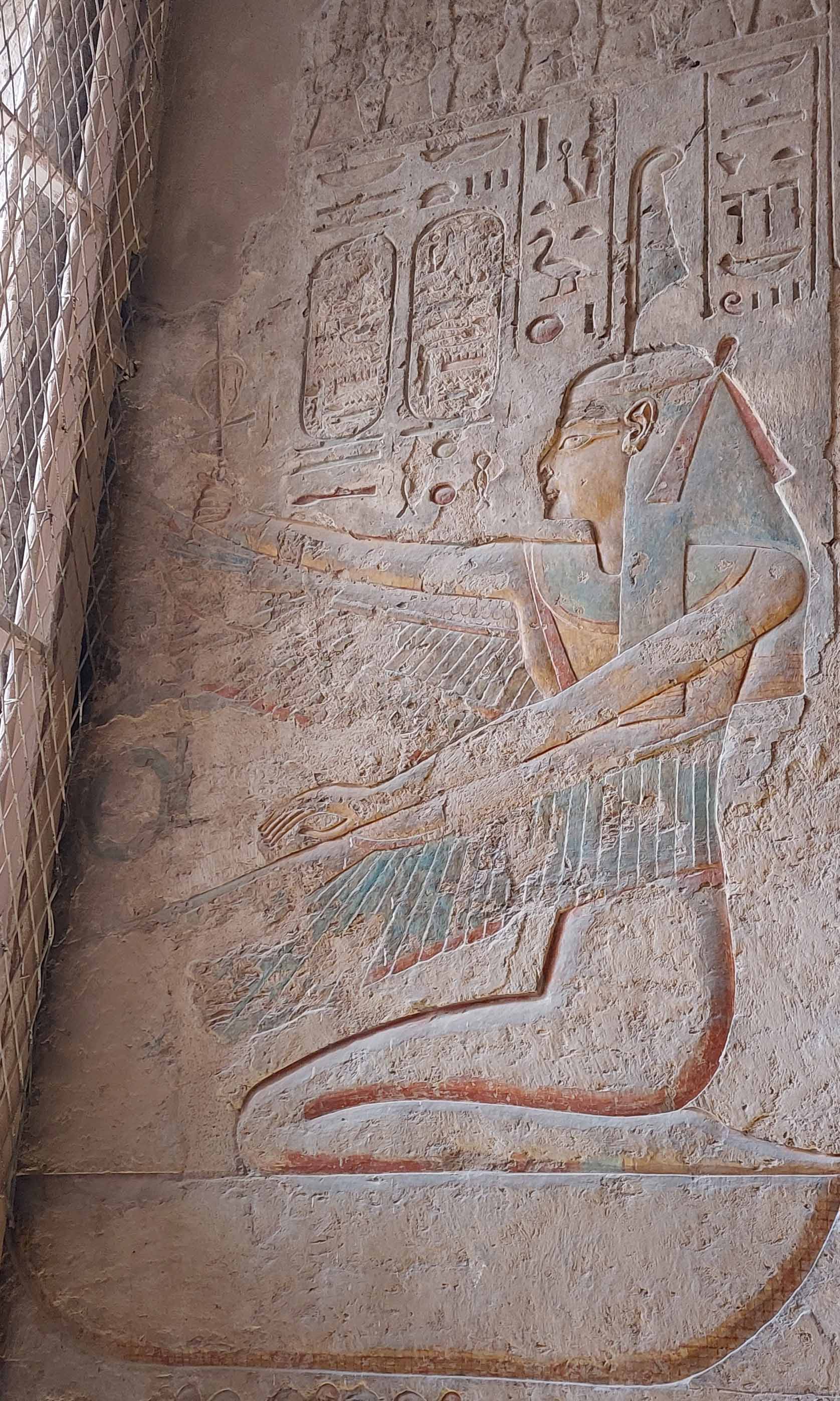
Inside the tomb, images of Ma’at guard its entrance and appear many times over. There is a scene of Ma’at with a harpist, and one of her with the sun god Ra.
The soul would ride on a raft through the Duat. Nephthys would oversee.
Some gods would appear differently in the Duat phase. Here is Afu Ra, how the sun god Ra appears in the Duat.
We are now in the chamber where the sarcophagus is located. Along the walls are more scenes from the journey through the Duat. We see the soul being challenged by serpents. We see the representation of the journey through out the night. The goddess Nut covers the ceiling from one side to the other. She oversees the stars. Beneath her elongated body are more scenes from challenges the soul faces on its way.
From an artistic and engineering point of view, the tomb is fantastic. Here is a video!
Glimpsing the chamber was simply awesome, to use a cliche expression!
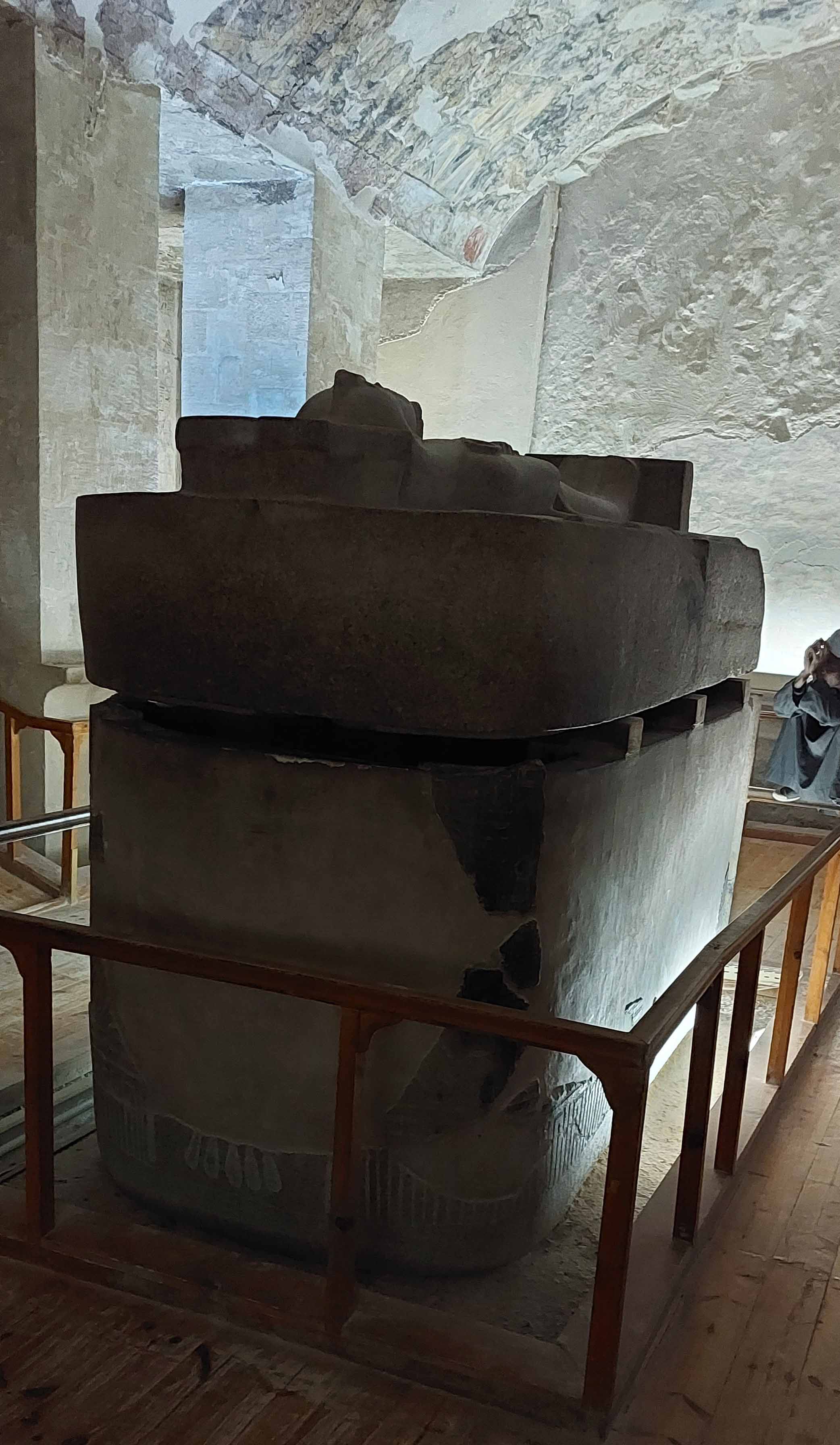
In the center lay the sarcophagus, which must weigh tons.
Our ship docked at Luxor, on the east bank of the Nile. We reluctantly left the ship and checked into a riverside hotel for the next two nights. This hotel had a really nice pool area which was perfect for relaxing on hot Egyptian afternoons!
The Luxor region is probably the most archeologically rich in the world. It contains mind blowing temple complexes like Luxor, Hatshepsut and Karnak, plus the Valley of the Kings. Add the palm treed Nile to the mix and you have a recipe for an unforgettable experience!
The city is one of the oldest in the world. In ancient times, it was known as Thebes.
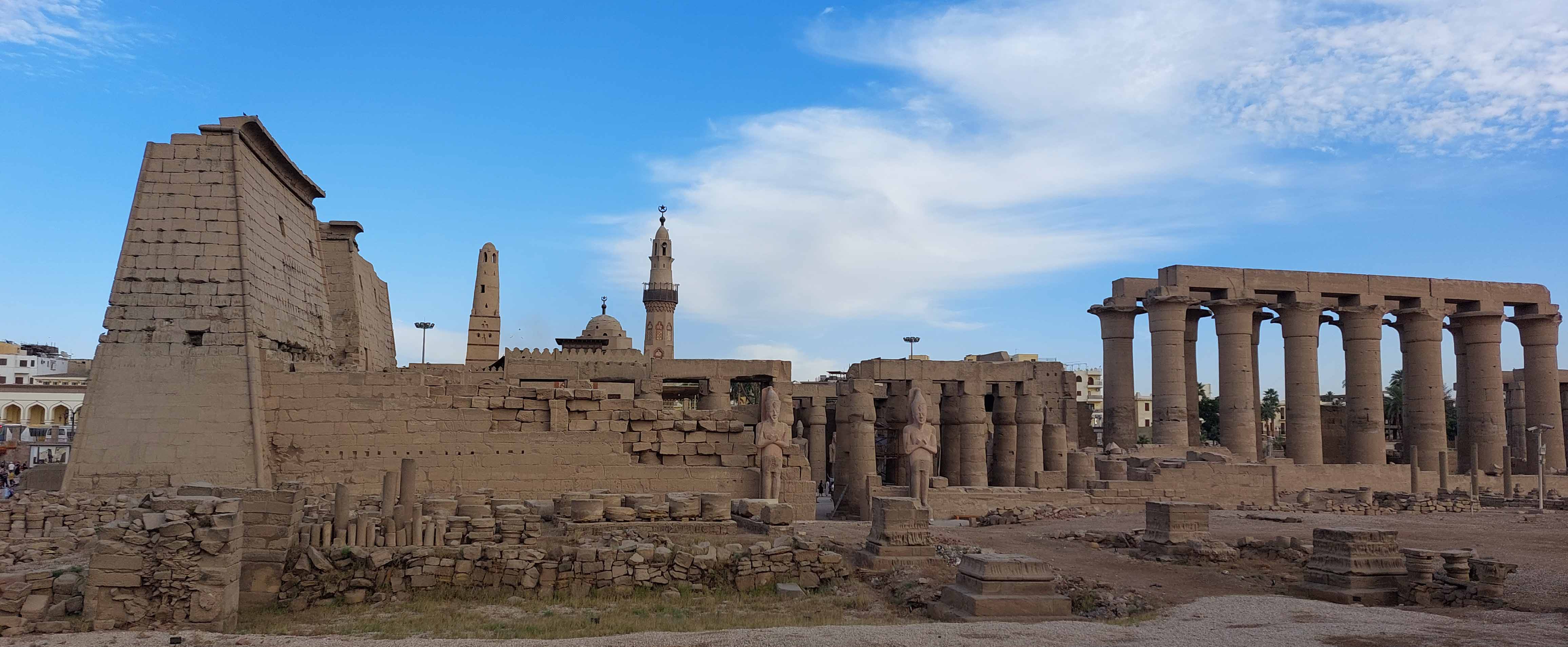
Our guide Ahmed encouraged us to get some pool time in during the hottest part of the day and then head to Luxor temple for the sunset. WOW was this a perfect choice. Luxor is said to be a location where pharaohs were crowned. Alexander the Great said he was crowned here. A number of them contributed to its construction. Amenhotep III, Ramses II, Horemheb, Queen Hatshepsut, and Tutankhamen all are represented.
We were struck with something awesome before we entered the temple. There is a 2.7km long “Avenue of the Sphinxes” with literally hundreds of sphinxes connecting Luxor Temple to Karnak Temple!
We turned around to face the temple. Also, walking along the outside, you can glimpse most of it.
Once inside, there are a number of chapels dedicated to various gods and goddesses.
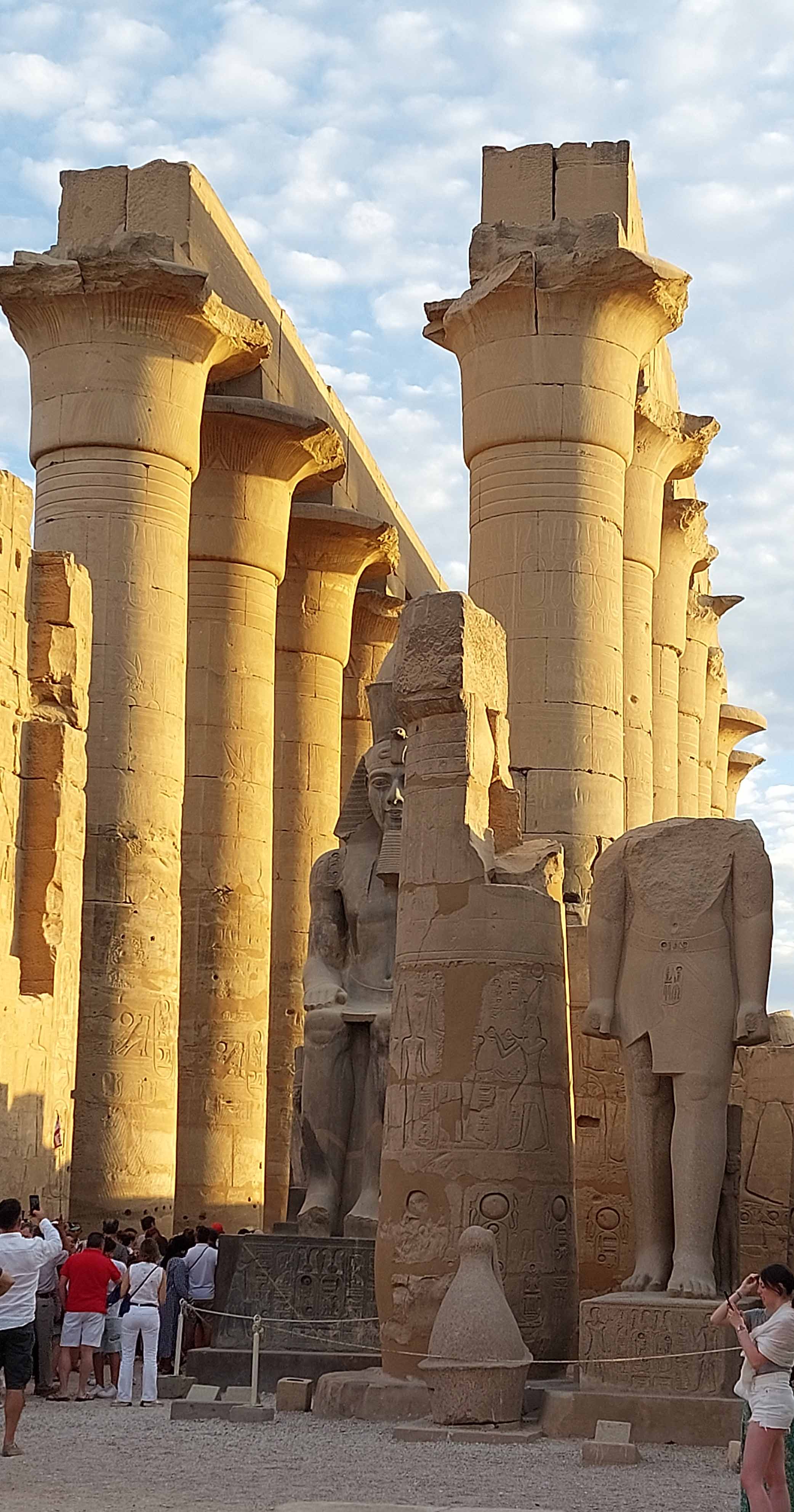
There are beautiful columns, which, in the late afternoon, were eye catching!
The blue Saharan sky, puffy clouds, the amber glow of the sunset. The columns. And these statues of Ramses II were, well. You decide!
The place is SO old. Of course it was used by the Egyptians. But then Romans. Then Christians. And now, Muslims. Here is some evidence of Christianity.
Once the sun set, the most incredible images came out. I just love love love the facade with the lights!
From here we could walk back to the hotel. Next morning, in the cooler temperatures, we’d head to Queen Hatshepsut’s Temple, and the Valley of the Kings.
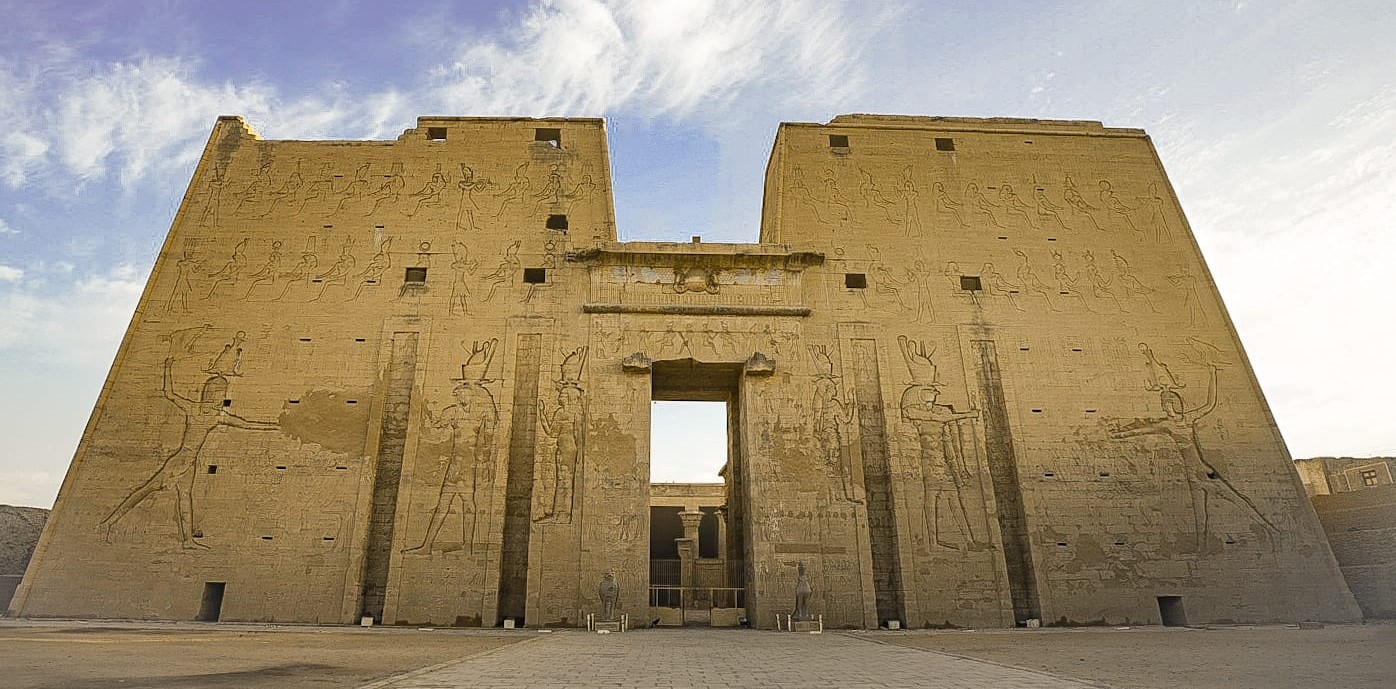
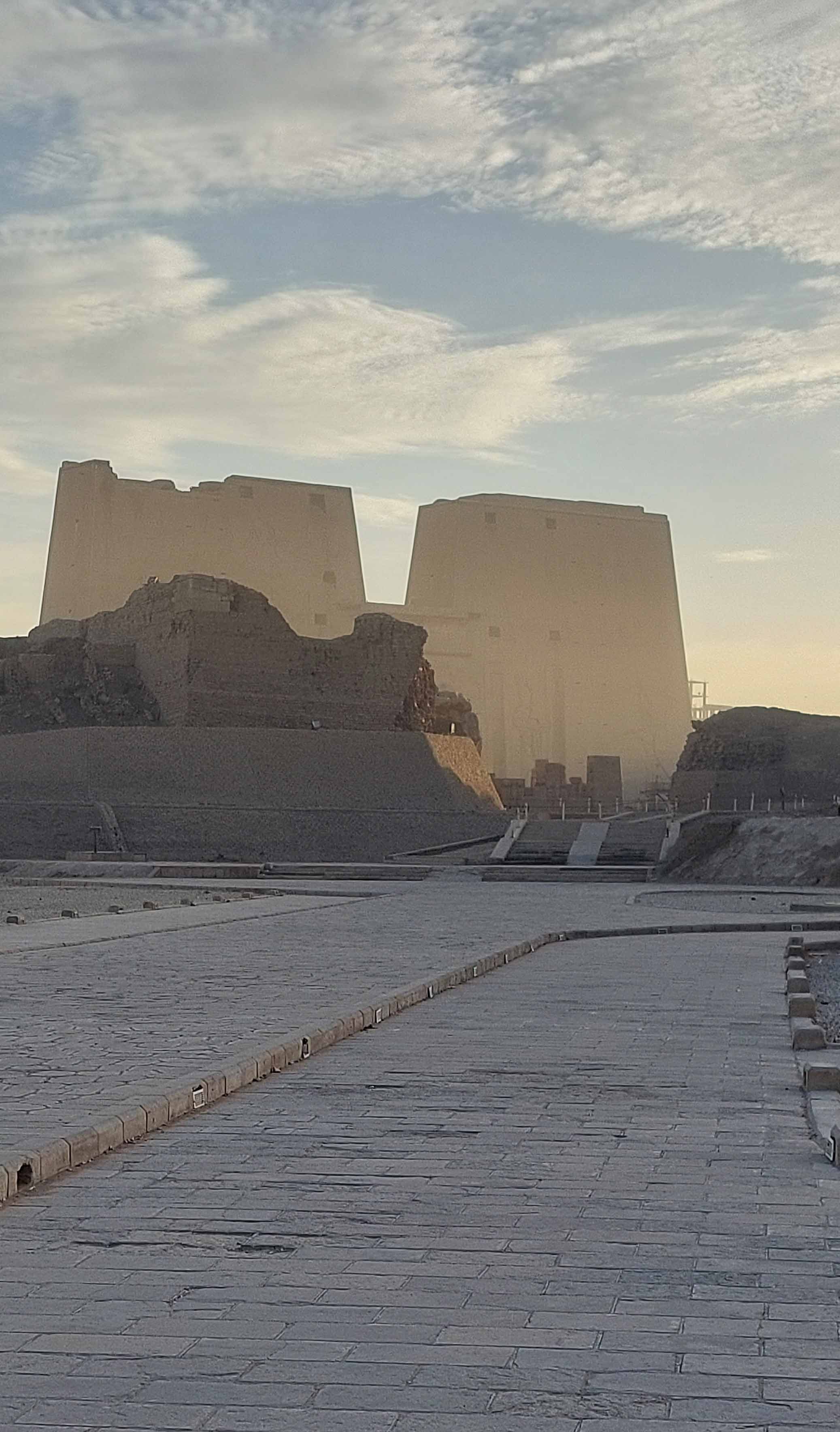
Our Nile ship docked for the night at Edfu. The famous temple is about a kilometer from the dock, and can get very crowded. So Ahmed, our best-in-Egypt tour guide, arranged that we would arrive before opening. We took prearranged taxis and showed up first, well before dawn. Completely worth it!
Waiting for the door to be unlocked to enter Edfu Temple!
As other groups followed, many guides warmly greeted Ahmed, and told us how lucky we were to have him!
Once the doors opened, we trotted as fast as our legs could carry us to the temple.
The place was ours for a short time.
The day dawned blue and bright. We got some very good images – clear – and thankfully right then, because it wasn’t long before smoke from neighborhood cooking fires obscured the sky. For maybe 20 minutes we had Edfu pretty much to ourselves. Edfu, constructed over 180 years starting in 237 BCE, is so well preserved because it was completely filled in and covered with sand until its rediscovery in the 1860s by French archeologist Auguste Mariette. For two thousand years before construction this real estate was already a holy site for Horus worship.
Columns line an interior courtyard.
The falcon God Horus, to which this temple is dedicated, is the God of the sky, healing, kingship, and protection. Horus is a part of the most famous of all ancient Egyptian stories, and his symbolism is with us today, in the symbol for a prescription medication, Rx. Rx is a derivative of the hieroglyphic for the eye of Horus. Essentially, this is the story of the marriage, betrayal, conspiracies, incest, sexual intimidation, love, murder, reincarnation, and more, amongst the gods and goddesses Osiris, Isis, Set, Horus, and Nephthys.
Eye of Horus, synonymous with healing, morphed into the symbol for prescription, Rx.
Part of this important story is that the God of violence and chaos, Set, and Horus had a fight. Horus lost eyes. His mother Isis, Goddess of motherhood and healing, searched with Nephthys, her sister, for the the eyes and found them. Isis healed Horus’ eyes, and ever since the eye has been a sign of healing. Ancient Egyptians believed this battle happened exactly where the Temple at Edfu was constructed. All sorts of unmentionable acts occurred in this lengthy story.
More on this complex, completely bizarre, and important story later.
Our O-Dark Hundred arrival had its benefits.
I couldn’t resist acting like a Pharaoah smiting down my foe. The many walls were worth up close examination. For a fleeting time, we could explore on our own. But it wasn’t long before 1,000s of tourists turned up.
This temple astounded me in that it is a temple within a temple within a temple. Each “layer” is completely covered with exquisitely carved scenes. The work undertaken is unimaginable. There are many scenes of the barge carrying Horus on his journeys.
And in the center temple ‘layer,’ is the Horus barge itself.
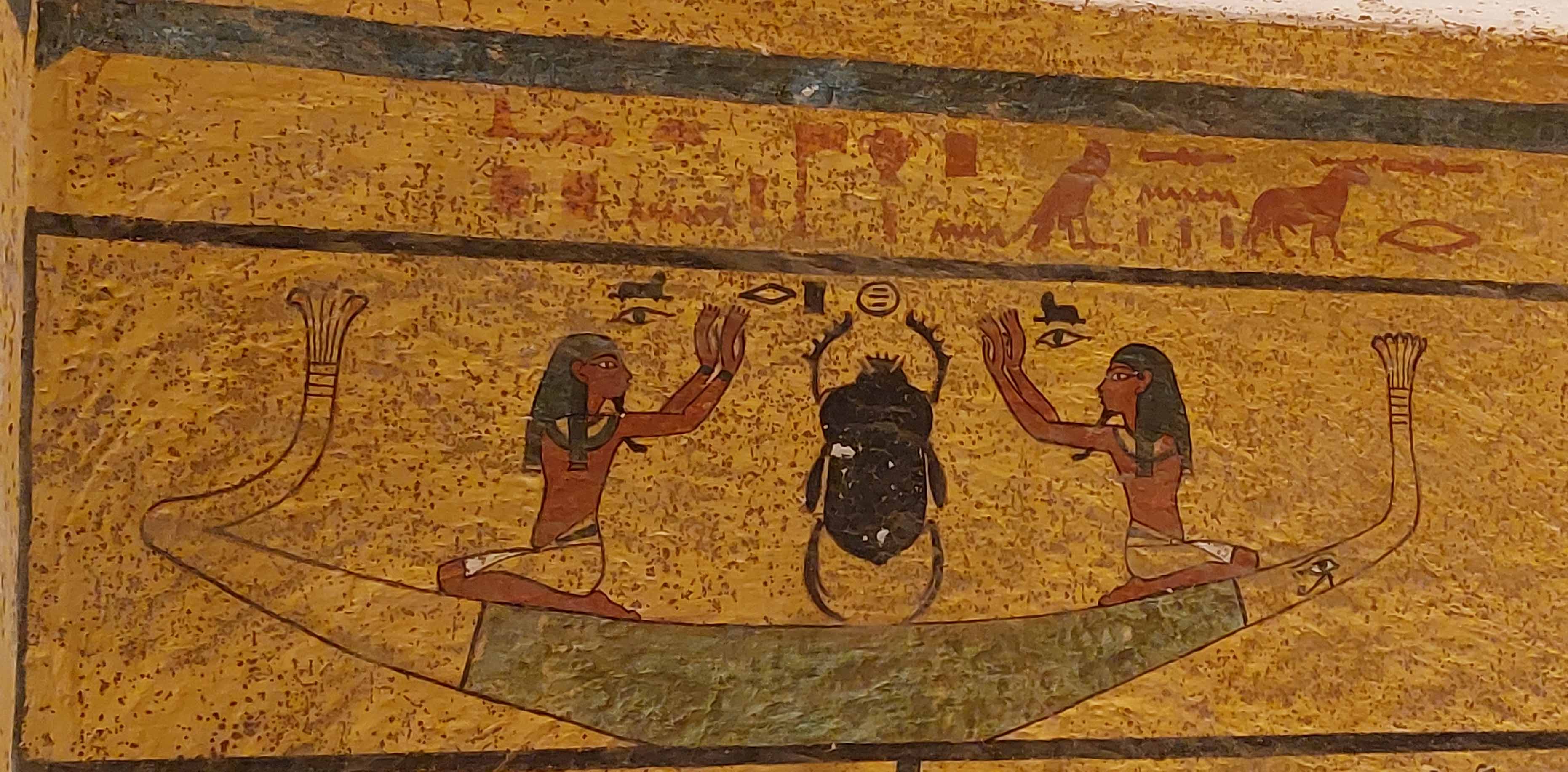
Stars on a ceilingThe winged beetle is a scarab, associated with resurrection
Horus was married to Hathor. Hathor was the goddess of dance, joy, love, sexuality, and music. Her dedicated temple was at Dendera. Twice a year, ancient Egyptians engaged in festivals dedicated to this couple. A statue of Hathor would travel 106 miles up the Nile from Dendera to meet Horus at Edfu. This meeting kicked off a terrific celebration.
The Story of Osiris, Isis, Set, Nephthys and Horus
This R-rated story was fundamental to Egyptian mythology, symbolism and their lifestyle. It lays out the landscape of various ultra-important things to Egyptians, such as who rules the afterlife.
Who is Who
Osiris – Osiris, ruler of Egypt and descendant of the origin Gods, is god of agriculture, fertility, and the underworld. His role in the underworld is not a devil. He manages souls crossing the underworld to the next life. It Osiris who decides if a soul is worthy of crossing into the afterlife. Osiris is married to Isis.
Set – God of violence and chaos. Set is brother to Osiris – and a rival.
Isis – Goddess of magic, motherhood and healing. Wife of Osiris.
Horus – God of the sky, kingship, healing, protection. Son of Osiris and Isis.
Nephthys – Goddess of mourning, protector of mummies, protection, the dead, and, oddly, beer. Sister of Isis. Wife of Set.
Ma’at – Goddess of balance, harmony, order, law, morality, truth, and seasonal and cosmic rhythms. Ma’at was also a set of 42 principles by which Egyptians lived their lives.
Got all that? Time to grab a beer or a glass of wine, because this is quite a story. Many twists and turns. Put the kids in another room. This story is said to be dated to at least 2,400 BCE. It was recounted by the Greeks and the Romans. I will say this! To come up with this kind of stuff, they must have had time on their hands. And lots of ancient Egyptian beer. So, without further adieu…
Set is jealous of Osiris, the highest god. He wants to get rid of him and take his throne. Some versions say Set was furious with Osiris for having sex with Set’s wife Nephthys. So, he hatches a plan. He has a party, invites many of his friends and relatives. He builds a lockable box in the exact dimensions of Osiris. Once the party turns lively, he brings out the box and challenges everyone to see if they can fit inside. Everyone tries and nobody fits, but the last to try is Osiris, and he fits exactly – so tightly that the only way he can fit is by crossing his arms. Once inside, Set locks the box! With Osiris inside, Set manages to throw the box into the Nile, and it drifts away. Osiris drowns. And ever since, Egyptians had themselves put into sarcophaguses with their arms crossed, because this was the right way to the underworld. Set takes the throne.
With Set “in charge,” the morality, balance and peace of Maat is upended. Chaos ensues. Civil unrest erupts. The Nile floods at the wrong times. Celestial movements are off kilter. The once predictable seasons are off. Egyptians steal from and lie to each other.
Osiris is terribly grieved and recruits sister Nephthys in a search to find the body of Osiris. Legend has it that they turned into falcons, scanned everywhere, and found it (in parts) many miles upriver. They mummified him and set about various incantations to bring him back to life. He does come back. And Isis has sex with the resurrected Osiris, becoming pregnant with Horus. Osiris, however, isn’t interested in the living world anymore, and decides to become ruler of the underworld.
Pregnant Isis knows her progeny would be a threat to Set. So she hides herself in a marshy area on the Nile full of papyrus. There, after months, she gives birth to Horus. The early life of Horus was full of challenges, some versions say poison by snakebites. Isis is said to travel amongst ordinary humans in search of treatments. Many of these turned into magical spells.
As an adult, Horus challenges Set for the throne. An 80-year long, often violent, contest ensues. In most conflicts Horus wins. But the “judges,” other gods, often are favored of Set. Then the conflict turns sexual. Set wants to have sex with Osiris, who agrees if Set gives him some power. Central to this story is that Egyptians thought semen was poisonous. Set’s semen enters Horus’ body and makes him sick. OK that’s one story! Get ready for the alternative version. In this story, Horus prevents by catching Set’s semen in his hands. Then, and don’t ask me details, because I can’t find any. But Isis puts Horus’ semen on a lettuce leaf, which Set eats and becomes poisoned and pregnant instead. In more sexual violence, Set removes the eye of Horus and a testicle!
Well, Isis the healer once again comes to rescue and puts everything back together. With Horus restored, Set is finally defeated, Horus becomes ruler of Egypt, and all the gods and goddesses celebrate.
With Horus on the throne, Maat is restored. The moon returns to full brightness. Egyptians live peacefully. Seasons once again become dependable. The stars and constellations are once again recognizable.
So. I said it before and I’ll say it now! To me, this just proves how productive Egyptian agriculture had become. They had so much bounty that they were able to “hang out,” think about things, drink beer, and make up the most crazy stories ever told!