One of the reasons I chose the Rick Steves Paris and the Heart of France tour was that the island monastery-fortress of Mont-St-Michel was on the itinerary! Ever since I learned of its purpose, history, and legendary status in French language classes, it’s been high up on my bucket list. This tour included a night’s stay on the island, complete with a multi course seafood supper.
This is just the appetizer!
Its is legendary in that at at high tide it is an island, but at low tide it can be accessed via mud flats. Since its first construction in the 9th Century, it has been a magnet for religious pilgrims, armies, and tourists. Twice it was a prison. Today, it’s positively crawling with tourists daytime. But after dusk, when the causeway closes, it returns to its cloistered-like state and you can be all alone with its mysteries. Its permanent population is less than 100.
The island is surrounded by a castle-like wall, within which is a village and up top an incredible Catholic abbey inhabited by monks. The sea breeze is most welcome and smells sweet. Centuries-old cobblestone streets lead to restaurants, shops, cemeteries, a couple of lodges, and finally the abbey – and several times daily the abbey bells ring out. The 45-ft tide coming and going was said to be as fast as a galloping horse – swallowing entire armies trying to take the island. The English tried and failed in 1423 and 1434. Over the ensuing centuries it became a prison, was used by Germans as a lookout and for 300,000+ German tourists during WWII. Today Catholic monks still worship in the monastery.
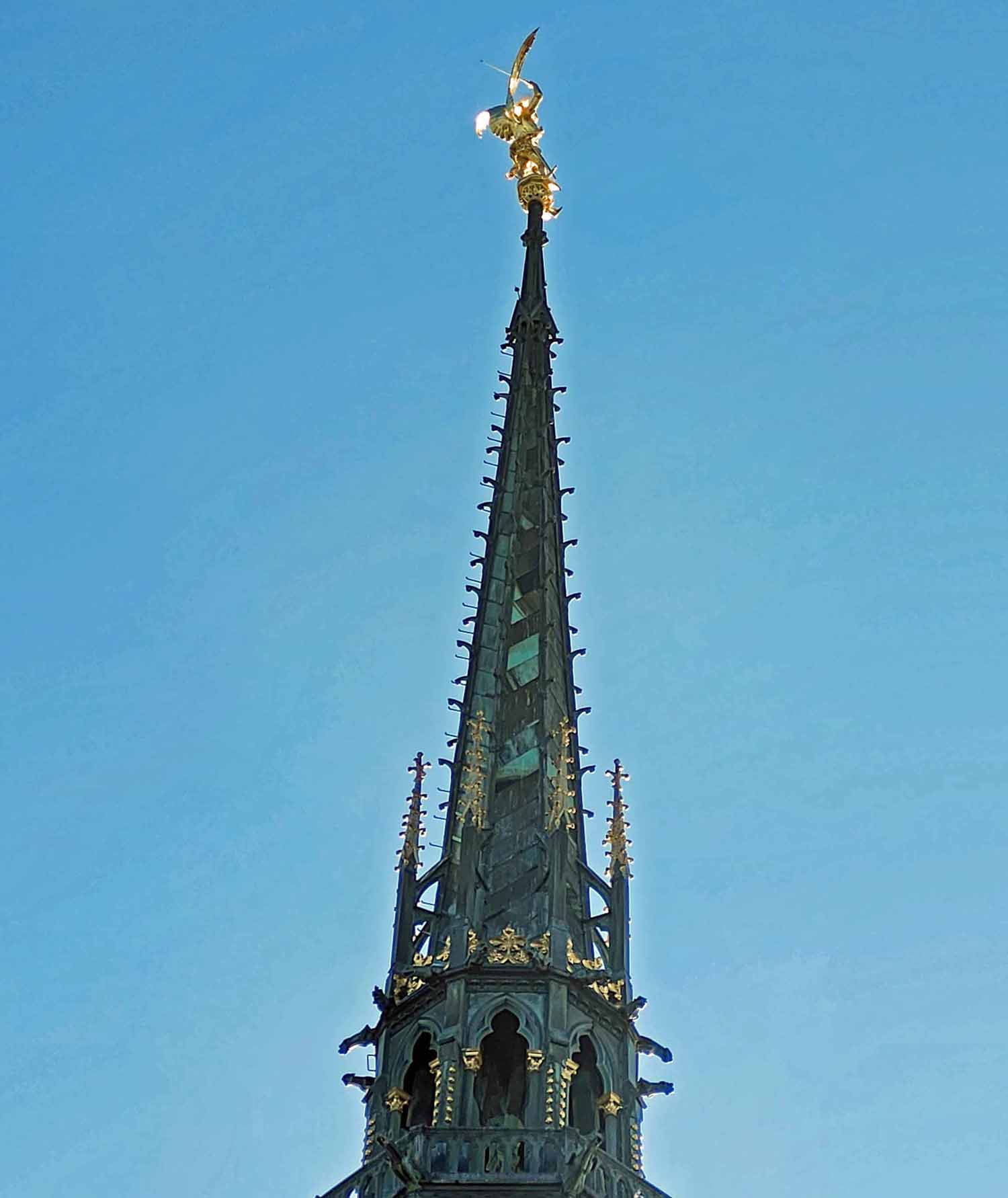
Views of the surrounding area abound. You can watch the incredibly fast-moving tide. One thing that really struck me is the golden image of Saint Michael topping the abbey. The sun lights it up like a flare. And it is visible for miles along the adjacent coastline like a flaming beacon.
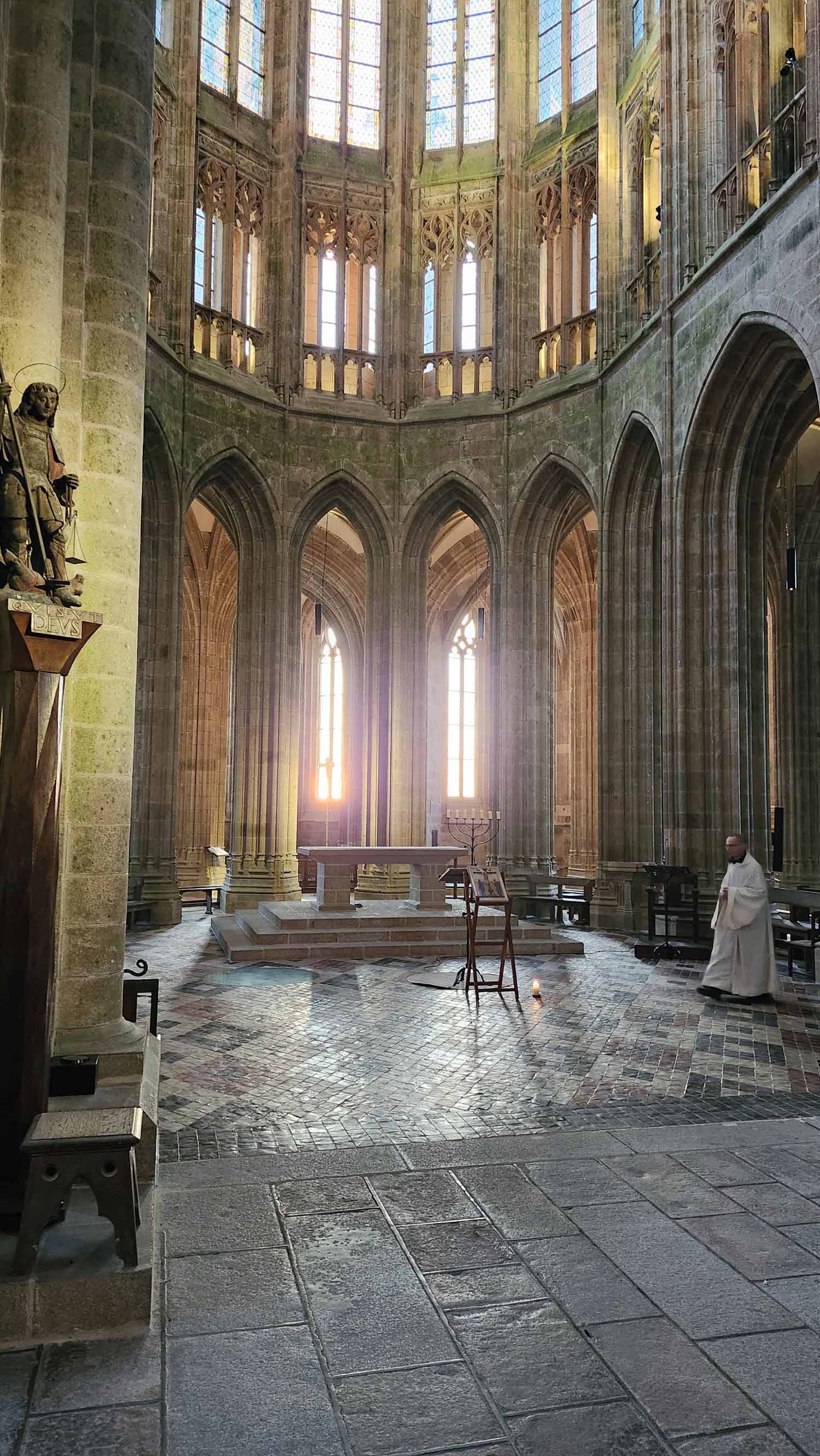
On this visit I learned it was possible to experience a once-in-my-life moment: Attending a dawn service in the abbey given by the monks! This experience requires ascending dark, pre-dawn steps to a lonely door, arriving at 5:45 a.m. This I HAD TO DO! Carefully, I hiked up those steps – and was joined by 15 others. Then, at 5:45, we heard skeleton keys jingling on the other side of the door and then – a hooded monk cloaked to the feet opened it up and let us pass – locking behind. We entered a chapel, and inside there were monks on the floor covered in their robes – facing the alter.
The service began. They arose. And chanted. Then sang. The sound was acoustically ethereal to experience. We joined in – there was a pamphlet. Though in French – hard to follow for me.
The sun arose behind the stain-glass windows, and the expression on their faces was pure love. Indescribably pure. Unforgettable to behold.
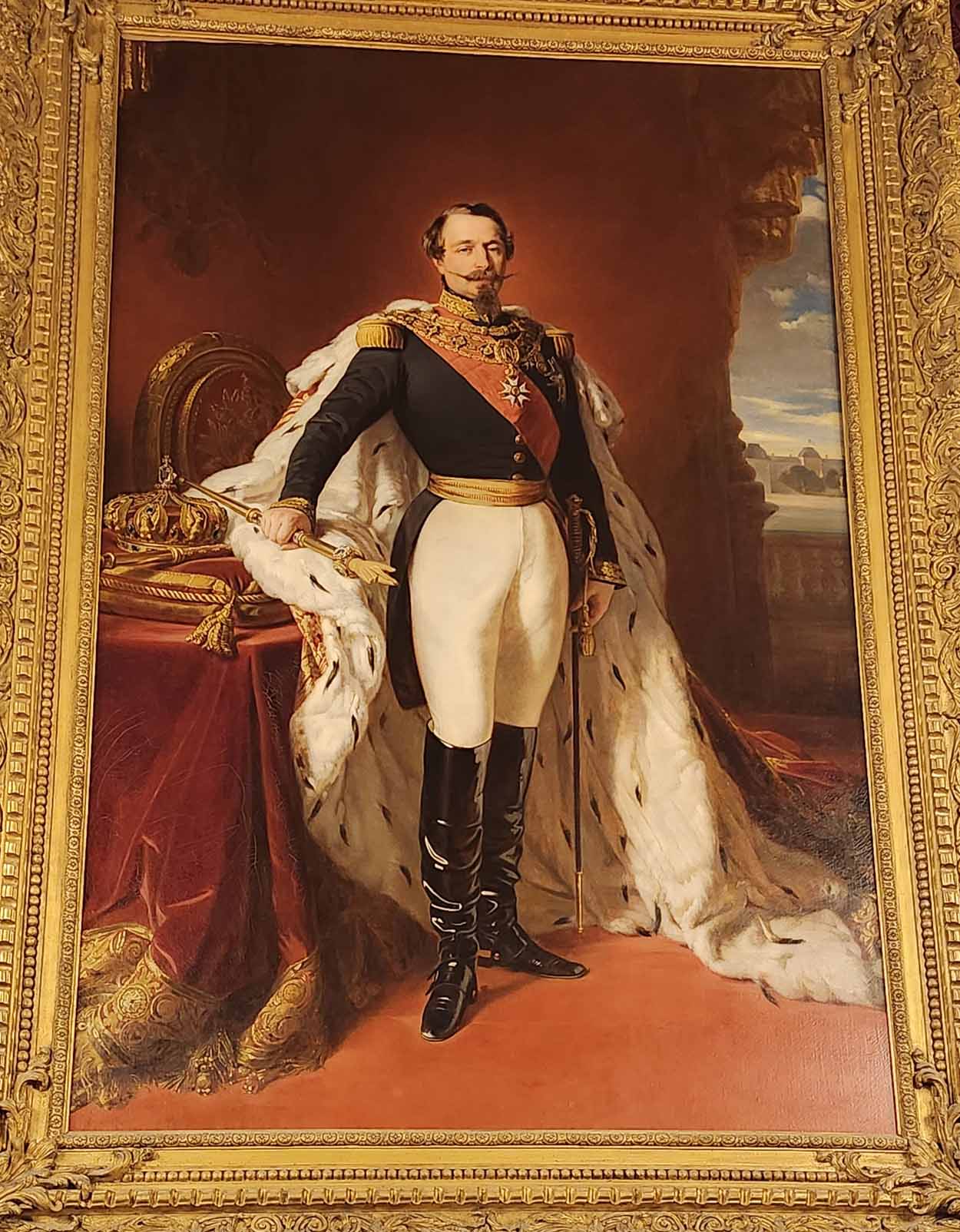
On Day Four of my Rick Steves Heart of France tour, we were to visit The Louvre – the museum housing the largest collection of art and historical artifacts on Earth. I’d been there before, and yes, I’d seen the Mona Lisa, which was underwhelming. This time, unlike the rest of my group, I was on a mission to see one exhibit only – one which I had learned held a painting of a famous distant cousin – a member of my Clan Kirkpatrick – the Famous Empress Eugenie de Montijo – born as María Eugenia Ignacia Agustina de Palafox y Kirkpatrick.
Prior to my visit to France, I’d been in touch with several guides. When I told them I was doing family research on the Kirkpatricks, they all said I must go to the Louvre because there is a painting of a Kirkpatrick clan member there! I couldn’t imagine. But that was when they told me about the Empress. She was wife to Napoleon III in the mid-19th Century, and was instrumental in French politics as well as fashion, art, and the re-shaping of the Paris landscape into what we see today. I had NO idea! They insisted I go to the Louvre and visit the Napoleon III Apartments. These apartments were built to house foreign diplomats when visiting Paris.
We met our local guide, Sylvie, who took us on a walk on the neighborhood near The Louvre, and then we wound up there. When I told her I was a Kirkpatrick she knew exactly what I was looking for. Then, once inside the museum, I asked some staff for directions. When I told them I was a Kirkpatrick I got a reaction I will never forget as long as I live. It was like a combination of respect, awe and wonder. It was as if I was in America and I was a relative of George Washington! They kind of snapped to. Before I could mention Napoleon II Apartments they knew exactly what I wanted to see and took me up there! Who, me? It was from this point on Paris was a different kind of place, for outside, on the streets, I knew the sights I saw were built by her and Napoleon III and their architect Haussmann. Holy cow. OK, these are images from the Napoleon III Apartments!
They even had some of her over-the-top royal gowns!
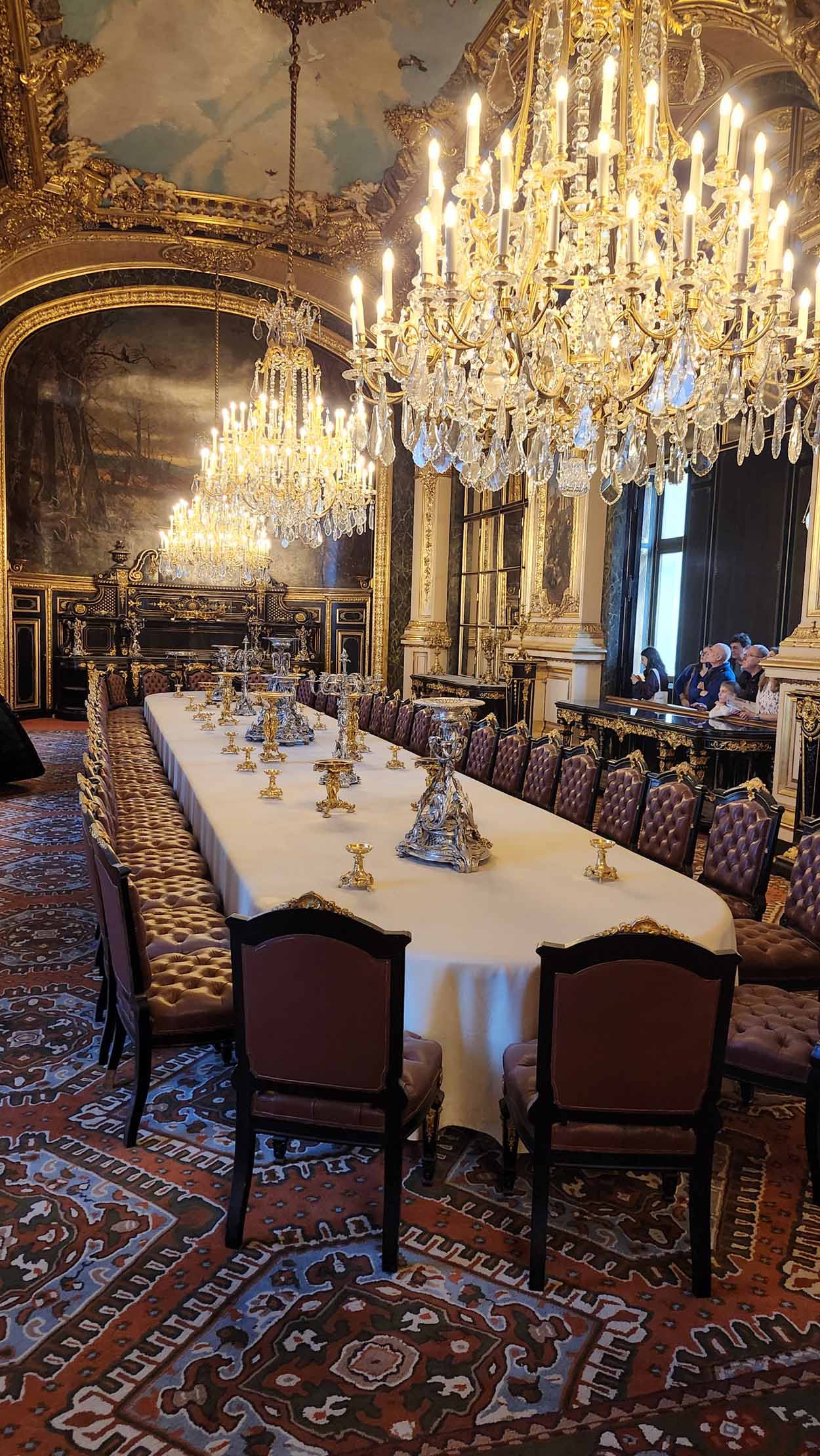
Here are pictures of the Grand Salon for the diplomats, and the official table at which they ate official meals!
I was pretty overwhelmed. Not just looking at these things, it was the times and the history! After the Louvre mission, I was done for my day. I headed back to my hotel in Montmartre and the nearby cafe. I called it a day!
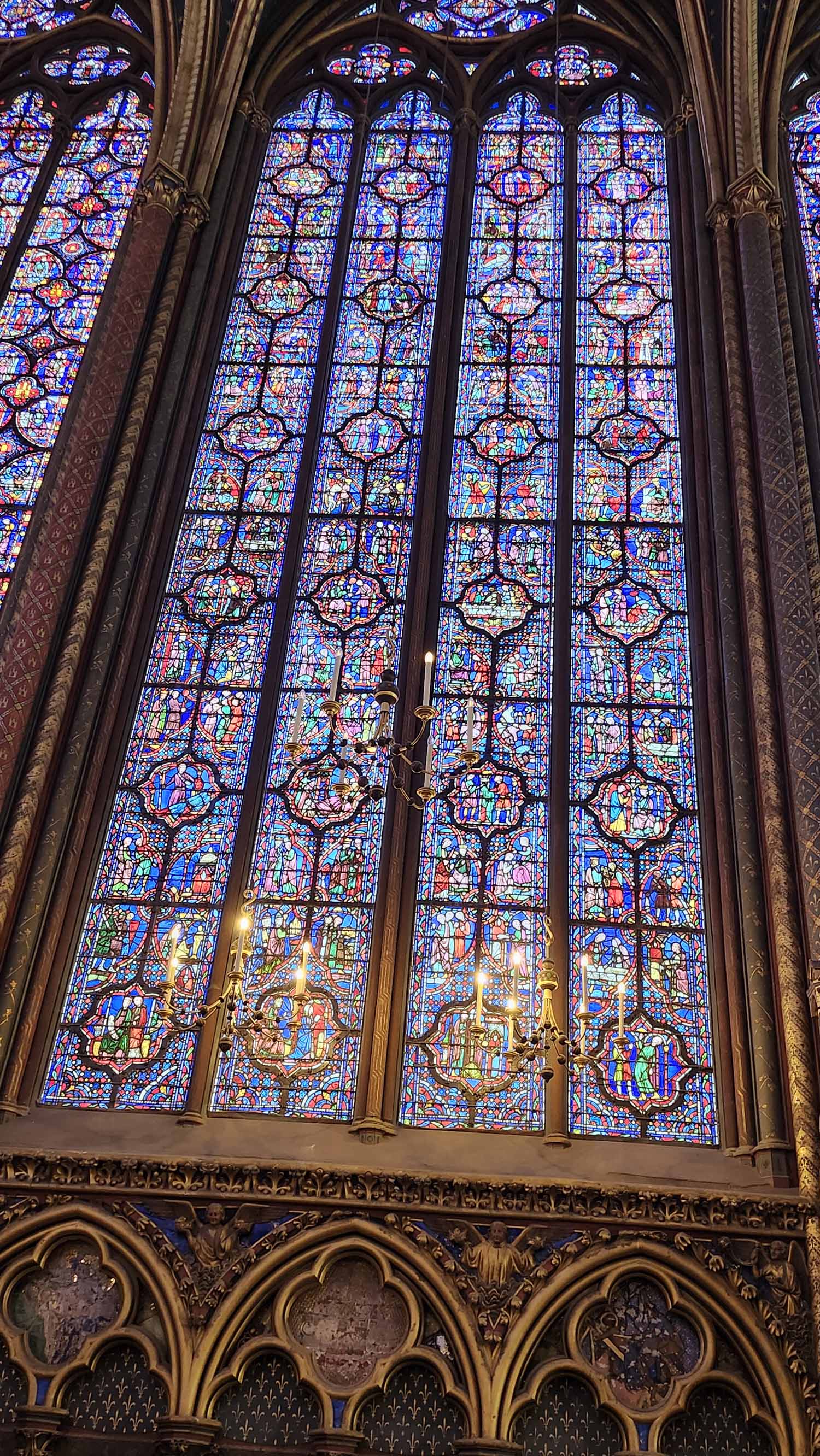
This morning, I joined my Rick Steves Europe group visiting Notre Dame Cathedral and nearby Sainte-Chapelle. Notre Dame has re-opened after its reconstruction following the 2019 fire. We did not go inside, for the crowds were huge. Still, the exterior is very impressive! Then we visited Sainte-Chapelle, with its famous windows. As with most French Catholic cathedrals, there are reliefs of what happens to those who follow the 10 Commandments, and those who don’t.
Sainte-Chapelle WindowsLong wait at Notre DameEternal torture for sinners!
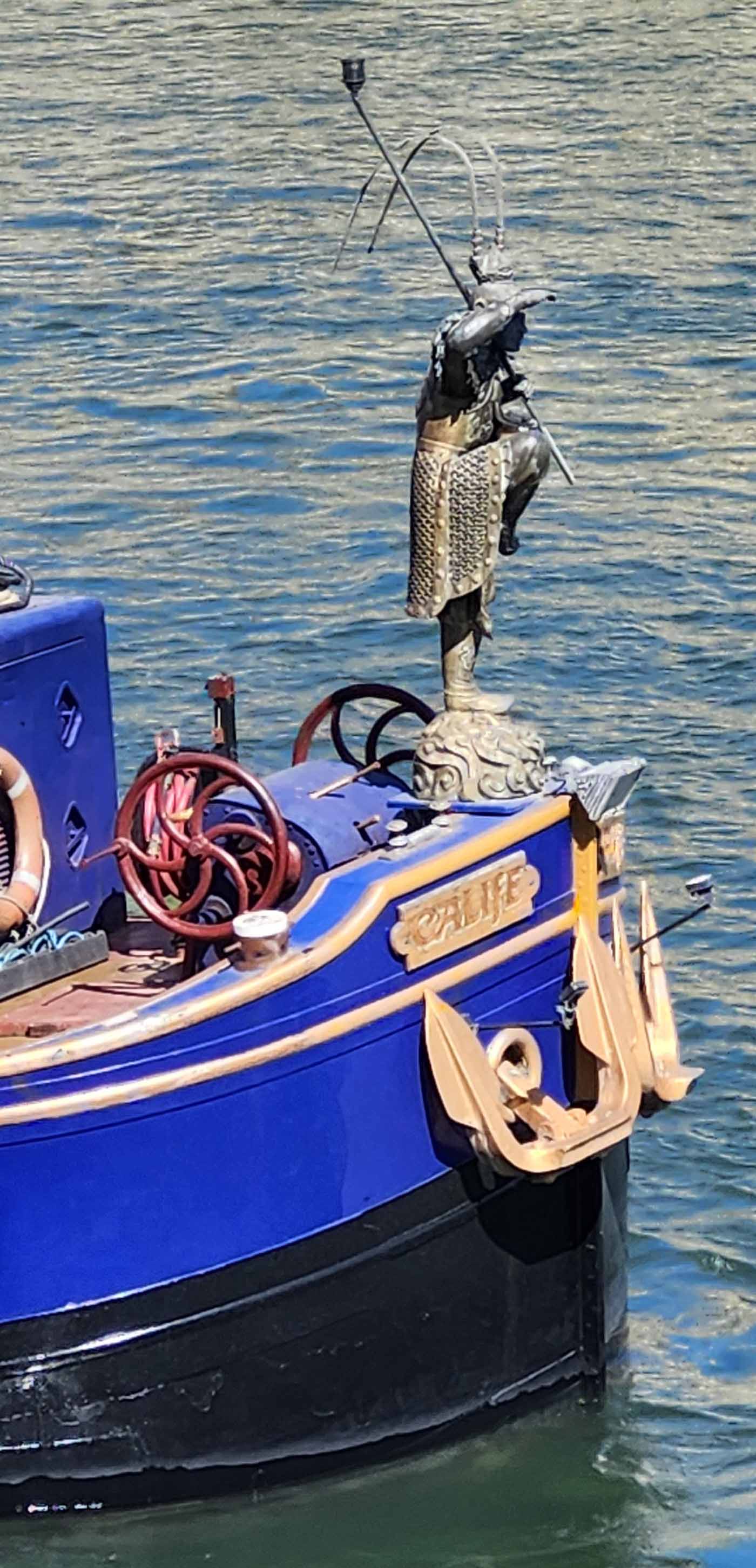
This day I had tickets for the D’Orsay Museum, housing the largest collection of Impressionist paintings. So I departed the group and walked up the Rive Gauche towards the museum. The Rive Gauche is famous for its being a beehive of artistic creativity. Artists such as Pablo Picasso and Henri Matisse held lively conversations with writers like Gertrude Stein, Ernest Hemingway and Jean-Paul Sartre. Once past the Notre Dame throng, this walk became a stroll, allowing for people watching and taking in the scenery. One of the most ornate dinner cruise barges chugged by. Adorned end-to-end with art deco. On its bow, a feather-headed woman stood on one foot peering ahead. Its fancy anchor.
For several blocks, the sidewalk is lined with stalls selling all sorts of things, including questionably “authentic” old magazines and cliche Paris images. All for the fun I say!
Like my previous walks, I glimpsed the relaxed bicycle pace. The live-aboard barges plying the Seine. Cafe after cafe with Parisians at their sidewalk tables enjoying casual conversation. It was getting towards mid-day, and I had just enough time for lunch. So, I picked out a cafe table and ordered a Croque Monsieur. I indicated to the server that instead of a leisurely lunch, I needed it quickly so I could make my 1:00 D’Orsay Museum time. He wondered if I wouldn’t enjoy my meal? I just said no, I had to eat and dash. Typical American, no?
I wasn’t too enamored with my meal, in fact! Just not for me.
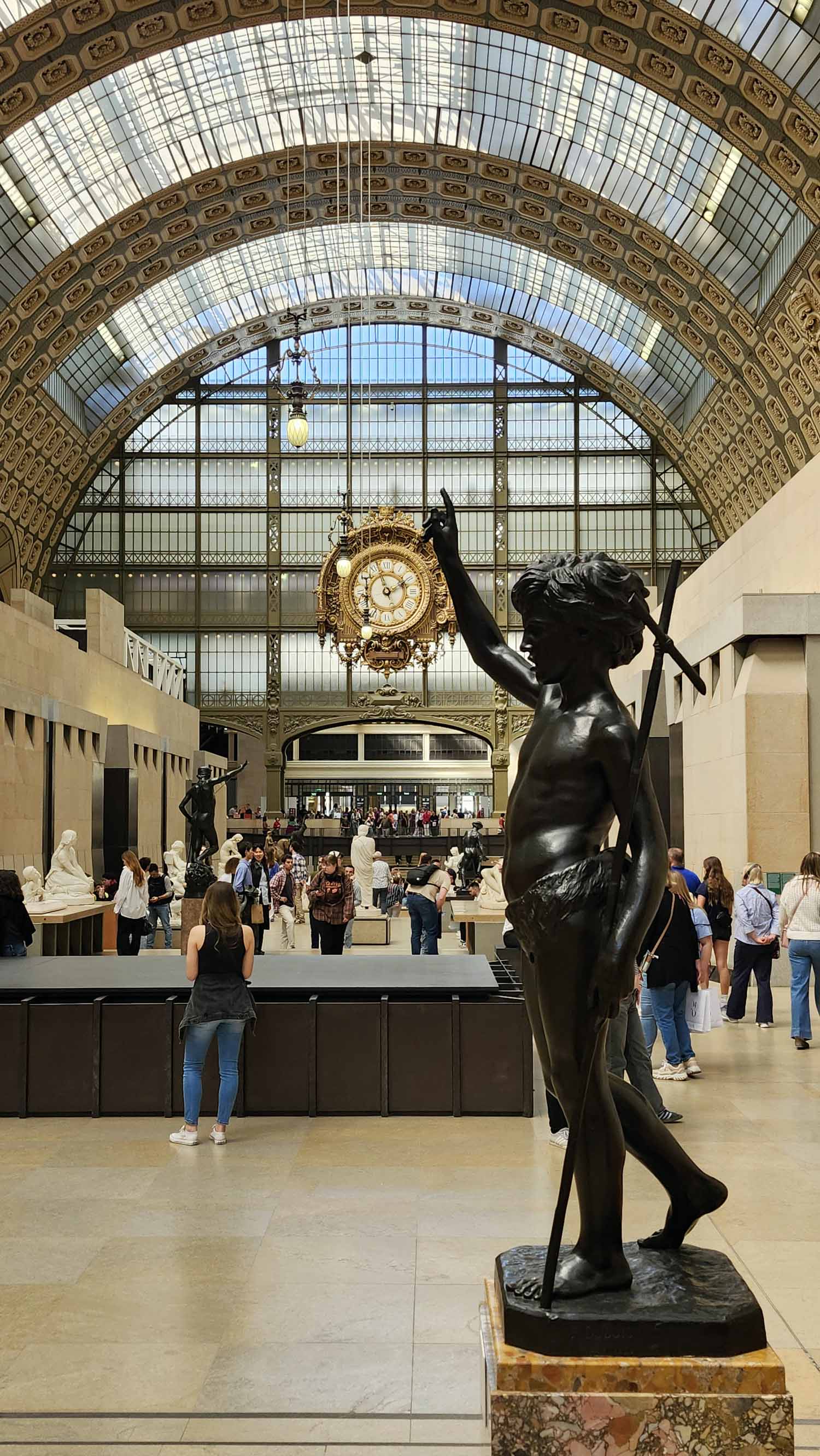
Topped up, I headed up to the museum. The D’Orsay Museum is a repurposed railroad station. So, on the inside, it is very open and airy. I think it is just fabulous. It has collections from various artistic genres. Passing through, I admired some before entering the Impressionist collection at the far end.
I was introduced to Impressionism by one of my French Language teachers. From there, I checked out some library books on Impressionism. I’d seen a number of original works in New York, Boston, Washington D.C., and London. I have prints of two of Pierre Auguste Renoir’s paintings in my office. So with this, combined with the fact that I’d just been to the Opera Garnier two days prior, held me in rapt anticipation. I did not realize, until I saw some of these paintings, how important it was I’d seen the Opera Garnier first. For some of these very masterpieces depicted events at the Opera!
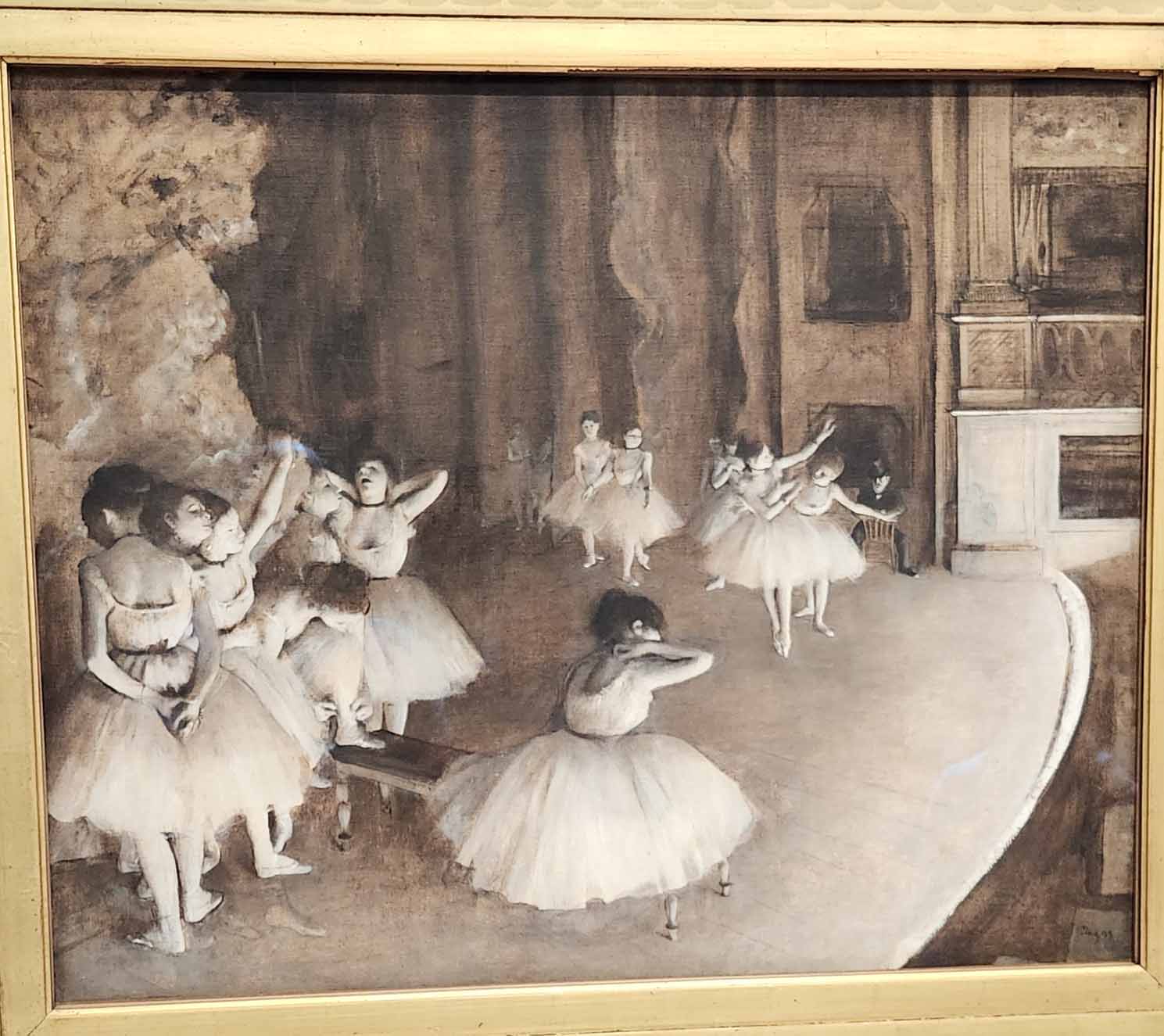
Entering the collection, I immediately recognized paintings I’d studied. What I was unprepared for was that there were SO many! And I could walk right up and examine every brush stroke. I was so overwhelmed I teared up several times, as one masterpiece after the other revealed themselves. The thing about Impressionism that is so meaningful to me is that these are illustrations of ordinary life in a specific time period in a specific country. They capture the style, the joy, the intimate details of the lives of French in the late 19th Century. Everything from picnics, to dancing, to walking a field, to sunset on a cathedral, to collecting flowers in a field. Some of the paintings are so iconic that they could be said to represent the entire genre all by themselves. These three depict life at the Palais Garnier.
Degas – The Orchestra at the Opera Degas – The Dance Class (at Opera Garnier)Henri Gervex – Le Bal de L’Opera
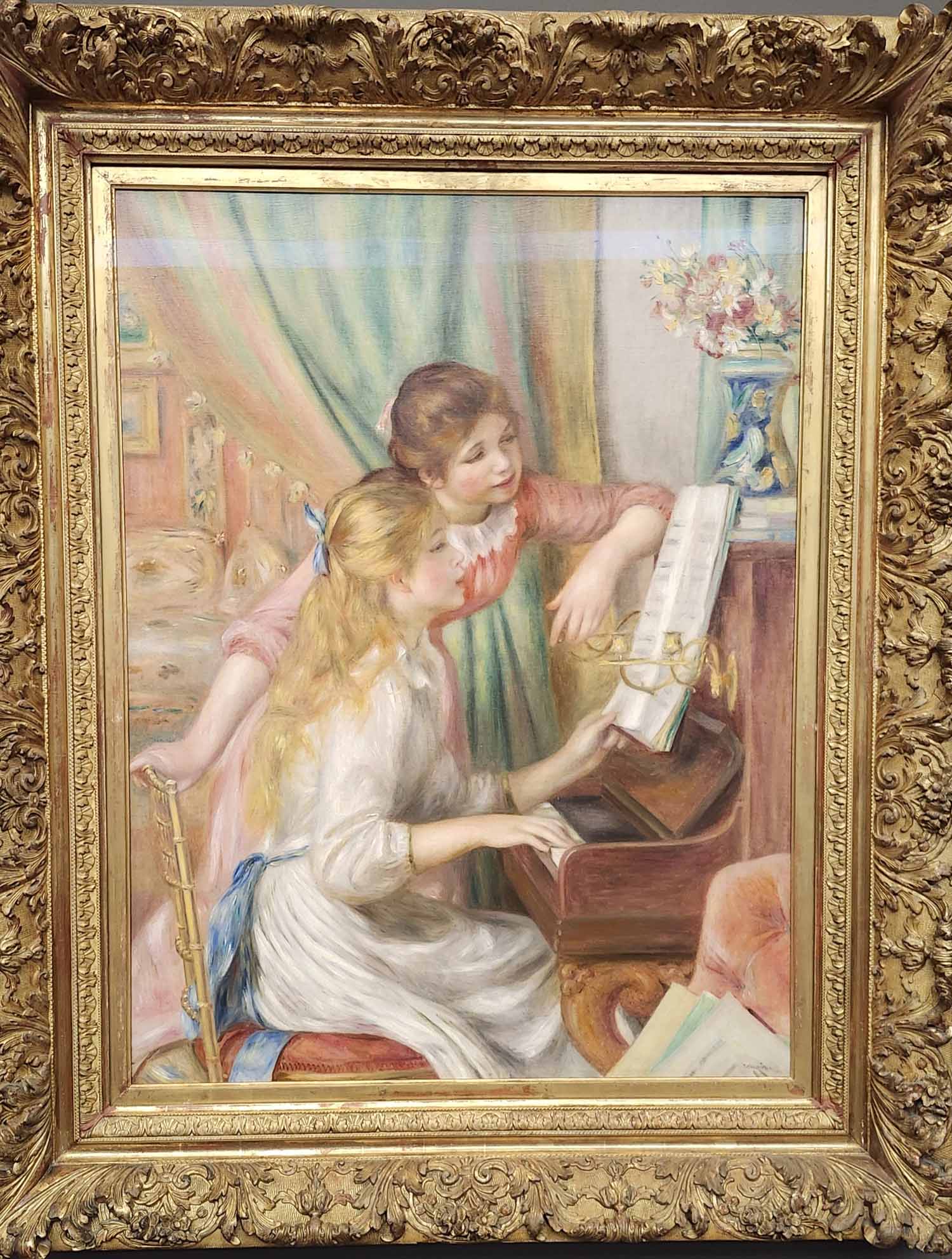
Works by Pierre Auguste Renoir were prominently shown. I love Renoir, because his efforts candidly display Parisians enjoying life. Dancing, socializing, or simply learning to play a musical instrument.
Renoir – Dance at BougivalRenoir – Bal du Moulin de la GaletteRenoir – Young Girls at the Piano
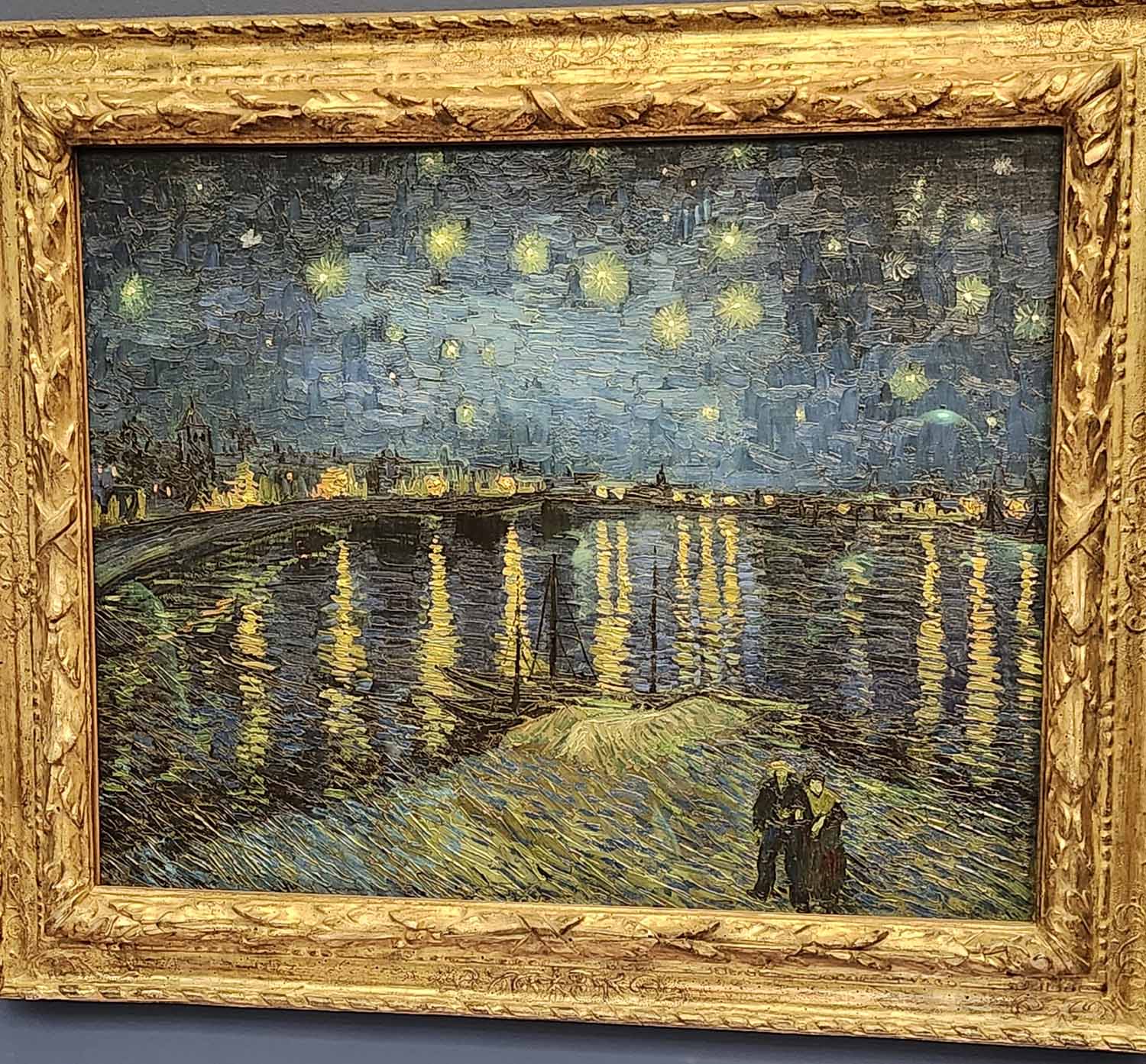
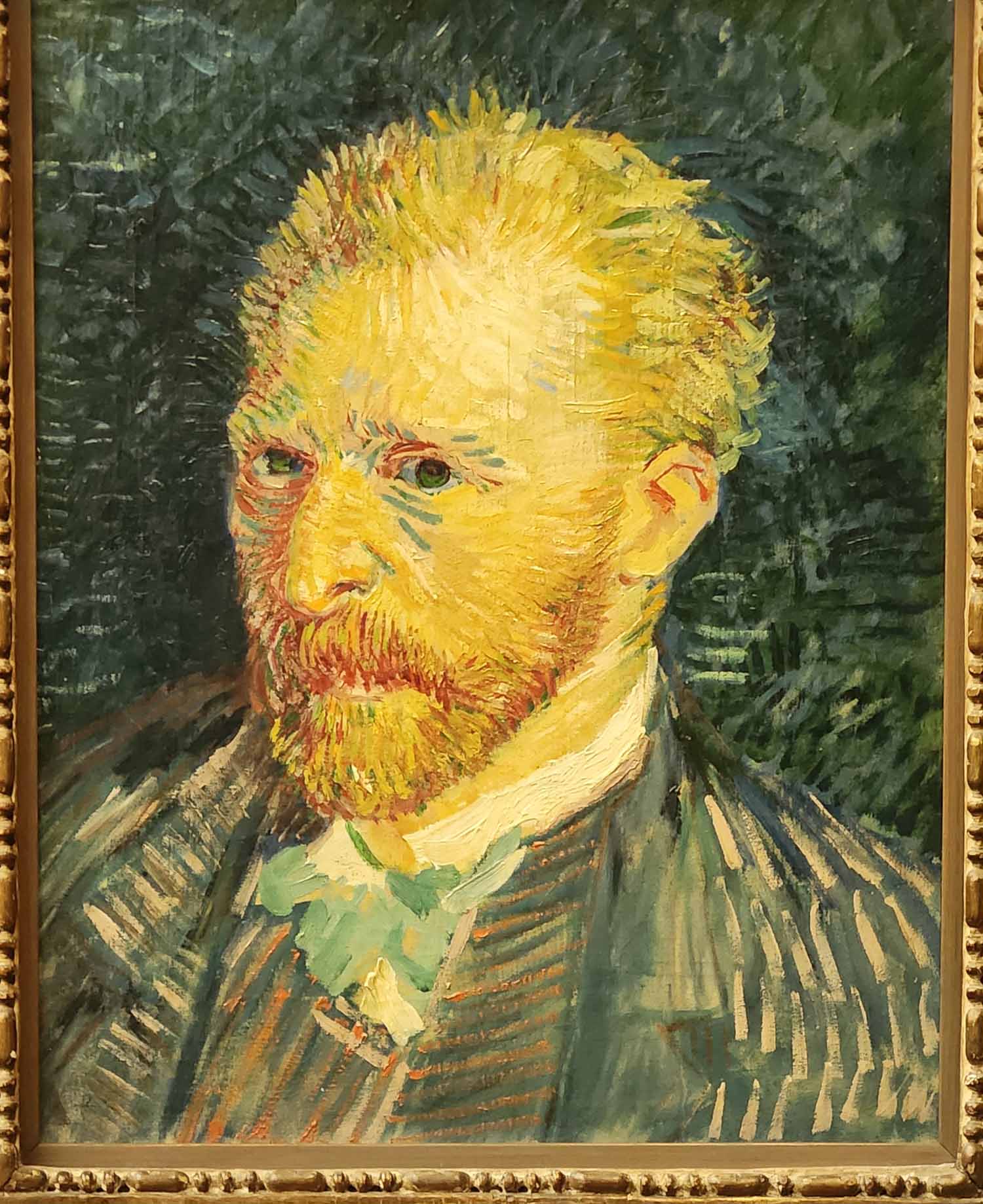
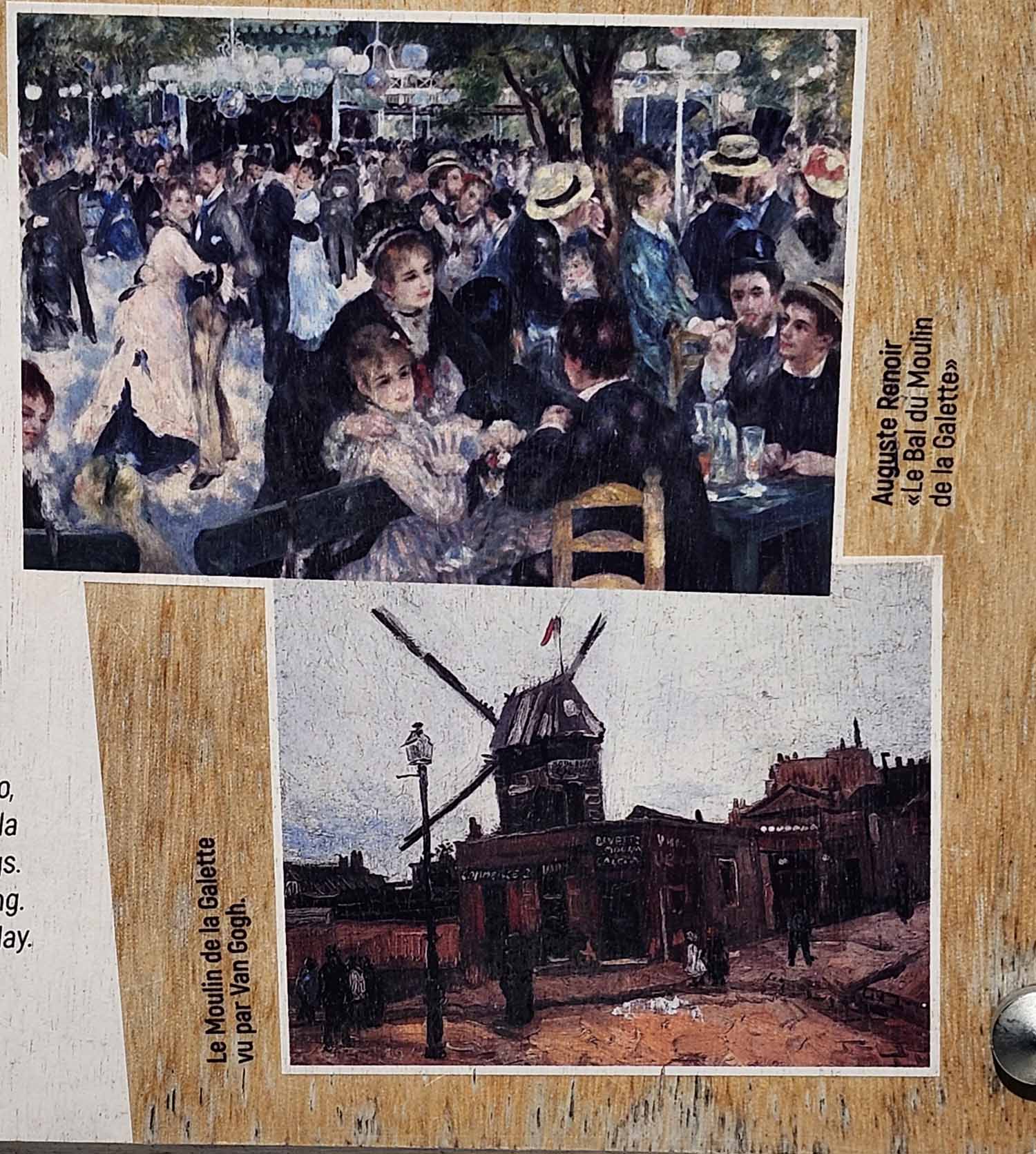
The museum has thoughfully prepared a background for Bal du Moulin de La Galette. And who does not love Vincent Van Gogh! No introduction needed. Just look at these!
Van Gogh – Starry Night Over the RhoneSelf Portrait
More information on “Starry Night” by the Museum. It’s really interesting!
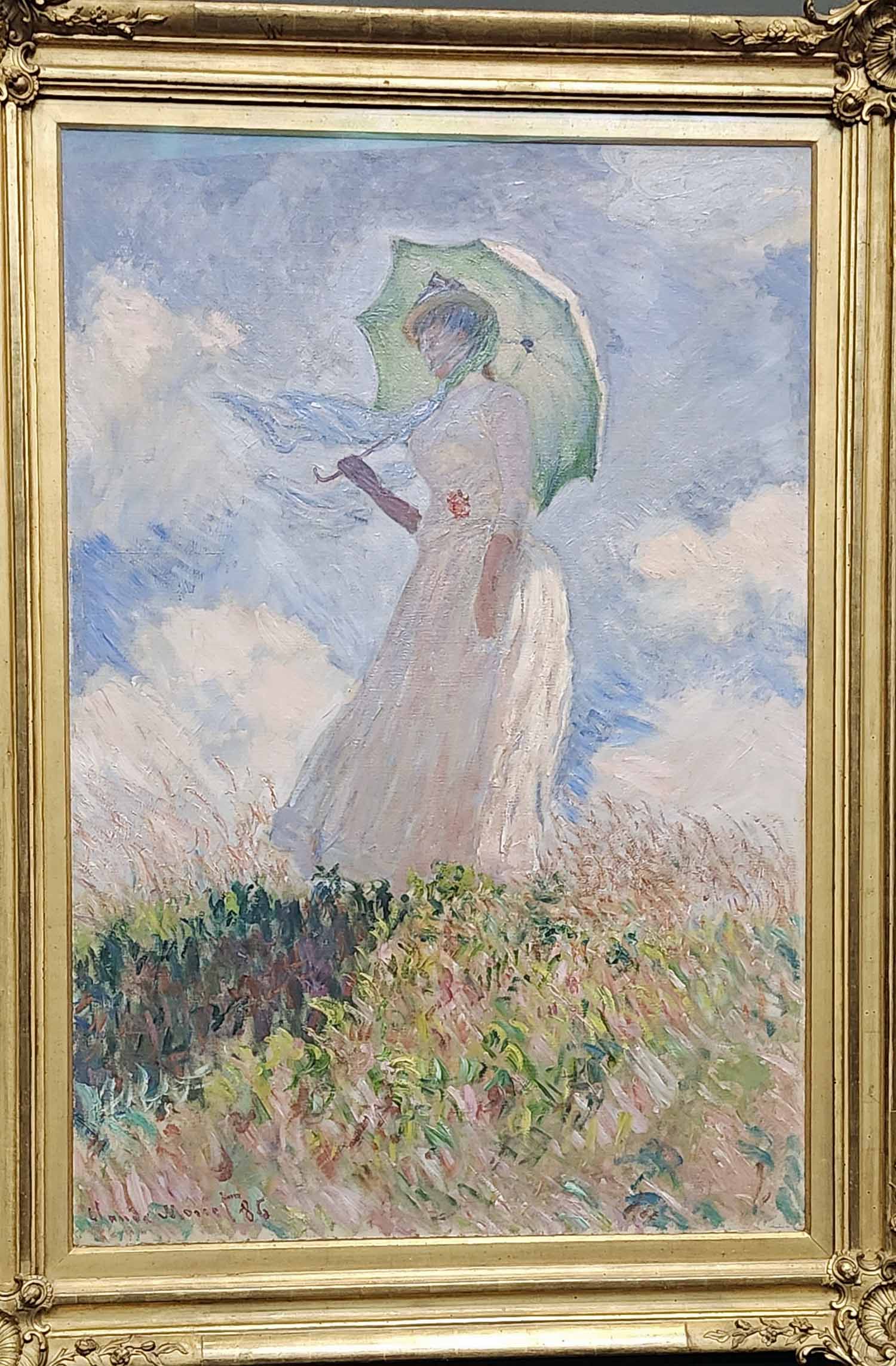
And do you think I’m done here? Oh no. Now here comes Monet. With I think, for me, the absolute most iconic Impressionist paining of all. The humbly titled “Woman with a Parasol Left Side.”
What sets this image apart is not only the beautiful day and the style, but the perspective. It is from the ground up. Making this woman, with the sun shining through her parasol and the breeze blowing her dress and scarf, stand so high in the way it shows off the times in which it was painted.
I had to take a selfie with it!
Lastly one of my favorite painters who was of the “pointilists” wing of the Impressionists.
I’ve always enjoyed the works by Georges Seurat.
In the D’Orsay Museum, they have one of his iconic paintings, “Circus Side Show.” The Pointilists were known for how they rendered images. They used single “points” of paint, thousands of them, like pixels on a video screen, to make an image. Up close you see just dots. Stand back and the image comes to life.
After viewing all this I was pretty taken aback. Wow. I returned to the hotel to take a nap, for my day was far from done. I had dinner with a friend from college, Jeff Russell! We had not seen each other in decades. So much to cover! It could have taken three such dinners! It was great to see him!
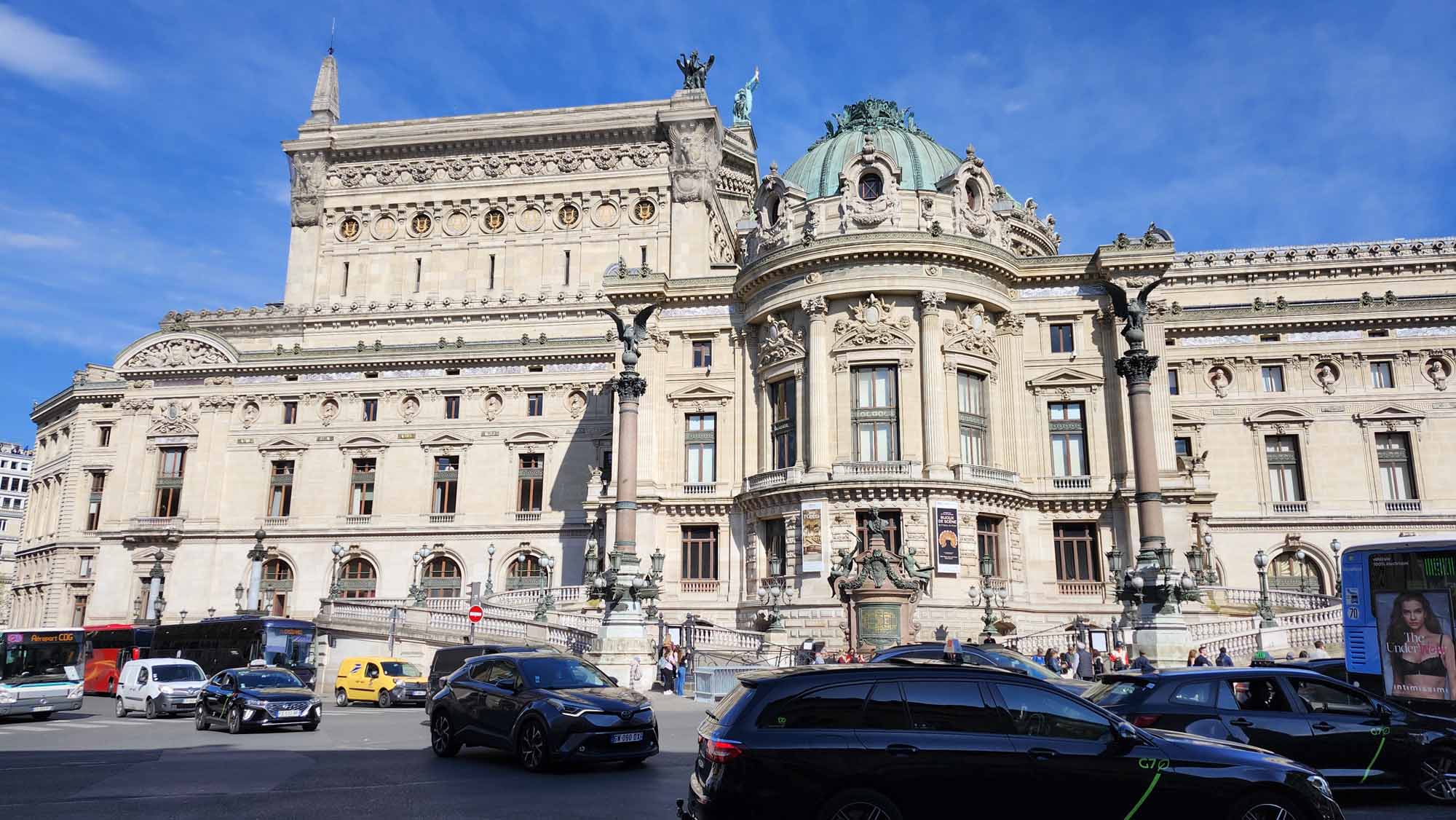
The Palais Garnier, or Opera Garnier, is a focal point of Paris.
Visiting France was far overdue! I’d visited in college for part of a big Europe tour, but it was a whirlwind and I only spent two days in Paris. I completed 7 years of French in school, and my teachers had special classes introducing us to French cuisine, history, the chateaus, Impressionism, the cathedrals, and even Rossignol skis. I read Stendhal’s “Le Rouge et Le Noir,” and Zola’s “Germinal,” in French. I’d spoken French in Morocco. But being crowd-averse, I’d been traveling to less busy places such as small sailboat cruising in the Greek Islands, Scottish trekking, El Nido in The Philippines, or British Columbia ski resorts. I seemed to think, “Oh I’ll get to France someday.” Well, I awoke to my mortality now that I’m 63, and decided I’d better see some of France! And I sure made the most of it. I allowed myself to be part of a Rick Steves tour (by far the largest group of any I’ve undertaken), because it had Mont St. Michel on the itinerary. It was a lot of fun. Rick picks smaller hotels which is generally nice. Our tour guide, Arnaud, is a veteran and took great care of us.
I should note that I’ve been on a genealogy quest of late. And, it’s taken me to France! I’m part of the Scottish Kirkpatrick Clan, and I came to dig up that one of our Kirkpatricks became Empress of France! She was Eugenie de Montijo – Maria Eugenia Ignacia Agustina de Palafox y Kirkpatrick – Empress to Napoleon III of the Second Empire! Together, they hired Haussmann, the architect of the Paris we know today. I reached out to several Paris guides before my trip, and they all knew about her and the Kirkpatrick connection. They told me she had input into the Palais Garnier, oversaw the opening of the Suez Canal, and gave Luis Vuitton his first gig. They also told me there is a painting of her in the Louvre! SO, I had quite a bucket list for Paris!
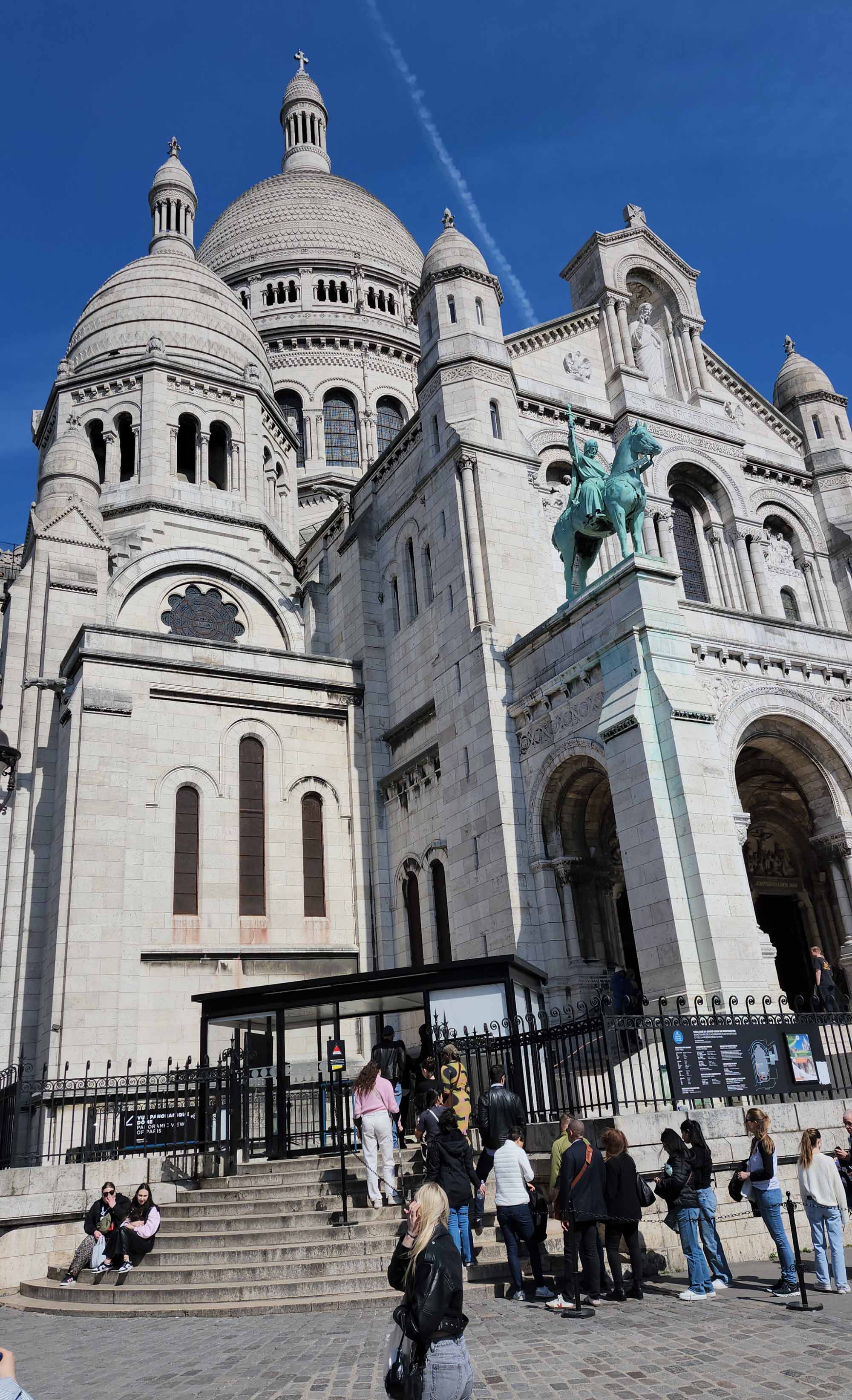
I wanted to take a guided tour of the Palais Garnier, and the only ticket I could get was on the same day I arrived in Paris. It began at 6:30 p.m., so I knew I had a very long day coming. I did quite a bit of reading up on the city prior to arrival. Although Paris is famous for its Metro, it is very much a walking city brimming with small, twisty streets and neighborhoods sporting unique personalities. My hotel was the Hotel B. Montmartre – not terribly far from the famous Basilica Sacre Coeur. Little did I know on that first day I would be immediately immersed in the culture and history of Paris – quite by dumb luck!
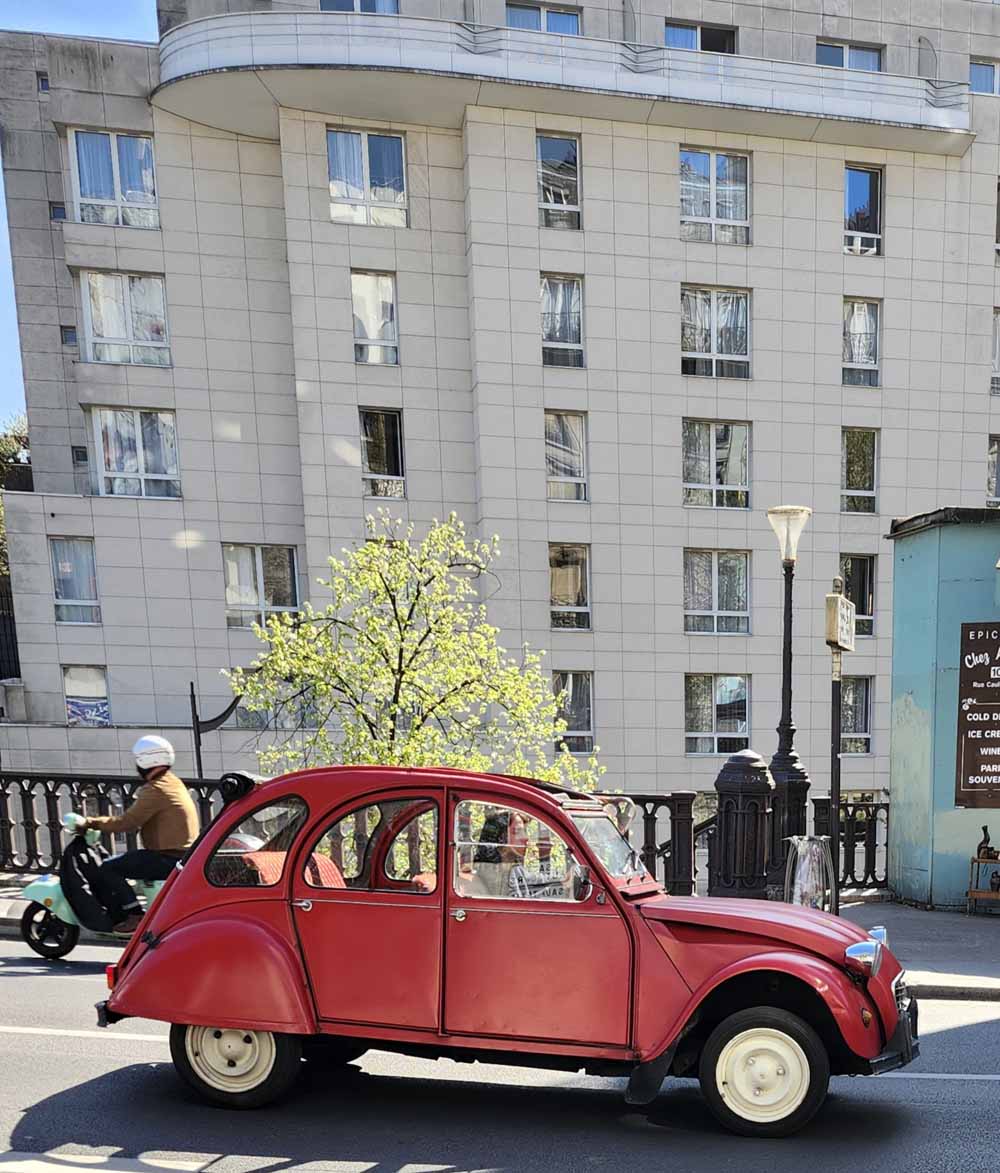
An iconic Deux Cheveux
I arrived at my hotel at 11:00 a.m. but my room would not be ready until 2:30 p.m. or so. The concierge held my luggage and suggested I stroll up to the artistically significant Montmartre neighborhood and see the Basilica Sacre Coeur – that would be an interesting few hours. And so I headed out. I was hungry after the 10-hour flight, so I picked out a sidewalk cafe table and had lunch. Thus settled and satiated, I could people watch. Turns out this is a Parisian thing. Cafes are ubiquitous, and you can have a table for hours if you like. The staff isn’t in some “turn the table over” hurry. Enjoying time-out is expected. As is conversation with a friend at your table.
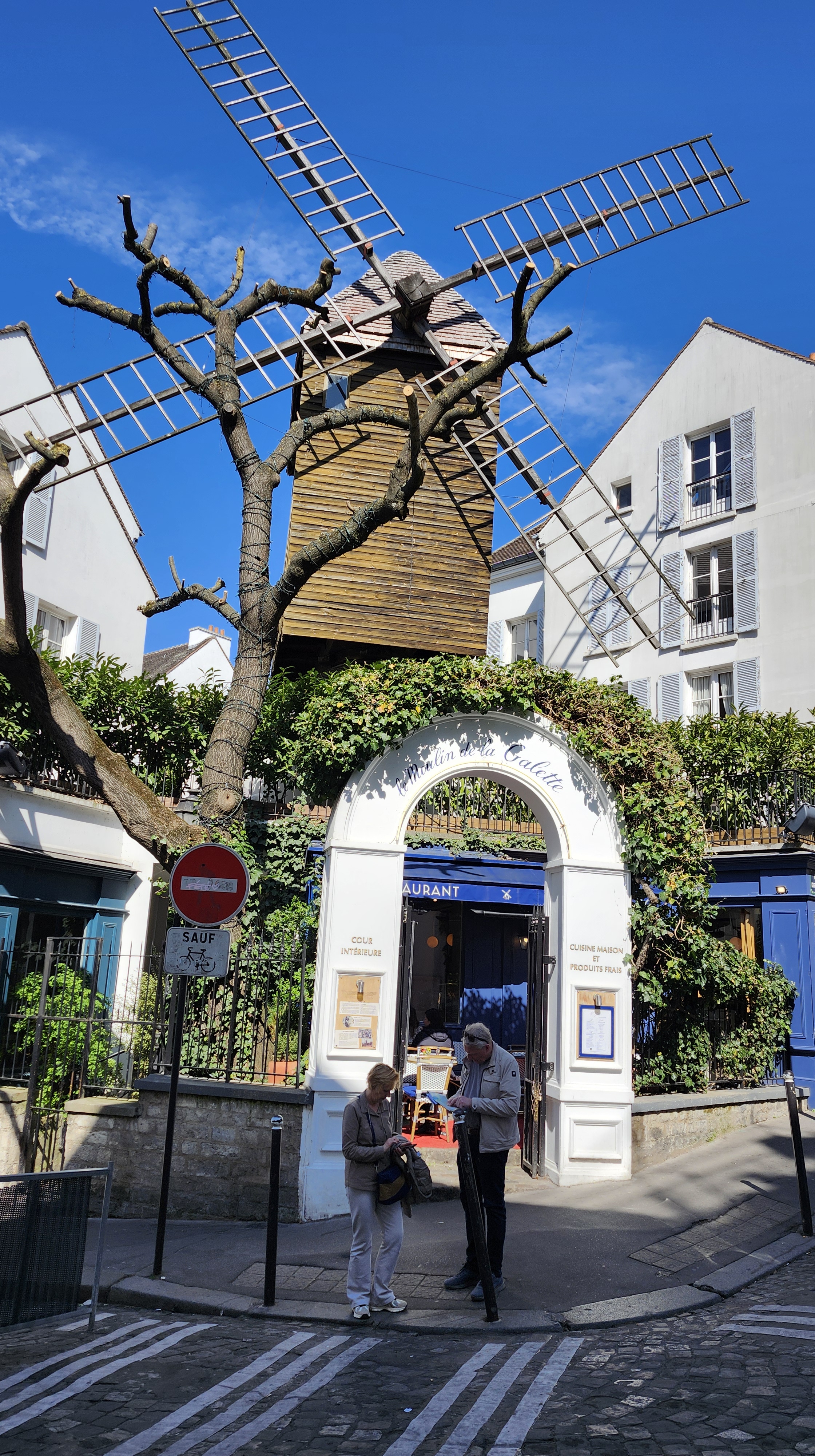
After lunch I wended my way over to Montmartre. Once off the main avenue I strolled up the cobblestoned Rue Lepic. Immediately Paris history and culture were in full view. I chanced upon middle-of-the-afternoon diners sitting at candle-lit tables sipping fine wine with cheeses. Apartments several hundred years old and flower boxes in windows. And then, without notice, I stumbled upon a famous sight I learned about in school – in fact I have a Renoir painting of it in my office! It was the Moulin de la Galette restaurant! OMG I had only been in France two hours! It has a windmill outside and a gate. I had to double check but sure enough there was a little paragraph on the outside saying YES, this is the place Renoir and Van Gogh would gather for lunch and they painted images of it! What’s next I wondered?
I continued and discovered a very busy square with lots of restaurants, plus shops and artists sketching scenes – the Square of Montmartre. Although I’m sure there were many tourists like myself, it was clear this was a very Parisian atmosphere going on. Waiters and waitresses clad in white shirts with black aprons taking orders. Guests immersed in conversation – and the weather – blue bird skies in early April! A truly merry atmosphere for sure.
I had just arrived in France, and was immediately immersed in how the French just “know how to live.” In cafes, it’s completely normal to “sit and watch the world go by,” and enjoy in an unhurried fashion. This was all on display in Montmartre. Upon reaching the Sacre Coeur I was amazed at its size. I had no idea.
It sits on a hill from which most of Paris can be seen, including Notre Dame and the Eiffel Tower. I drank in the view and then strolled, all downhill, back to the hotel. Once settled in, I set out for the Palais Garnier. I tried to use the Metro, but my credit card would not work in the ticket machine. So instead, I opted to walk, which turned out to be an eye opening experience! I walked along many small streets, passing by all sorts of shops, boutiques, cafes and a bakery. Nobody seemed in a hurry. The women seem to have a certain Parisian style – not shabby, but not formal either. It’s some kind of perfect in between. It’s definitely put together in a certain snappy style. And I like! A LOT. Bikes leisurely pedal by, and almost nobody wears a helmet.
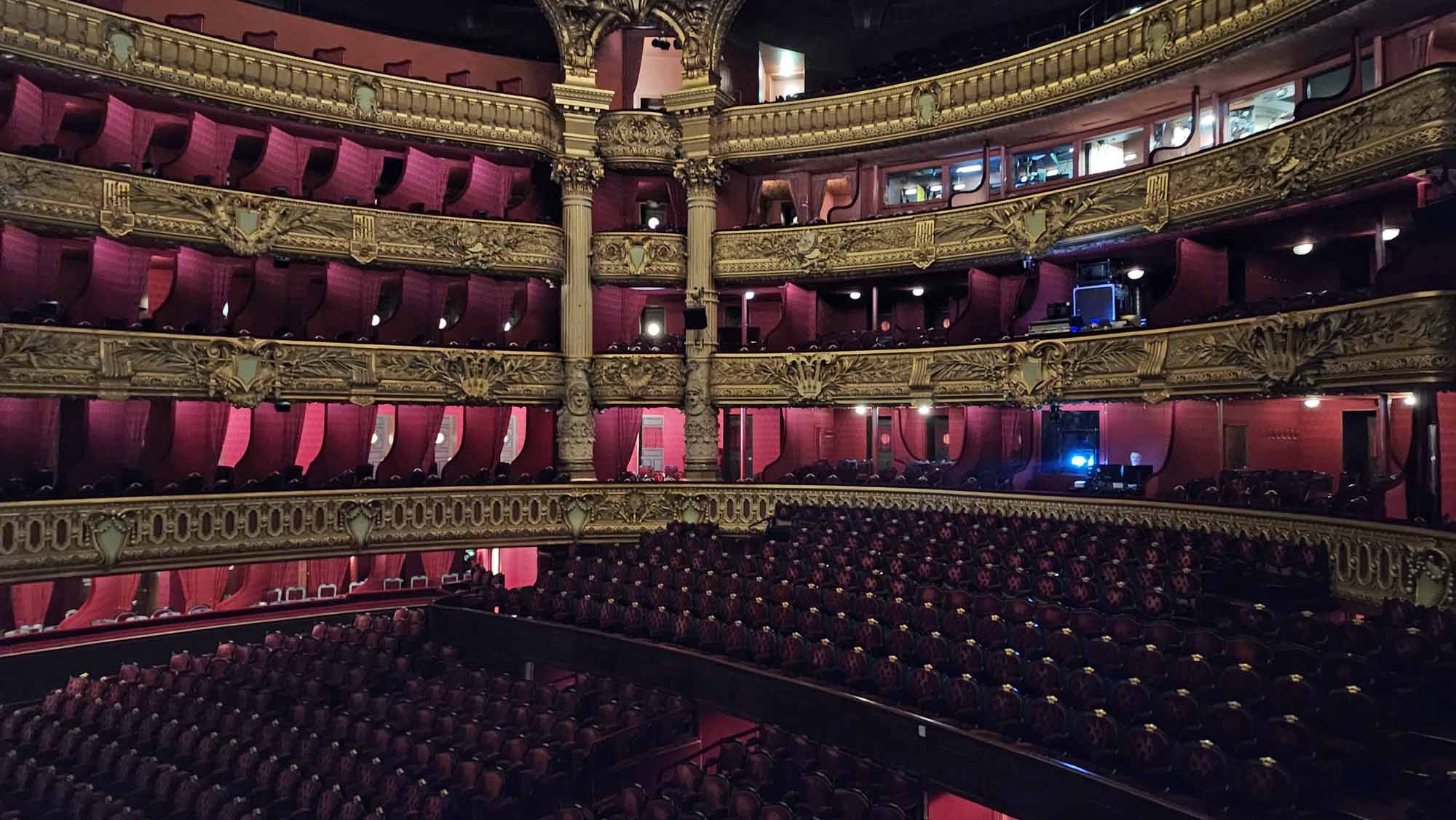
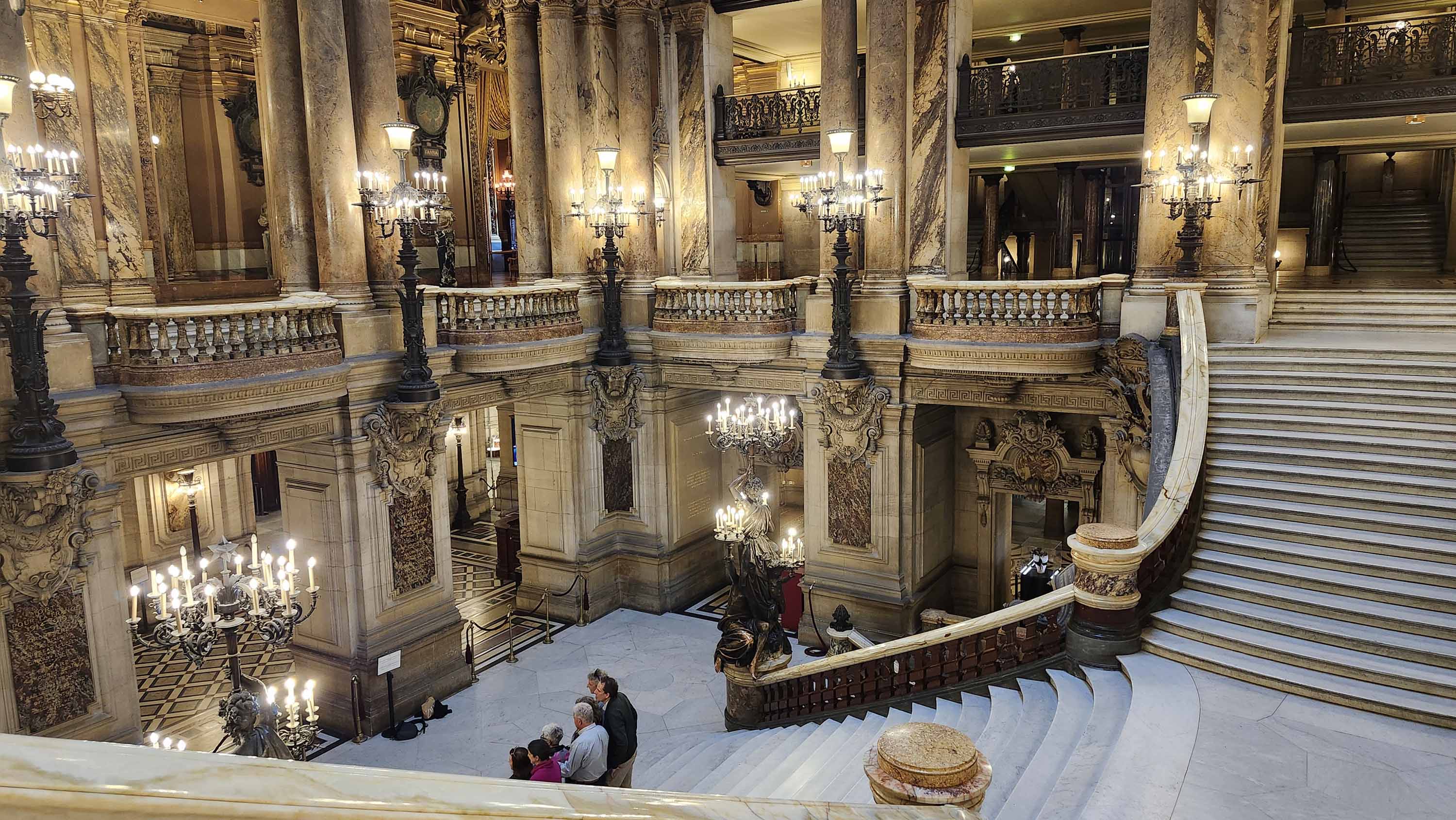
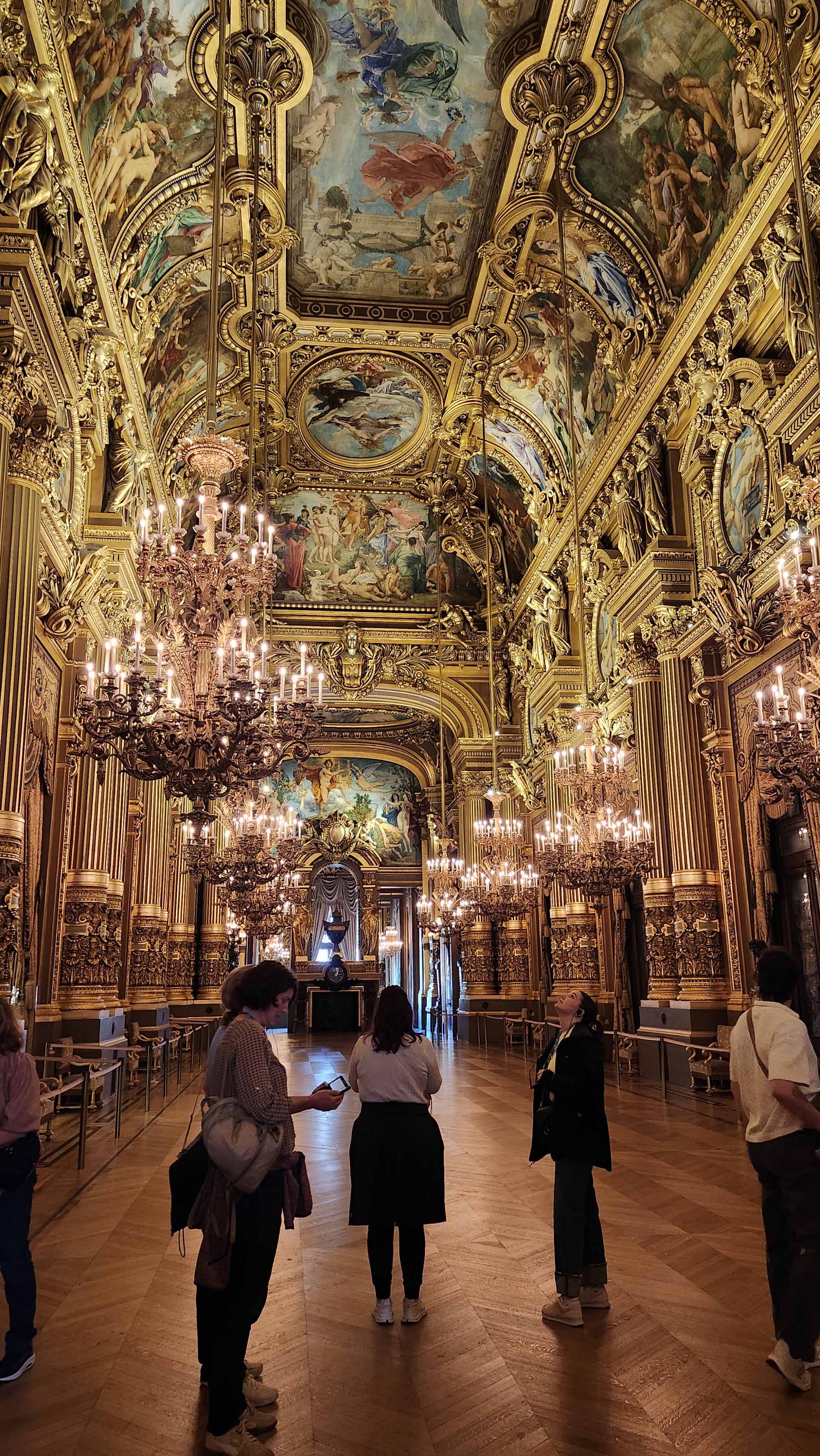
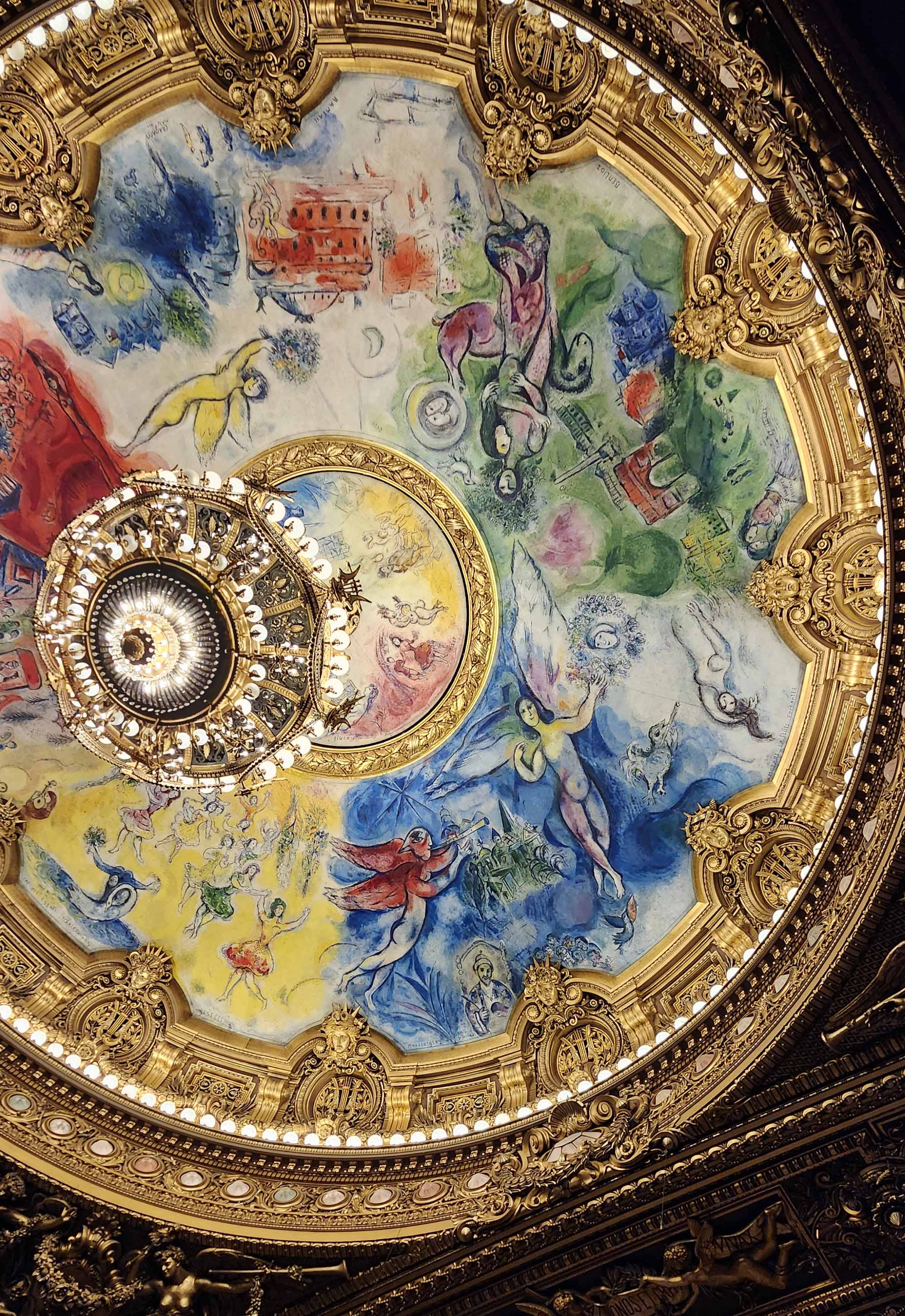
And then I glimpse an enormous building with statues on its roof – the Palais Garnier! I arrive on its side. Entering, I join a group which embarks on a tour specializing in a Phantom of the Opera spiced up fashion. It turns out that the Phantom of the Opera was set in this very opera house. We viewed the marbled, multi-staircased entrance, the Hall where guests gathered for refreshments, and the theater itself. Its ceiling was painted by Chagall in the mid 20th Century. Until a 2nd Opera House was built in Paris, this was the largest opera house in the world. Empress Eugenie de Montijo was a regular attendee. In those days, the upper class went to the Opera Garnier not to see the performance, but to see and be seen.
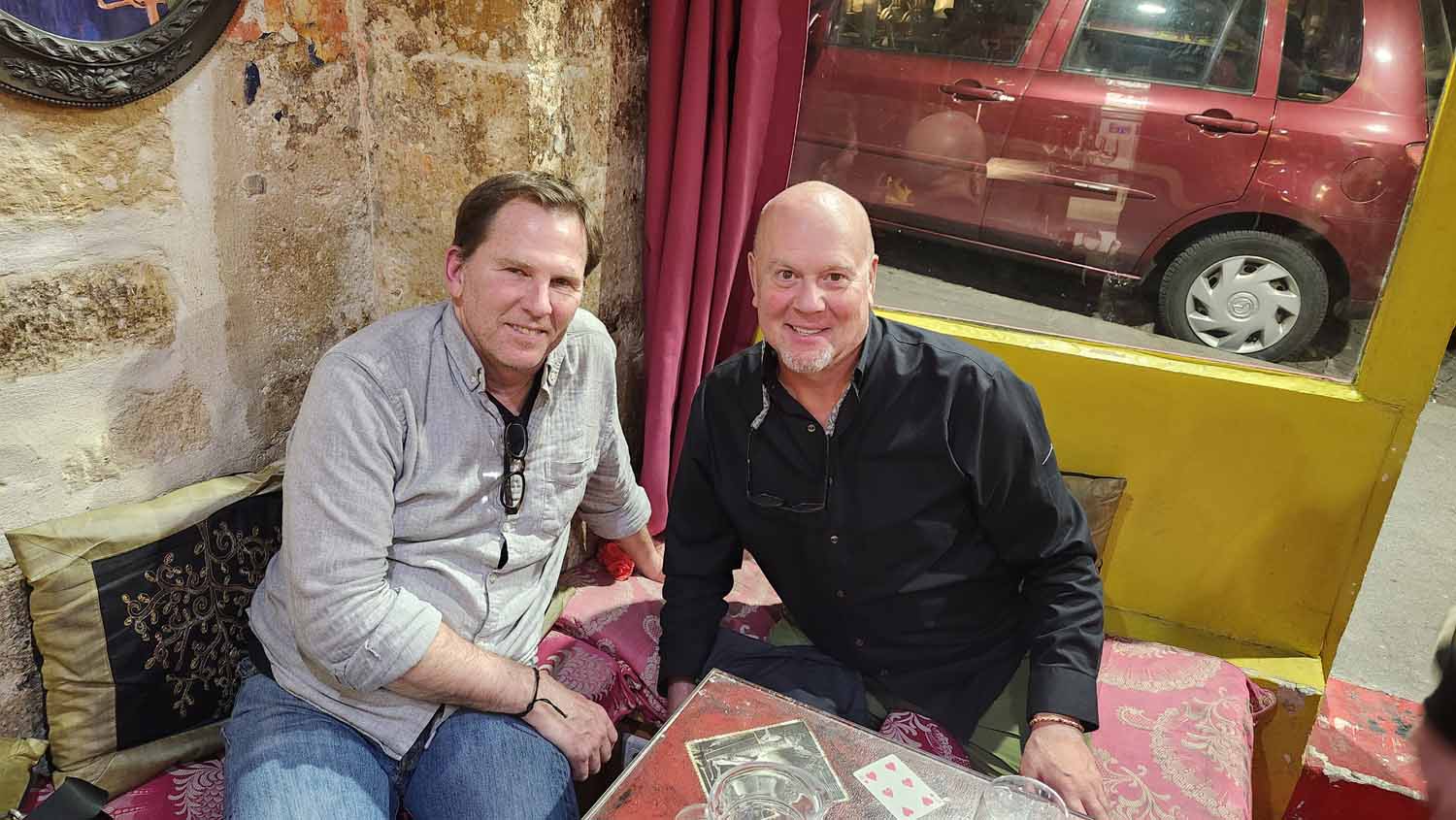
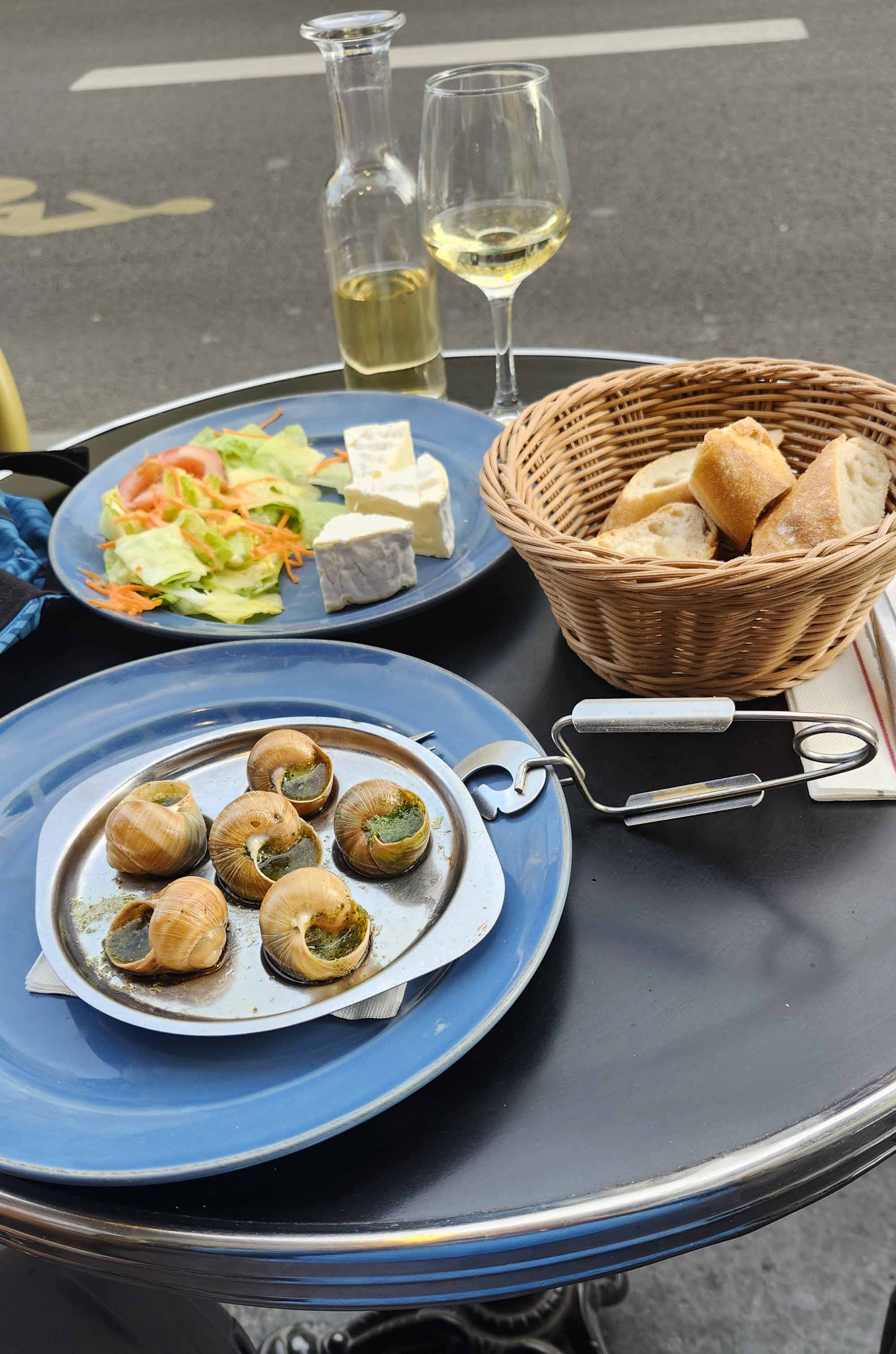
At the conclusion of the tour, I walked back to the hotel. It was supper time. And I remembered that, in one of the Rick Steves Europe audio interviews, a guide recommended that to get to know Paris, one should find a cafe and make it your “home,” so I did just that. The idea is that you can get to know some Parisians that way. I wanted Escargot. It just so happened that a cafe right around the corner from my hotel, Brasserie Le Moncey, had escargot. So I staked out a sidewalk table, ordered escargot, white wine and a cheese plate (it came with bread and a salad), and watched the world go by. Within 20 minutes the guests at the neighboring tables introduced themselves and I, in my broken French, introduced myself and spoke a bit about my day. And with that, Paris became real to me! They told me about their jobs, families, and even told me to meet them at the cafe for coffee and croissants the next morning. The fact that I spoke some French made me more than welcome. Every time I said something correctly it was like a 4th of July firework went off – they were so pleased I tried so hard to fit in! And this happened all over France. So the French reputation for being rude and distant was, for me, completely washed away. They do expect some formality when meeting a stranger but quickly become warm and friendly once some familiarity is established!
Tomorrow I’ll do some more walking around Paris. I’m headed to the Musee D’Orangerie, where Monet’s Water Lillies span a city block, and will take in the Seine and some park-time!
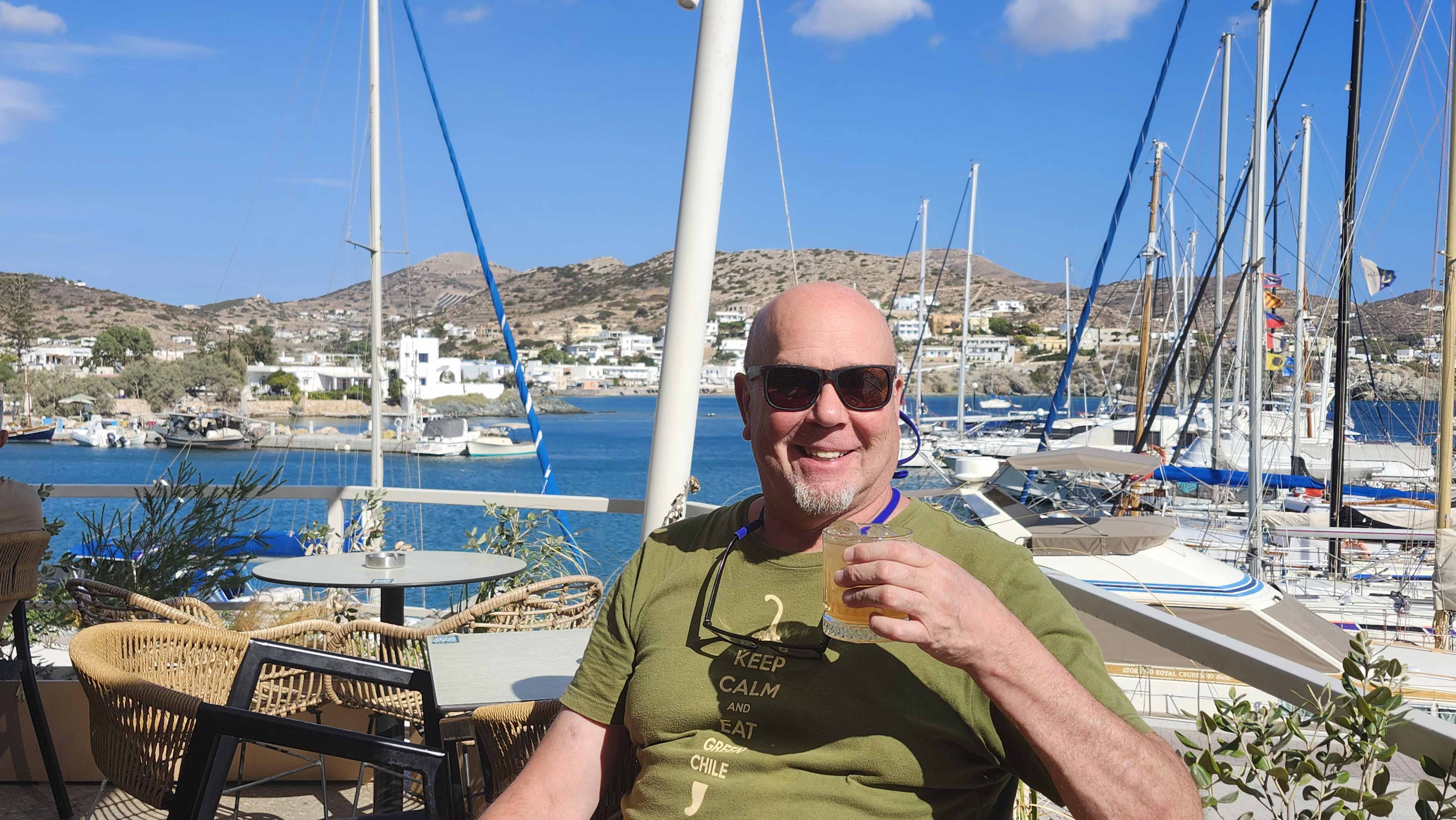
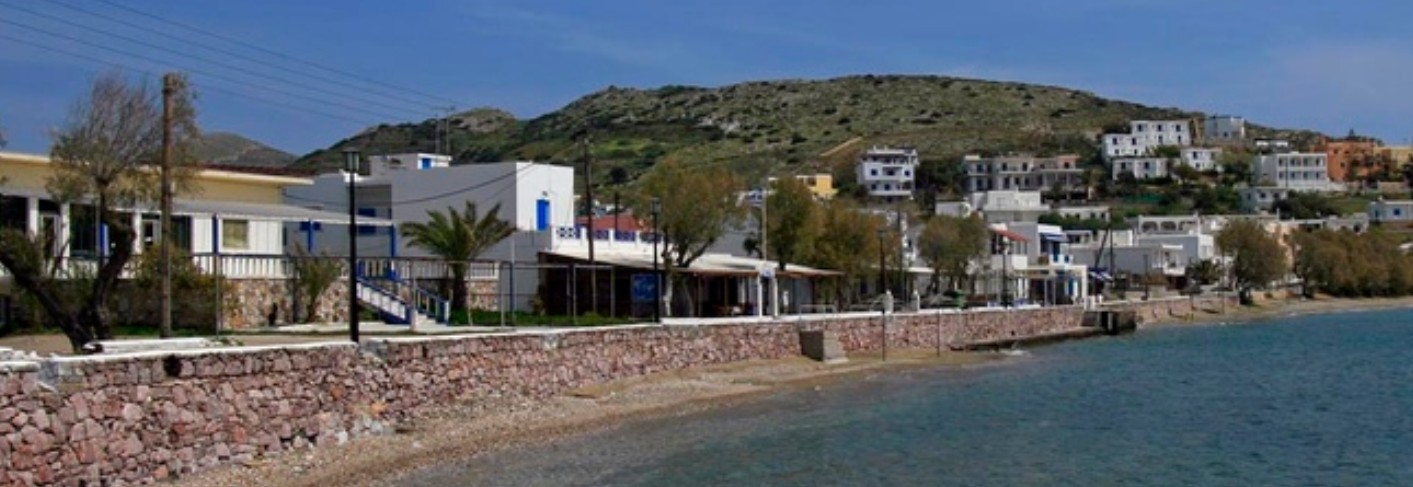
Hoisting a cold one at the marina cafe in Finikas harbor
With a stiff wind over our stern, we headed to Syros. Syros is a blend of the urban life of the city and quiet coastal villages. Its primary city, Ermoupoli, is the regional capital with a rich history, opera house, two cathedrals and port large enough for ship building and repairs. We spent two nights on Syros. I rented a car so we could get around. Since my insurance doesn’t cover overseas rentals, I had to opt for the insurance offered by the rental car company. We paid for it out of the group kitty.
Gina looking good!
Rather than dock in the city, George chose what was to become my favorite port of this trip, Finikas. Finikas is worthy of an Ernest Hemingway novel. The marina, with showers and a cafe, sits at one end of a 600-yard long semi circle harbor. From there, you can walk the boutique hotel and taverna lined waterfront to which the cutest brightly colored fishing boats are tied. As you stroll, occasional steps lead down to the the narrow beach and its free umbrellas. Sailboats swing at anchor. Being so late in the season, no tavernas were more than 25% filled at dinnertime. The atmosphere was peaceful bliss.
For supper, some chose to visit Ermoupoli, but I couldn’t resist the opportunity to check out the waterfront restaurants at Finikas Port! The attraction was too much. When the time came I set out wandering along the waterfront, passing fishermen mending their nets, a marine supplier, and checking out menus as I went.
I settled upon an open air spot with lots of open tables. The server was incredibly pleasant. I sipped a glass of red wine and awaited my meal. And then, my luck turned gold and just as I hoped, the magic happened!
A trio of local musician friends sat down right across from me and began practicing, whilst waiting for their own meal! THIS is what travel is all about. It is priceless moments like this!
The following day we did a little exploration of Ermoupoli. We strolled the steep streets, with their pastel painted Italian inspired buildings, checking out shops, and spending a little time at the Apollo Theatre, built in 1864. More music! A pianist was practicing!
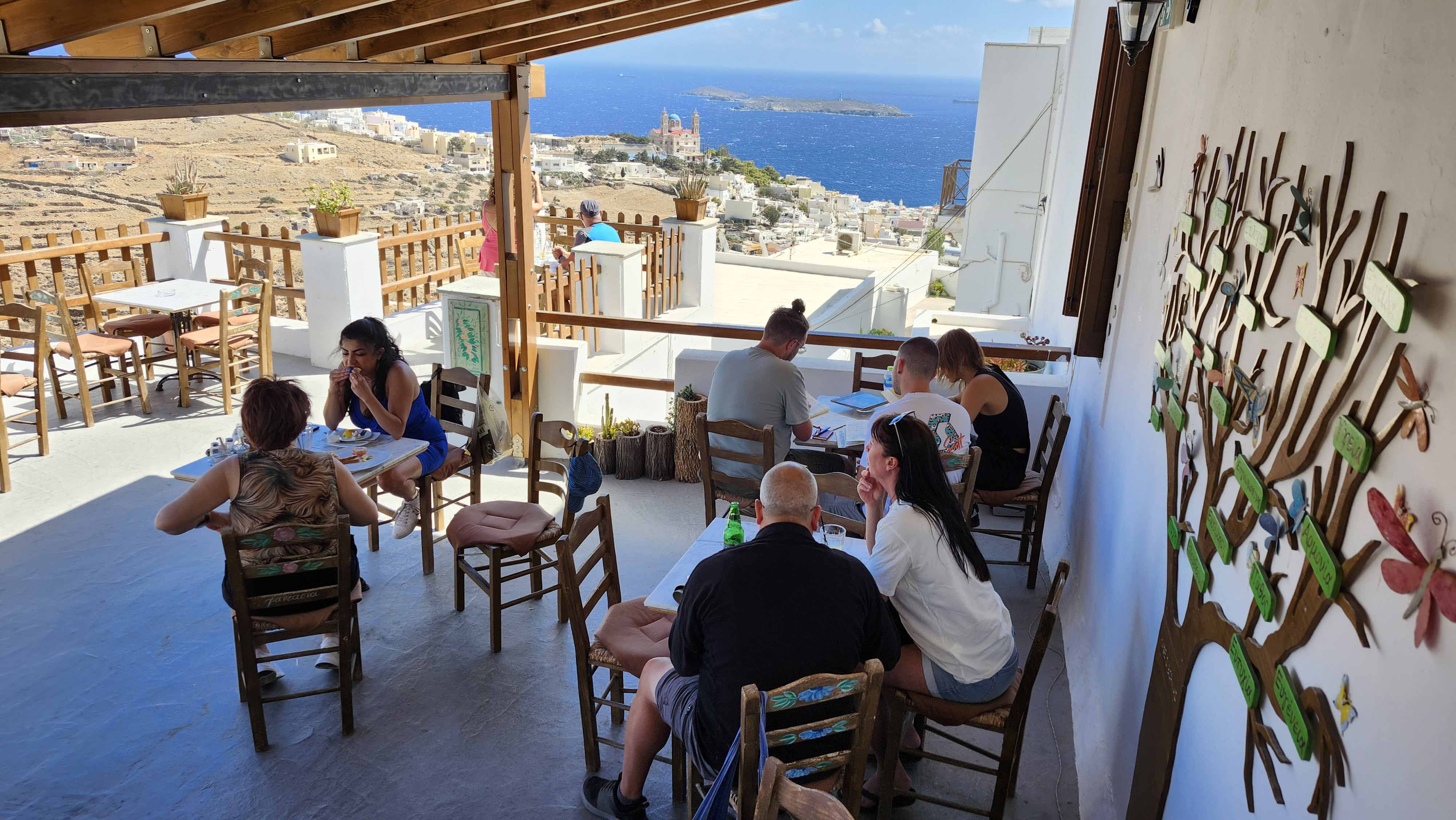
Then it was time to explore Ermoupoli’s cathedrals. One of them was closed, but I found a cliffside restaurant with a commanding view just a short walk away! Terrific lunch spot.
Next, we drove to St. Nicholas Church, a cathedral built in 1870. A Greek-Australian wedding was taking place!
If I had to pick favorite stops on this voyage, I would choose Ano Koufonisi, and Finikas, on Syros! Love love love them!
Our sailing journey would put us this day on the infamous party island of Mykonos, something I was set to endure, not enjoy, or so I thought. What actually transpired turned out to be one of the highlights of my Greek vacation! I love archaeology and ancient civilizations, and I was not expecting to see a lot of Ancient Greece on this sailing-oriented vacation. What I discovered on this day was that there is a very important Ancient Greek island city a 30-minute water taxi away from the hubub of Mykonos! It is the island of Delos.
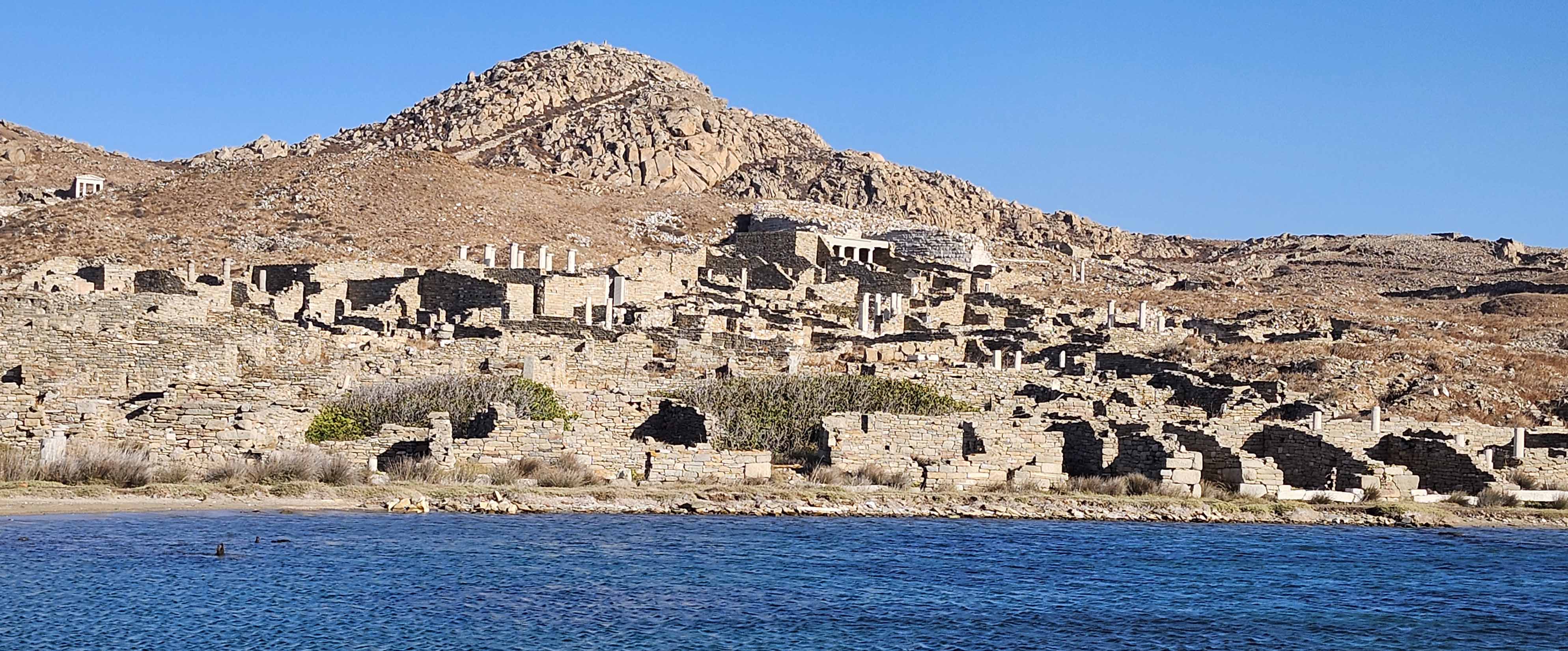
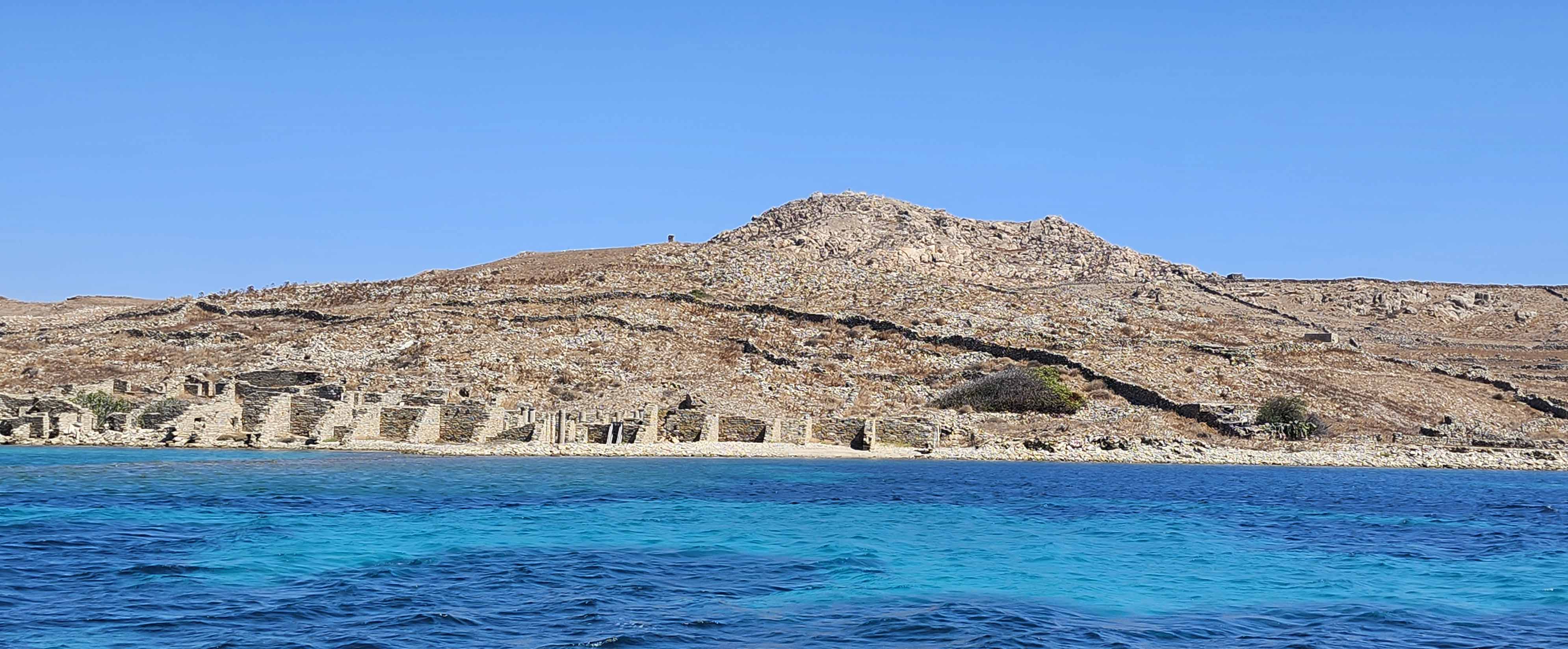
After our snorkel and lunch break, we motor sailed on our way to Mykonos. Passing amongst some smaller islands, George pointed out some ruins on the shore. It was Delos! Cool!
As we sailed past, George gave us a briefing on Mykonos. One of the activities was to take a water taxi to Delos, and the price included a guided tour of the ruins! Kathryn and I were in. This would be a perfect way to avoid the Mykonos crowds and take in some Ancient Greece! It would complete my vacation! I was stoked!
Past Delos, we came into what I learned was the windiest passage in the Greek Islands – between Tinos and Mykonos. We took a long starboard tack north upwind before coming about and making a port tack east over to Mykonos. Some of the waves came over the bow! The hull actually pounded after going over some waves.
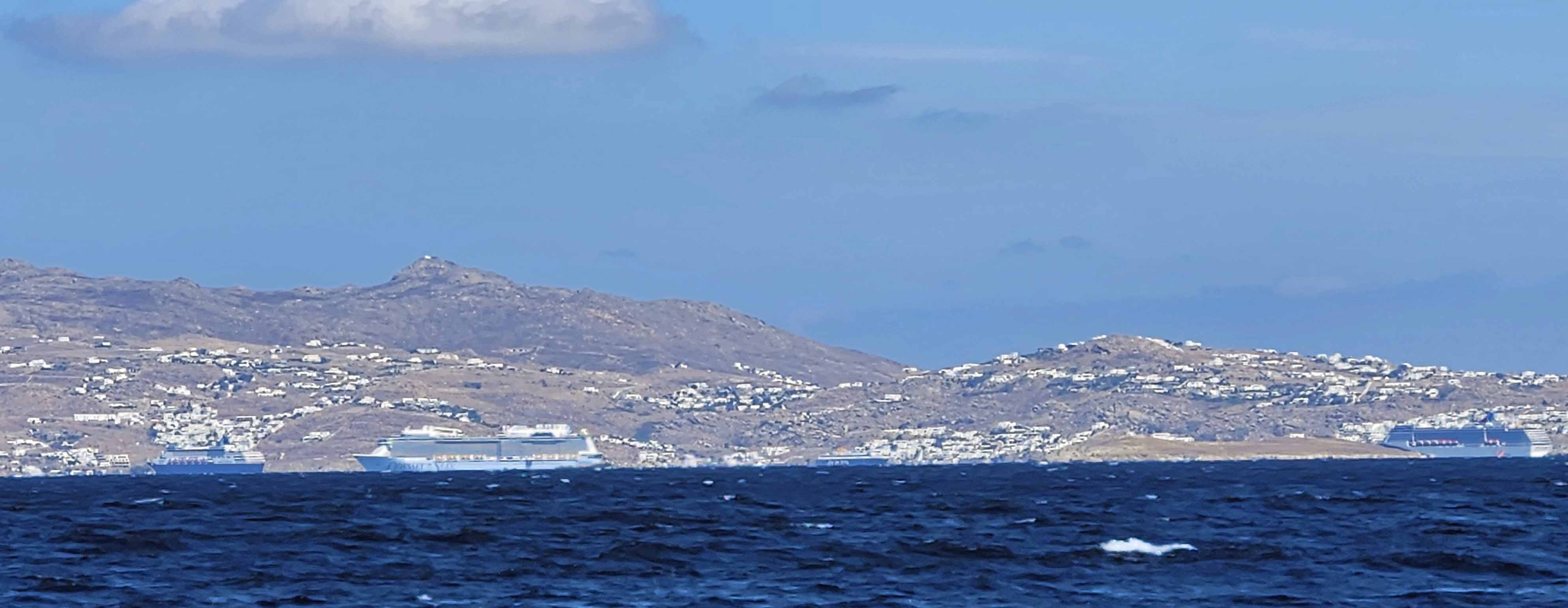
Eventually, the Mykonos waterfront came into view. What I read was true. It would be packed with tourists. There were three cruise ships – Royal Caribbean’s Odyssey of the Seas, a 1,138 ft monster with 5,510 guest capacity, Carnival Cruises’ 963 ft Carnival Legend, with 2,124 guest capacity, and another from a cruise ship line I could not recognize. Together, these three ships are capable of dumping about 10,000 people on the port. I didn’t want to be there.
We docked at the comparatively minuscule sailboat marina, and George educated us that Mykonos has an efficient water taxi system which can whisk us around the bay, with “bus stops” along the way. He let Kathryn and I know which stop to use for the Delos water taxi. We were on our way! We were dropped off at another water taxi station, where Delos tour operators sold all inclusive tickets to the island. While waiting to buy our tickets, we saw a hundred cruise ship guests waiting in line for prepaid “shore excursions,” and they just reminded me of cattle being herded around. I was glad for our freedom.
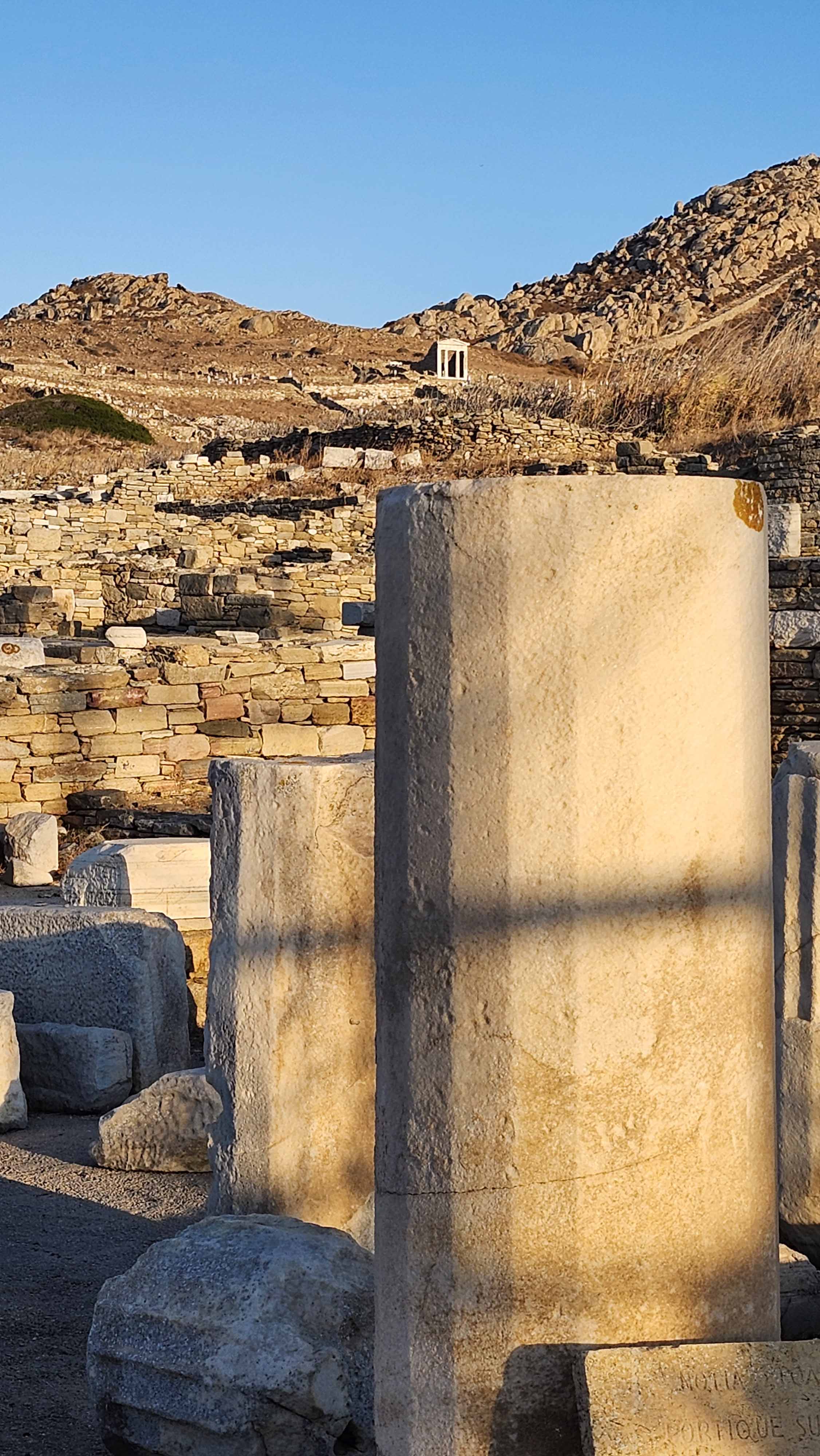
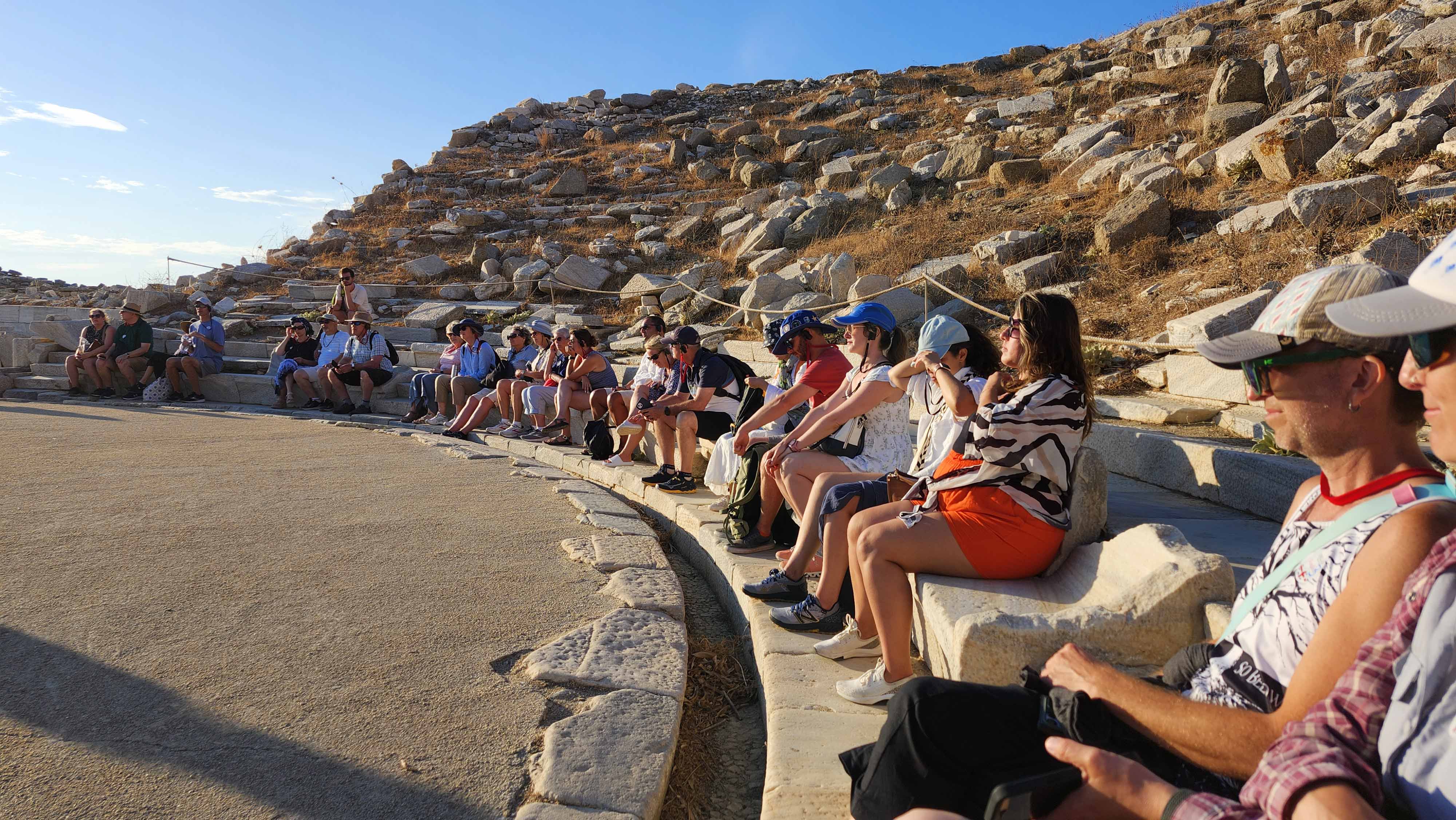
After disembarking at Delos, we were met by our English-speaking tour guide, also an on-site archaeologist. It was a 90-minute walkabout. The island isn’t big. It’s 5KM long and 1,300M wide. It isn’t favorable to agriculture, so food had to be imported.
For people of antiquity, Delos was a very important island city. It was said to be the birthplace of Apollo and Artemis. Situated at the center of a spoked wheel, if you will, Delos was a wealthy cosmopolitan trading center for all ancient civilizations, and a melting pot for religion and culture. At one point it had various neighborhoods housing Greeks, Romans, Egyptians and Syrians. Its earliest settlements began about 2,500 B.C. Its greatest importance grew from when it was declared a free port in 167 B.C. Wealthy merchants, bankers, ship builders, and traders from Persia, Rome, Egypt, Syria, Turkey and beyond set up businesses.
It became “Maximum emporium totius orbis terrarum,” the greatest commercial island in the known world. Its prosperity attracted organized looters, for it was sacked twice and eventually abandoned. Today, evidence of its role as a crossroads are everywhere on the island. There are sanctuaries for Greek, Syrian and Egyptian gods.
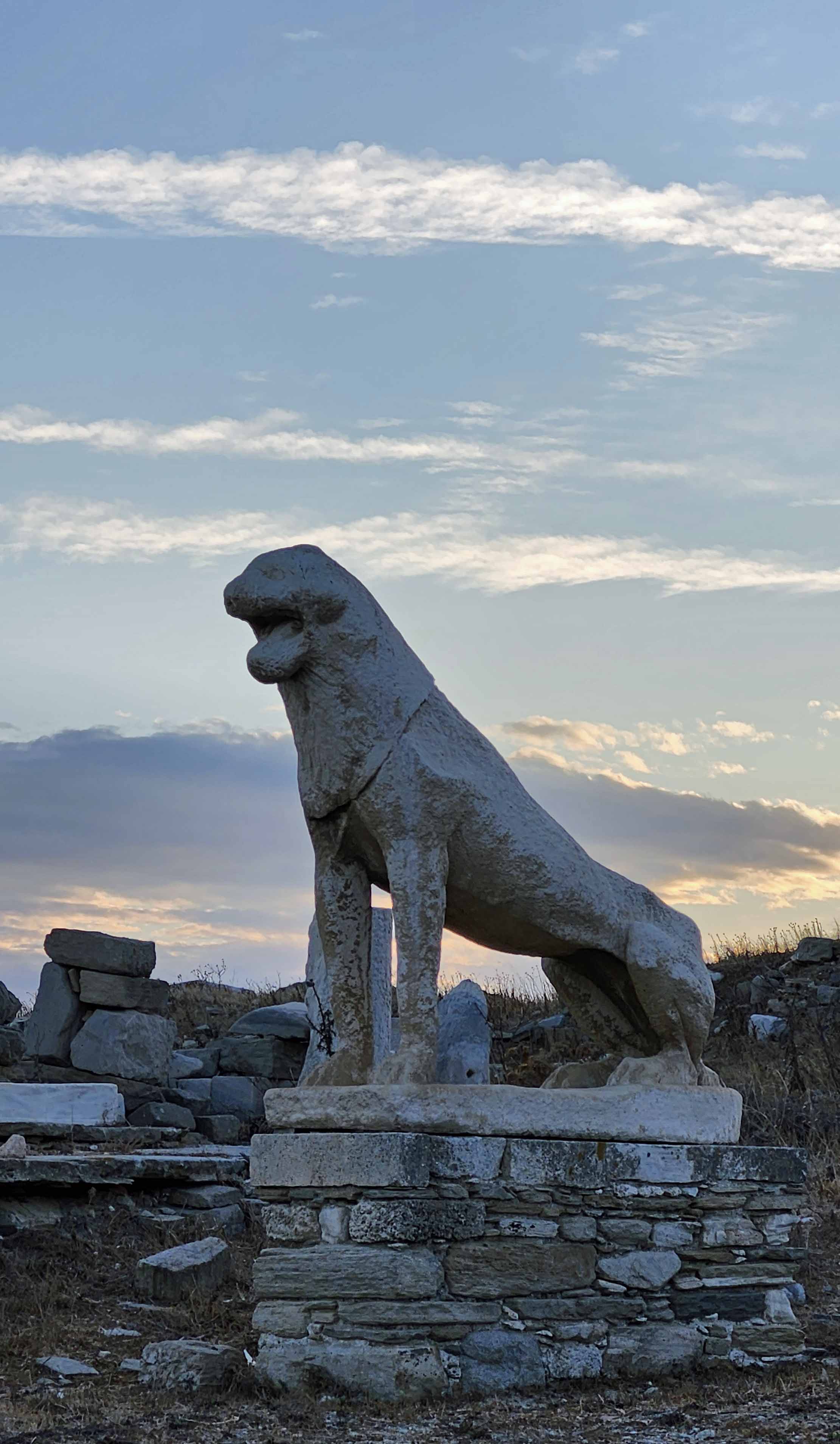
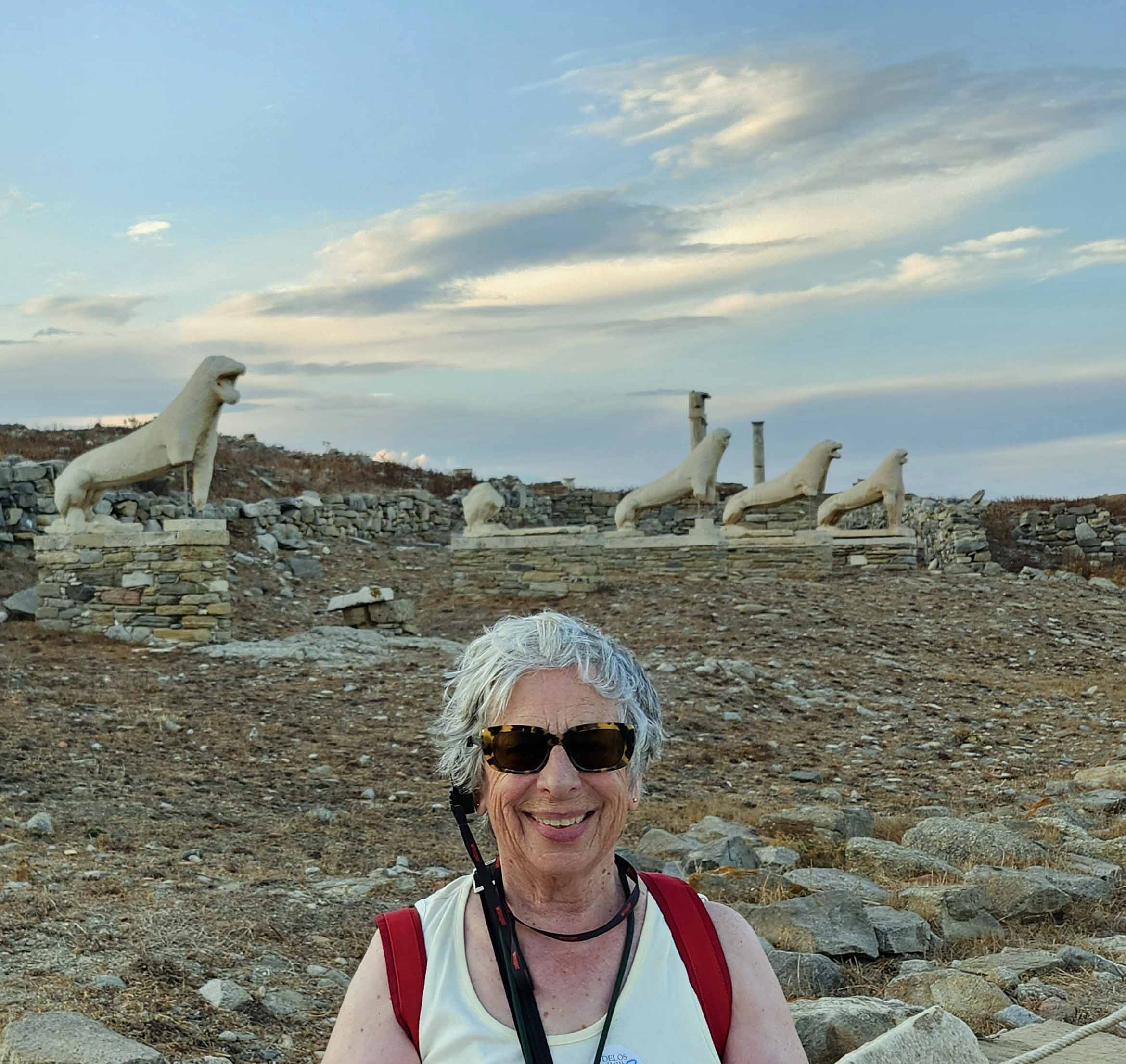
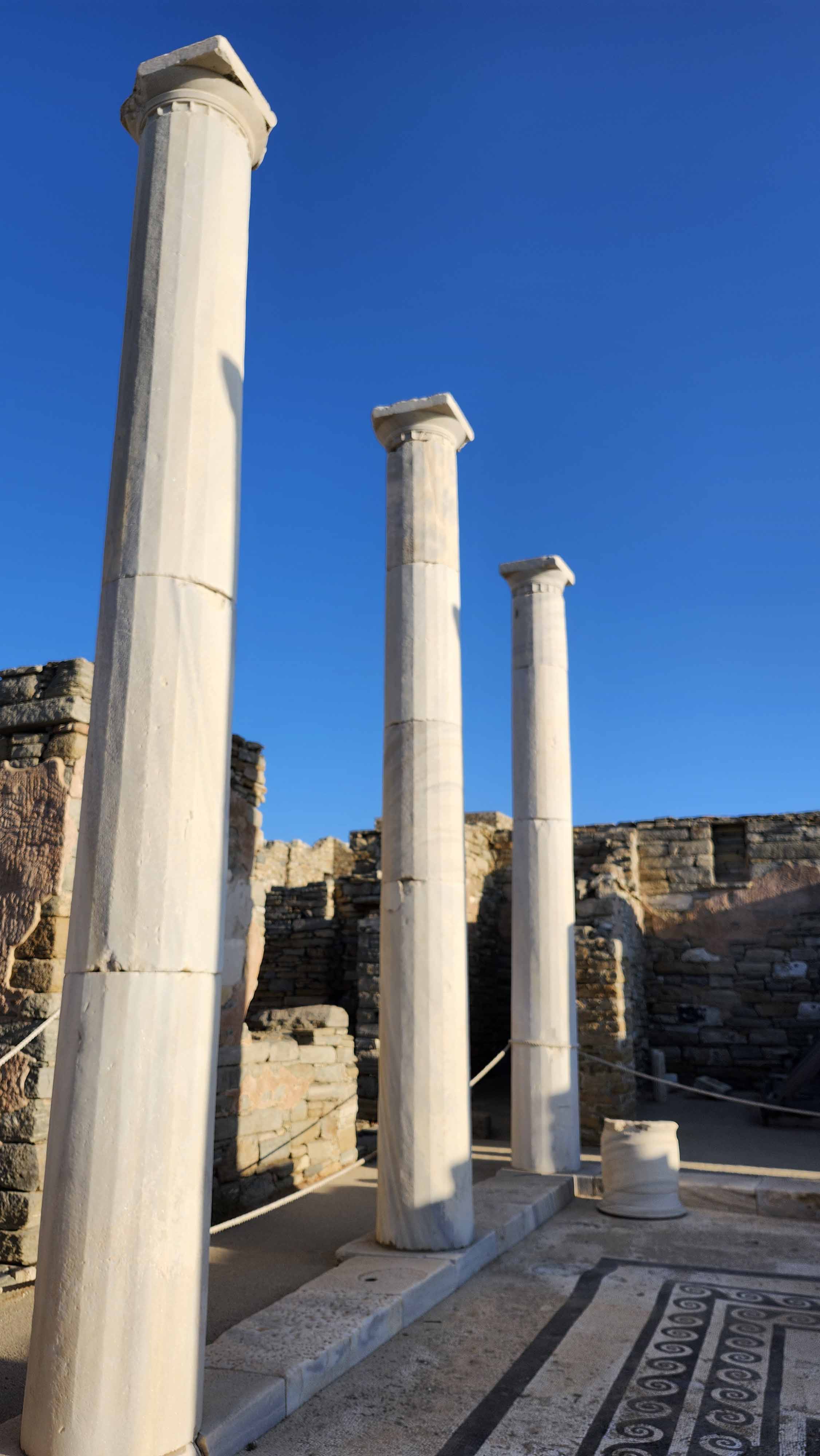
I really enjoyed the Naxian Lions, checking out the 6,000 person amphitheater, the fish monger / butcher areas, and admiring the mosaic tiles on the residential floors.
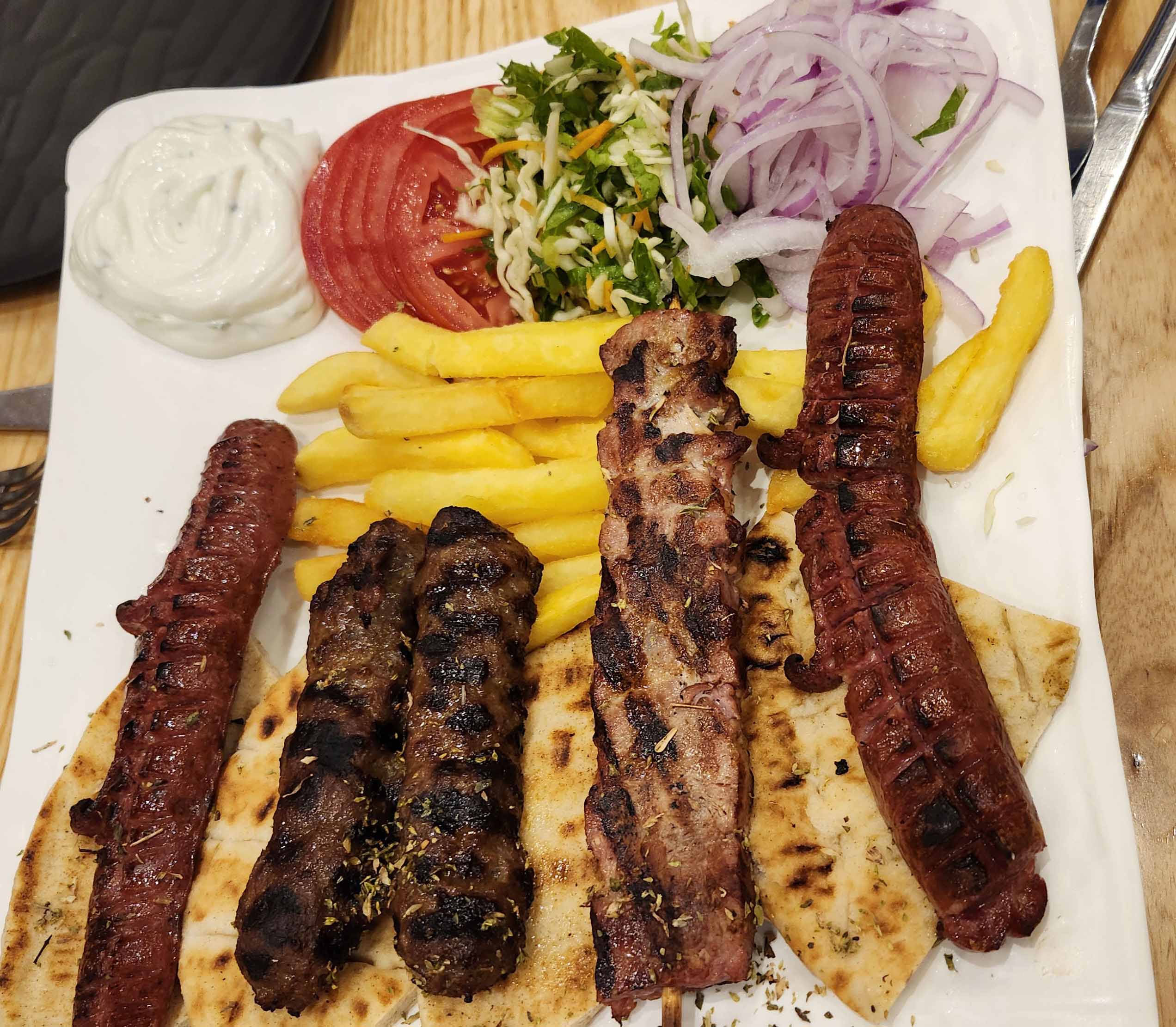
As it was late in the afternoon, the light was very striking. It was breezy and pleasant. Then it was time to head back to the water taxi, and Mykonos. Kathryn and I arrived about dinner time, and set out to find a unique and economically priced restaurant. George told us that the places on the Mykonos waterfront are not only overpriced but charge a reservation fee! So we prowled the back streets. It was there that we noticed a guy walking by with a to-go food box. We asked him where did he get that? It was a place called Sakis, around the corner, and he said it was great! We checked it out and scored big time! It is an “over the counter” style eating place with shared tables. Not a restaurant with servers. So, we ordered from the counter and found seats. It wasn’t long before we were joined by other guests, and then a street artist. We gladly shared our stories! This turned out to be pure joy. And my meal was only 9 Euros! Wow!
This was a lot of food. And so fresh. Over fed, completely stuffed and happy, we waddled back to the water taxi station out on the waterfront. There, we found Mario, Ingrid and Natalie too! So all in all, my Mykonos – Delos experience turned into one of the crown jewels of this Greek vacation.






































 Cabin Fever Chronicles - Getting Outdoors with Rod