After a frustrating period of stubbornly cold and cloudy weather, the weekend of May 8-9 dawned beautiful. And I was delighted to take advantage.
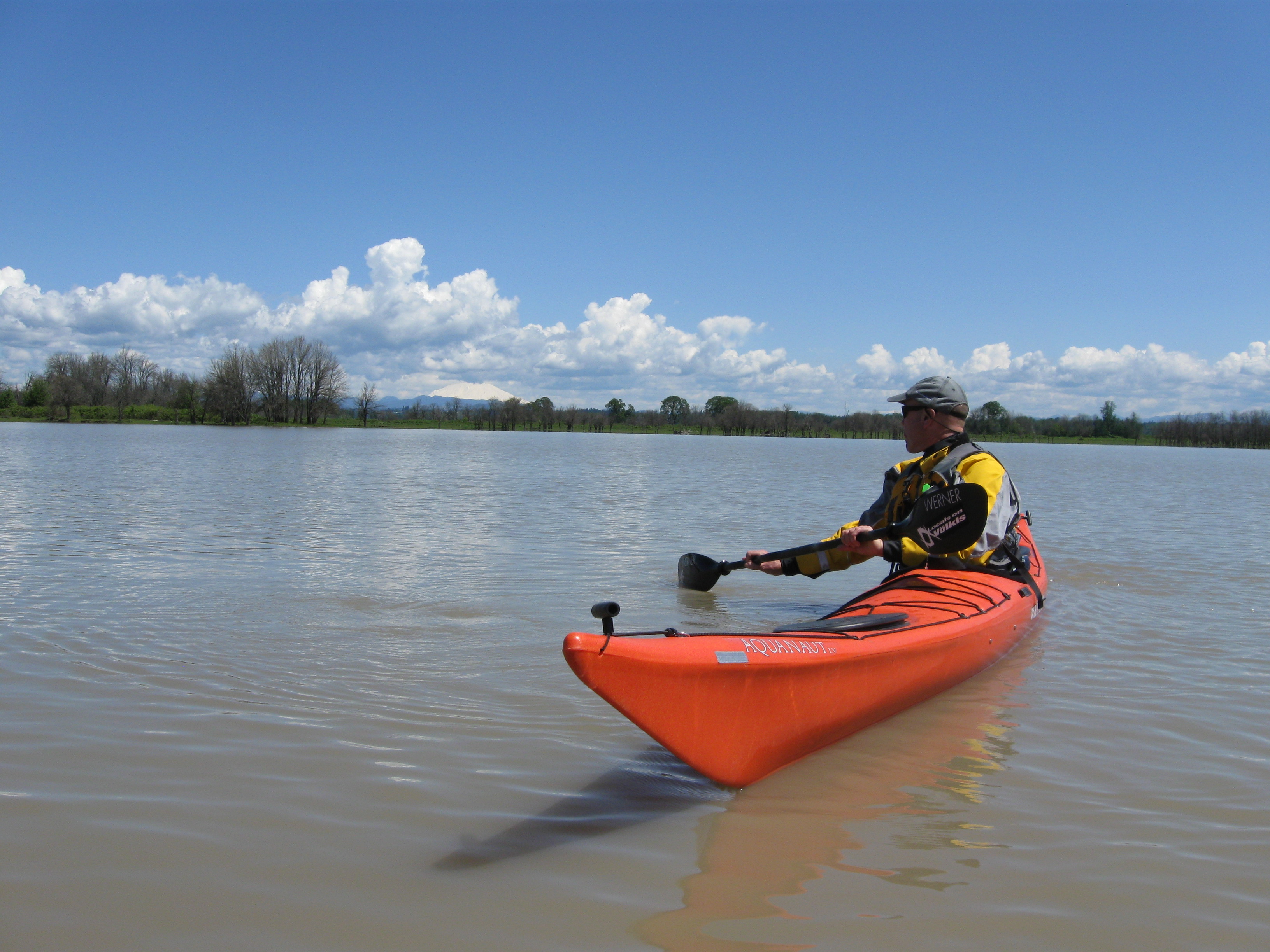
Looking back at Mount Saint Helens from Sturgeon Lake
OOPS had a scheduled trip around Sturgeon Lake and into the Gilbert River – I was fortunate to grab a last minute spot.
I used to live in Washington, DC and in the summer we’d visit Maryland’s Eastern Shore. Every time I cross the bridge over to Sauvie Island, and drive a mile inward, I’m transported back there. It’s flat, with old hardwoods, cows, fences, farms, and produce stands. All things one would see on the Eastern Shore. Except for the majestic snowy Cascade peaks in the background.
Over the years, I’ve talked to a lot of paddlers who’ve said good things about Sauvie Island. I’ve been there a number of times without discovering anything to say positively about paddling it. This weekend I learned why. The reason is timing. When I’ve visited the island in the past, it’s either been in the summer or hunting season. The little shallow lakes were always full of disgusting green water (due to cow poo) and there were cows everywhere. I remember walking past cow manure to the shore. One time it was so muddy you couldn’t get to the put in. In hunting season, it’s closed altogether.
This time, though, it is mid spring. The water was, well, brown/muddy, but at least it didn’t seem a poop lake. The day was as picture perfect as can be, some trees were flowering, the sky blue, and views of the Cascade peaks as glorious as can be.
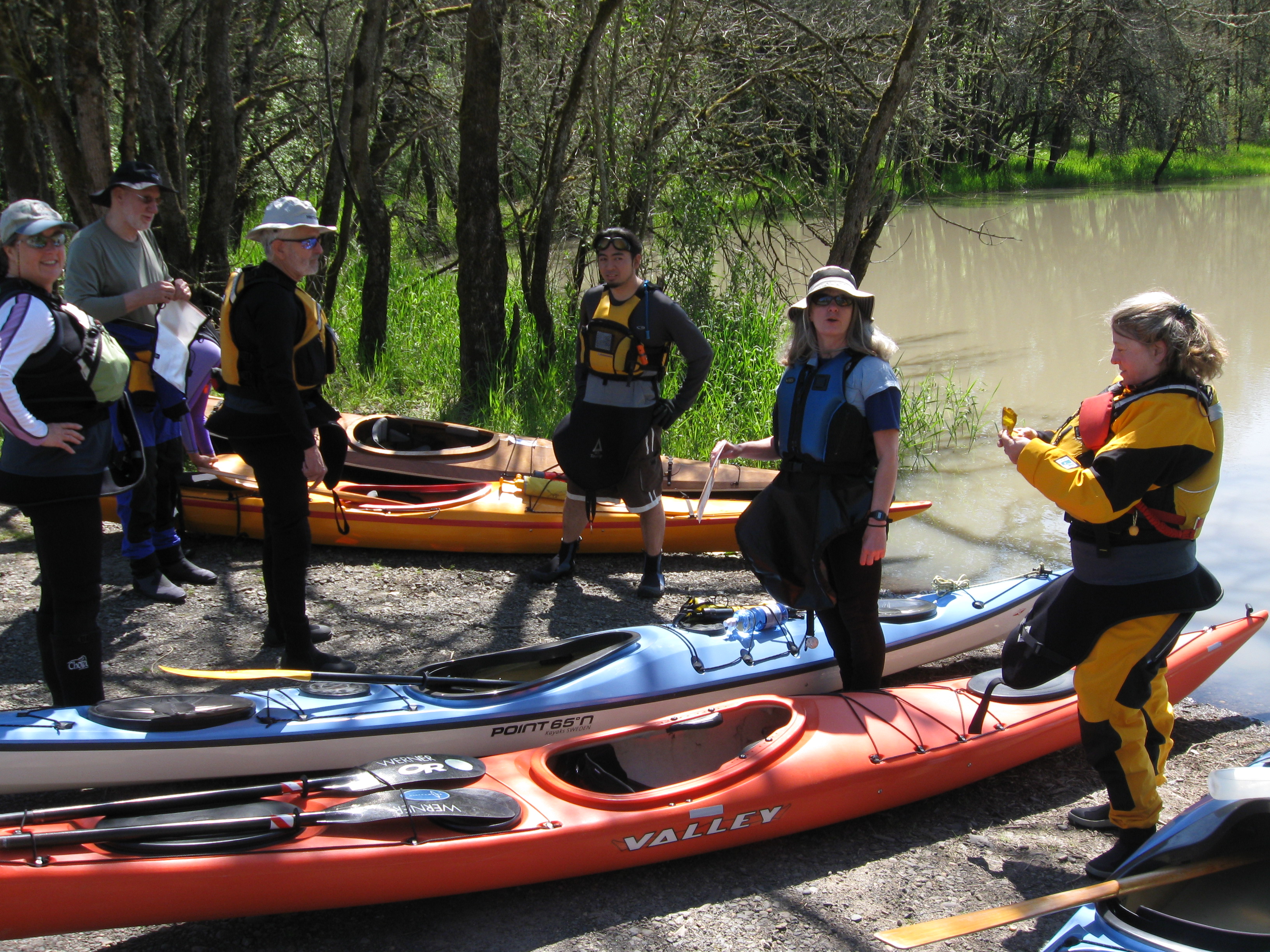
We suited up, got through the safety talk and headed out. I was thankful to not be leading a trip for a change! Nice to just paddle along. The total mileage was to be 10 miles – most I’ve done this year on the injured shoulder.
We cruised along through Sturgeon Lake. The water was muddy everywhere, and at one point it was so shallow each stroke left a swirl of mud behind. Then, even shallower, paddle faces were covered with mud after a stroke. Out in the widest part of the lake I could see carp jumping in the distance – when we drew closer, it became evident there were thousands of them, and they bumped up against my boat and sometimes my paddle would smack into them! That’s a first.
All during the day, we saw adult and immature bald eagles. Some were pairs circling in the sky, while others were perched regally on overhanging branches. Used to people, none of them even flinched when approached. We also saw plenty of blue herons, wrens, red winged blackbirds, carp, and turtles.
Turtle Party!
Today’s trip required a small portage. When we arrived at the spot, we paused for lunch. Nesting birds were not all that pleased with us, squawking their disapproval. The put in was a bit tricky as the water deepened quickly right at the shore. Where I put my boat, it was a muddy incline, and just before I was to alight my kayak, I slipped, and my drysuit became mud-caked! Once back on the lake, we soon rounded a bend and started down the Gilbert River. This stretch is clearer and deeper. It eventually leads to the Multnomah Channel. Along the banks of the Gilbert River picnickers and fishermen were clearly enjoying this fine spring day!
Smith and Bybee Lakes are an urban wildlife enclave
Ready to roll down to the put in
in North Portland, Oregon. Driving up there I thought I was headed into an industrial zone, which I was. The parking area sits right opposite a rail yard. Planes coming and going to Portland Airport glide in the distance.
Yet here is a tidy wildlife preserve tucked in the midst of all this. There is over a thousand acres of preserved wetland. Many species of birds make the place home.
Four of us met and set out onto the lakes. The weather forecast for this night was for sun – and of course they were wrong, as they have been for the past two weeks. We got there and instead of a lovely sunset the sky was full of storm cells. Nevertheless, we lucked out. We didn’t experience any rain, though all around us it looked threatening!
Sarah styling!
Heading out!
We saw five beaver dams. Lots of ospreys. Red winged blackbirds were everywhere in the trees. All in all, it was a really pleasant evening! We were glad to be there.
I’ve been paddling Werner and AT carbon paddles for years. One thing I’ve discovered is that my feather angle for the blades has narrowed with time. At one point 45-degree feather seemed right – but these days, I’m using a 30-or 15-degree feather.
At one point in 2009, I had both 45-degree paddles and 30-degree paddles in my quiver. I found both paddle strokes and rolling to be an adjustment with switching paddles – actually annoying. So toward the end of the year I conformed all the fixed feather paddles to 30-degrees.
The other elements are length and paddling technique. Some paddle blades are longer – for low angle paddling, while others are fatter – for high angle style paddling. High angle paddling is associated with power and is 100% used in surf / whitewater. Low angle paddling is more tied to long distance paddling. Theoretically one would get more fatigued using a high angle style on a longer day paddling.
For whatever the reason I seem to naturally prefer high angle paddling style. I’ve owned the Werner Corryvrecken for four years and the low angle Kalliste three years. I seem to feel natural paddling the Corryvrecken, with the caveat that its blades are gigantic, so it makes me a bit more tired. I’ve found my Kalliste frustrating because I just don’t like a low angle style – but also, I’ve found myself having to correct my index in the middle of paddling. Also it’s a 220 cm length, and for some strokes it seems awfully long. I asked some people at local paddle shops and they felt maybe my paddle shaft issues are that it’s a straight shafted paddle – maybe my hand slips as I’m not feeling the index as well as the bent? Not sure.
Enter the Cyprus. It’s a high angle style paddle with a medium blade. I wondered if I’d like this one. I know three people using it.
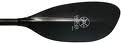
Werner Cyprus Blade!
So, in a conversation with instructor and 2-star BCU Coach awardee Teresa Webb, she offered my her bent shaft Cyprus to try while she was on vacation.
I took it down to the river to quench my curiosity. Twenty feet from the shore I knew I’d found my friend. This blade and paddling style just feel right – like an extension of my body. Not too over this or that, just right. Not only did it feel better for forward stroke, but in bow rudders and draws the length and blade size were just right – this paddle feels like an extension of my body!
So, I went up to Alder Creek to spend the credits I earned from working the paddle festival! And it was on sale! So a $465 paddle cost me $155! SWEET DEAL! Now I need to find some stickers for it.
I’ve been skiing all my life. One of the golden rules of the sport is get boots that are right for you – boots that have good performance, fit and comfort. Once you’ve got ’em dialed in, you can use them for years, well past skis that wear out.
Such is the case with my past two pairs – Lange Tii and Tecnica Explosion8. Each I loved, each delivered and each I owned for years. The Explosion 8 was still going strong this season. But I’ve learned the newer boots are designed with a new flex pattern specific to the latest generation of shaped skis.
That flex pattern is softer forward but just as stiff as before laterally (side to side). Older straight skis and earlier generation shaped skis were thinner and longer. The skier used forward pressure over the front of the skis to initiate turns. But today’s skis have deeper sidecuts and are all shorter and wider. This requires a different skiing style and therefore different boots have been developed.
Today’s boots are designed for a more upright stance with softer forward flex. Turns are initiated by “rolling” the skis on their edges.
With that knowledge I figured I’d try to take my chances and see what kind of after-season deals I could find at Hillcrest Ski and Sport in Gresham, Oregon. Greg Coulter, who’s been there for years, is a master boot fitter so he’s the man.
Rossi sans style
I tried three boots, one, Nordica, was too big, and another, a Dalbello, had a strange three-buckle/cable system. The last was a Rossignol, which thanks-a-lot was all white. It’s the SAS Pro 120. This boot’s a freeskier boot. I remember my friend Ed was all embarrassed this spring when the “right” boot was an all-white Salomon! They didn’t have any others in my size. The Dalbello and Rossignol fit pretty much the same. Regardless of part of me trying to say “it’s OK to try new things,” the wise part said, “don’t buy those Dalbellos. You have been preaching for years about sticking with a 4-buckle boot!” So I wound up picking the all-white boots!
Now, the question is, what to do with the blank slate?
Local film provides first hand look at unique dam removal and restoration project in the Wind River watershed in the Columbia River Gorge – The Wild River Restoration Night.
On Thursday, May 13th Crag and Gifford Pinchot Task Force will host the Wild Rivers Movie Night at the Hollywood Theater. The evening will feature the Portland Premiere of Trout on the Wind, a locally produced documentary about the removal of the Hemlock Dam from Trout Creek in Washington. Trout Creek is a tributary of the Wind River in the Columbia River Gorge, and in the summer of 2009 salmon and steelhead made their way up the creek without the aid of a fish ladder for the first time in decades. The Forest Service worked with local organizations, contractors and citizens to joined forces to remove Hemlock dam and restore over 20 miles of prime habitat for Columbia River Steelhead. This film provides a first hand look at how this successful restoration project was accomplished from start to finish.
Three additional selections from the Wild & Scenic Film Festival will be shown, including John Waller’s Ascending the Giants, the Good Life Parable: An MBA Meets a Fisherman and a short called SalmonsKin by Thomas Dunklin.
All proceeds from the showing will benefit the Crag Law Center and Gifford Pinchot Task Force. Crag is a public interest environmental law center that supports community efforts to protect and sustain the natural legacy of the Pacific Northwest. Gifford Pinchot Task Force supports the biological diversity and communities of the Northwest through conservation and restoration of forests, rivers, fish, and wildlife. The two organizations have worked together for many years on projects in Washington, played a role in the removal of Hemlock dam and restoration of Trout Creek.
May 13th, 2010, Doors 6:30 PM at the Hollywood Theatre, 4122 NE Sandy Blvd – $7



 Gresham, Oregon. Greg Coulter, who’s been there for years, is a master boot fitter so he’s the man.


