Trekking Peru’s Cordillera Huayhuash: To the Continental Divide

29 07 2017

Today’s plan starts at 13,776′ Cuartelhuain, climbs over our first 15,000’+ pass at 15,387′, and then we’ll descend to our camp at Janca at 13,940′. So today is the test I must pass if my conditioning and our acclimatization days have prepared me. I know I’ll see vistas indescribable to people back home, and experience physical and emotional feelings both excruciating and exquisite. And beyond today, there will be more 15,000′ passes and a 16,000+’ pass coming up.

So, what’s starting and ending the day like on the trail? Well, unzipping your tent you are likely to be greeted with eye popping views. And then, staff comes with warm beverages! After that, staff delivers hot water for washing. At day’s end, you arrive in camp with your tent set up and duffel bag inside. Staff brings warm wash water. And then about an hour later there’s “happy hour” in the mess tent, at which snacks and coffee/tea are served.

It chilled off last night to about 30 degrees. Ice crystals formed on the underside of my tent fly. The stars were incredible, with the Milky Way and Southern Cross right on top of us. But as the sun rose, it bathed our valley in motivating warmth this morning. With breakfast done, we are on the trail by 8:00 a.m. We are all dressed in removable layers – because we know we’ll be working hard climbing and the temperatures are going to rise.

We leave as a group. I stick behind local guide Roger, who, I discover, has this amazing slow pace so that we can make it over these passes. He keeps looking back, checking to see how the group is coming along. The other local guide, Anna, plays “sweeper,” going last, ensuring everyone makes it. Right behind Anna is Manuel – who is managing our “just in case” horses. About 90 minutes into our hike, the camp crew comes through with our parade of llamas, horses and donkeys! It is quite a show. This, plus the view, has me giddy. But then something happens. I am exerting so much I can’t remember the name of the trek I am on. YIKES! I realize the altitude is getting to me. And, the urgent breaths, plus the dry air, are making my throat sore. So, I start sucking on one of the hard lemon/lime candies I took for snacks. And I play a game in my head remembering the other treks, the Cordillera Blanca for example. Then it comes back, I am on the Cordillera Huayhuash. Well, that was alarming. But at least I was cognizant enough to be alarmed!

After a rest stop, Cathy Ann reminded us to pay attention to our steps and our breathing. Remember, the breathing gives oxygen to our legs! Sometimes, too much talking or socializing takes a toll. So right now, I pay strict attention to breathing and to matching Roger’s footsteps. Then I notice way up ahead – WAY UP – our crew hiking with the llamas! OMG. That means WE have to hike up there. Then somebody calls out, “Condors!” Just glimpsing these incredible creatures gliding up above made me temporarily forget my challenges. And then, Roger points to the pass. I will make it!

We make this 1st pass! This is the continental divide of South America. To one side, all rainwater goes to the Pacific. The other – to the greatest river on Planet Earth – the Amazon. We’d linger up here some 15 – 20 minutes, and then, time to descend to our next camp, at Janca. The hike to Janca was much more relaxing. Once off the pass, it was a long gradual descent.

Cuartelhuain wakeup1

Janca, from my tent!

A well deserved relaxation at Janca would be in store. There, we’d be treated to views of 19,000′ plus peaks of the Cordillera. I’d get my hot wash water, and then a nice hot beverage social hour after that. Trekking is good!

Janca shave

That hot water is most welcome. Time to wash up and heck, why not have a shave!

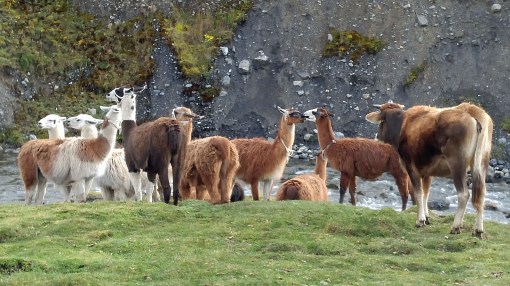
Our llamas are a bunch of characters. They hang out together, and once in a while, local “folk” greet them and ask how things are going.
Janca Llamas2

The light made for some sweet photo taking opportunities.

Janca Andrew M

With dinner finished, it’s time to bed down because tomorrow promises a day packed with adventure! We are told tomorrow’s lunch, and camp, offer unsurpassed views.


Trekking Peru: The Cordillera Huayhuash – Acclimatization Days 1-2: Huaraz

10 07 2017

20170619_100215

Here we go! This the first of about a dozen blog posts covering my June 2017 trek in Peru’s Cordillera Huayhuash! This was a big deal. Back in 2007 I did a Himalayan trek of Bhutan’s Chomolhari with Cathy Ann Taylor, and it stuck prominently in my mind. I watched her Cattara website for an Andean trek and when this one popped up I jumped at it!

These treks are simply the “bee’s knees” of hiking/camping trips. They involve undertaking the “ultimate challenge” level of athletic perseverance and mental toughness. Hiking 8 a.m. to 3:00 p.m. day after day at altitudes ranging from 13,500 – 16,404. All that effort is rewarded with beautiful, dry weather, flowers along the way, and views so spectacular as to literally defy description. But there is more: You don’t have to carry a big pack. Or cook. Or set up your tent. Staff brings coffee/tea to your tent to awaken you in the morning. And, they bring you hot wash water morning and after your hike. On this trek, we even had a portable shower – and one of our stops was at a thermal bath!

Why do these treks? I’m sure everybody has their own reasons. For me, it’s the chance to see mountains so big they are unimaginable at home. To conquer the athletic challenge. To completely disconnect from the snowglobe of distractive thoughts and temptations that are the Internet, e-mail, news, and ties to home. To peel off layer after layer of that routine, getting to the core and reconnecting with natural rhythms once again. For it is only then, free of the pull of those “can’t waits,” that things start to get back into perspective.


Huascaran from Airport

22,205ft Huascaran towers over the airport at Huaraz, Peru


There would be 13 trekkers on this trip. We all flew into Huaraz to meet Cathy Ann (CAT). Our first two days would be acclimatization days, staying at the Hotel Club Andino. Huaraz, with a population over 100,000 sits at 10,150ft. At this altitude even climbing the hotel stairs was a struggle! But we’d have to do more – for our very first camp would be at 13,776ft!

Hotel Andino is a Swiss-owned Euro-style hotel perched on a hillside street at the top of town. Rooms have a mountain view and the restaurant is 1st rate.


20170618_064954

View from my room!


On day two, the plan was a 4-mile hike at Huillcachocha Lake, up to 12,650 feet. We hiked to a rock where Inca sacrifices were performed. From this hike, we had horizon to horizon views of the entire Cordillera Blanca Range! And we encountered some local families going out for the day.

Family_edited-1

To me, the thin air and exertion of this “warm up” hike seemed like the max. But I knew in the next two days we’d be hiking to over 15,387′ and yikes. Can I do this? Will I make it?

The staff was excellent, making a slow, do-able pace. And they let us take breaks to get water, snacks, and adjust our clothing. The views would be one thing that would keep me going!


Cordillera Blanca Pano

View of the entire Cordillera Blanca! It’s the range next to the Cordillera Huayhuash.

CAT shows map

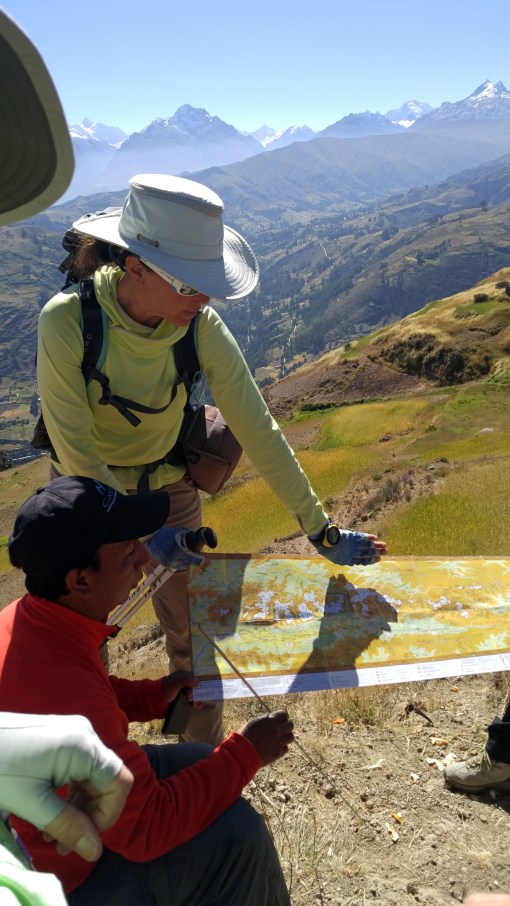
CAT and our local lead guide, Roger (pronounced “Roher”) of ExplorAndes, show us a map of the area

Rod and Anna

Myself with Anna, local Assistant Guide

So, how much equipment, staff and stuff did this 12-day expedition take? 10 Llamas, 16 donkeys, 2 “emergency” horses, 13 staff, kitchen tent, meal tent, a dozen or so Eureka! tents for guests, plus food and emergency gear. Yes, we had supplemental oxygen just in case. Quite the production!


The day’s acclimatization hike complete, we enjoyed a terrific welcome dinner at the hotel. Tomorrow, we’d be off on a 5-hour drive to our first trek-camp!

So, you may ask, “How do I prepare for such a trip?” Answer: 4 months of preparation. Lots of cardio. Running is fine, but about six weeks before the trip, switch to hour long hikes/walks. Four times a week. Hikes with elevation gain are the best preparation because instead of static roads, you’ll get the benefit of walking amongst rocks and such. Even better, hike with a 20 pound day pack. Because on the trek, you’ll be carrying a day pack with rain gear and layers, plus two liters of water.

OK, upcoming are a series of posts from the trail! Passes, 20,000 foot peaks, avalanches, glaciers, emerald lakes, Llamas, and flowers galore! Stay tuned.


Snorkeling in Nha Trang, Vietnam

17 01 2017

Our destination after Saigon was the coastal town of Nha Trang. After the noise, congestion and pollution of chaotic Saigon everyone was looking forward to some quiet time by the sea. Well, we were completely unprepared for what a mega town it is. Nha Trang is far from a sleepy beach town! It’s got 35-story hotels and boasts a population of over 400,000! So much for the Margaritaville experience. More like Atlantic City New Jersey or something! Nevertheless, I was able to get some decent snorkeling in.

The week prior to our arrival it had rained hard. So hard that runoff turned the sea brown that week. I was concerned the water would be too cloudy for good snorkeling. More than water clarity, I’d heard that many reefs in Asia were damaged due to dynamite fishing. In some places, people are so poor they don’t use nets or lines. Instead they blow up everything and haul in whatever floats to the surface. By doing that, they destroy entire ecosystems. Years before I’d snorkeled in Bali and it was tragic. The coral was dead. Only a few fish to see. I feared the worst.


blog2018

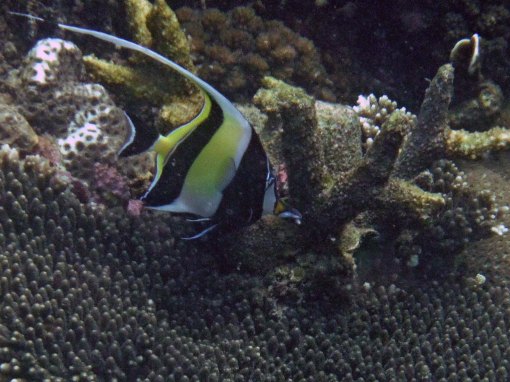
Well, well! Took a chance and was rewarded!


Nonetheless, six of us booked a boat to go out beyond the bay to Moon Island. We all said to ourselves, “Even if the water’s cloudy, heck at least it’s a boat ride, right?” Well, much to our delight, the water was clear. And the reef? Healthy!

The boat, which was also equipped with scuba gear, took us to a secluded spot maybe 50 feet from shore. I donned the mask, snorkel, and did my customary snorkel/scuba back flip into the water. The water was beautiful. Warm. Pretty clear! And the corals were so close to the surface, one only needed to drift along to view.

I’d been to Belize in 2014 and learned how to free dive. That skill came in handy in Vietnam. You simply take a breath, turn completely vertical, and allow your weight to sink you down. Sometimes having a rock or two in hand takes you down faster. This way, when you arrive down some 15-20ft, you have not expended energy to get there. My tour-mates were all amazed to see me down that far. Once down, you have a maybe half a minute to swim amongst the wonder. I found I got so intrigued that, when I needed air, I was suddenly freaked that I had 20 ft to rise!

It was a good day. We were all delighted we’d taken the risk because it paid off. Not only had we taken in some good snorkeling. But we’d escaped the busy hum drum of the Nha Trang waterfront!


Biking in the Rain in Hoi An, Vietnam

9 01 2017

dscf2035

On our bucket list for our visit to Hoi An was a morning bike ride. Hoi An is pretty flat, and the traffic moves at a pedestrian pace, so the slower, easy-going bike is a good way to enjoy the city and surroundings. But in November, Hoi An is known for biblical downpours, and we were not disappointed!

dscf2033

Cindy gets all custom fitted

The route would include gliding past wetland agricultural areas, villages, a food market, and then back along the Hoi An waterfront.

We’d been advised to carry water for rehydration, and to bring along at least a rain jacket.

Although we left by 9 a.m., it was already very humid.

It doesn’t take long in Vietnam to get sweaty. We got our bikes, moved the seats into correct height, pumped up the tires, and we were on our way.

We began pedaling along streets in town and soon headed out to some submerged farmland, where we rode along paved berms in between fields. I was unsure to call them fields or paddies. They seemed to be growing rice here, but also there were other crops, too.

dscf2040

We encountered a farmer riding his water buffalo. The water buffalo was very much focused on his breakfast of grass.

And then, without warning, the fire hose turned on! When it rains in Hoi An, all you get is one or two drops notice before the bucket is thrown at you! It rains so hard that no technical outdoor gear can stand up to the humidity, your perspiration and the volume of water coming from the sky. You are going to get soaked, and anything in your pockets, too.

dscf2042

Kristi and Cindy at the market

Instantly every local is donning ponchos. Rain doesn’t slow them down one bit. We paused for a visit at a local fresh food market and holy cow rain was cascading down on everything. I had a waterproof camera, but the lens got droplets on it!

Regardless of the monsoon, business must go on! They were selling everything. Produce, fish, chicken, pork. I saw a wahoo, lots of crab and some oysters, too.

Once the rain let up we got back on the bikes and headed back to town. But my bike broke down. The right pedal crank arm just slowly weakened and fell off! Metal fatigue. So I limped back using the left pedal only, until a replacement bike could be found. Back at the hotel, soaked, I just jumped in the pool. It was quite refreshing! And while there, another sudden downpour fire hosed me from above. But, since I was in the pool, it seemed refreshing.

If you are visiting Hoi An Vietnam, definitely try a bike ride. It’s a nice way to go!


Hoi An, Vietnam: City of Lanterns

28 12 2016

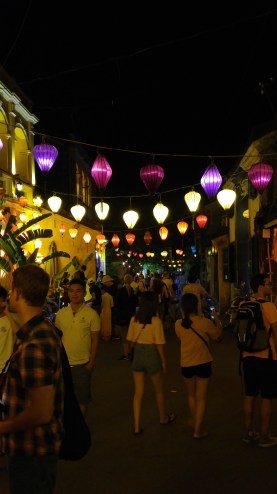
20161116_205006

Our Vietnam trip began with big cities, and we were in need of relief. Saigon, with over 10 million population, biblical traffic congestion and pollution was becoming exhausting. It made us yearn for something more intimate. But up the coast, what we imagined to be a peaceful seaside town, Nha Trang, turned out to be more like Atlantic City New Jersey, its beach lined with 40-story hotels and booming boardwalk. Hoi An would be the antidote we needed.

Hoi An was once one of SE Asia’s most visited ports. Its docks hosted ships from as far away as India and Europe. The architecture has roots in Japan. If its river had not shallowed due to silting after a major flooding event in the 1800s, Hoi An would no doubt still be an industrial magnet. Once the river became too shallow for big ships, other ports took up the trade and Hoi An’s economy collapsed. But its historical significance and beauty caused both sides in the Vietnam War to agree to declare the city off limits to fighting. As such, it retained its character until the 1990s, when Vietnam opened up again. It’s been designated a UNESCO World Heritage Site. Tourism  opportunities were realized, and Hoi An Town was declared a walking-only district. Today, one can stroll the streets free from choking, honking motorbikes and cars. Of course, that means the tourists come in throngs. Nevertheless, especially in the morning, Hoi An can be quite relaxing and charming.

We lodged at the Hoi An Lantern Hotel, conveniently situated walking distance from the vehicle-free zone.

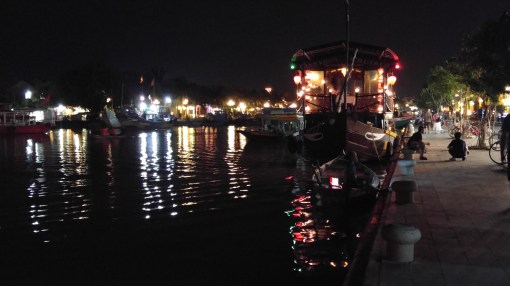
20161116_212500

Its rooms surround a nice pool. And I availed myself of its cool waters twice. One day, we had monsoon-like downpours which came without notice, completely drenching us on a bike ride. I returned soaked, and simply jumped in the pool!

In Hoi An, there are a number of top activities. Walking has to be numero uno. Just strolling around taking it slow is a good way to spend time.

20161116_183652

Along a canal

Renting a bike is another, and I’ll cover that is the next blog post. It’s easily pedaled. Sampling the cuisine, and taking cooking classes are not to be missed. Seafood, especially crab and dumplings are specialties. Some opt for a sampan ride. And of course the tailors. Supposedly Hoi An has 600+ tailors. So, if tailored clothing is your thing, you’ll love Hoi An. I don’t have much need for tailored clothing, and shopping is not my cup of tea. And frankly, the goods to buy in Hoi An are repeated over and over again all over the city. So walking early in the day, and just people watching were enough – plus some nice food!

I walked and walked, hunting for a crab lunch and boy did I find it! Two crabs with lots of to die for veggies. I risked a total stomach melt down on that lunch but it went well. There was no penalty for all those veggies! In SE Asia, you take risks when eating fresh veggies. You never know what might happen a few hours later!

A famous sight in Hoi An is the Japanese covered bridge. Reminded me of the Ponte Vecchio in Florence, Italy, with lots of tourists, and an exhibit inside. There, I was treated to some Vietnamese hospitality. I had an extra large umbrella from my hotel, and when I saw a friend, I dueled him with it. After some conversation, we were walking about two blocks away and I realized I didn’t have my umbrella! I headed back to the bridge, where I asked two police hoping to find it. Guess what? They actually had it for me!

There are some 800 designated historical buildings in Hoi An. Some are Buddhist temples of Chinese architecture, and entry to these is partially covered by a ticket folks must purchase to enter the vehicle-free zone. They’re worth exploring.

I kept walking back alleys, across the canal, to the part of the city nearer the sea. I was hoping to find a kayak rental facility, but when I got there, all that remained was a shell of an old boat. So, I stopped in for a hair cut.


$5 later, I was on my way. If you’re in Vietnam, I’d say you’ve got to visit Hoi An!


The Coracle: A Vietnamese Fishing Boat and Handy Dinghy

28 12 2016
20161114_083044

Paddling a coracle. The paddle is held on with a rope.

Along the Vietnamese coast and waterways, I couldn’t help but notice people paddling round basket boats. I’d heard about these boats and couldn’t remember what they were called. I thought they were found mostly in Europe, but here they were!  And I’d never seen one in person. Hot damn. I came to learn they are coracles. Not the most efficient craft for sure, but somehow, these craft have endured for centuries, so there must be positives for them to persist.

Some research reveals coracles have been used since the Bronze Age and apparently Julius Caesar’s army made use of them. Since then, the round boats have spread all the way to India and Southeast Asia. In Ireland, they are called Curragh, and in Tibet, Kowa. Traditionally a coracle is like a woven basket, with a layer of waterproofing on the outside. The waterproofing might be resin and tar, for example. Today such boats still ply the waters, though fiberglass and polyethylene versions are common.

My favorite memory of Vietnam was stopping by a fishing village where coracles were the primary means to get to the quarry. We walked through the village, and its inhabitants were not used to seeing Westerners at all. They looked at us with a bit of trepidation. We learned they were concerned we might be prospective real estate buyers. As if we might buy their whole village. There has been so much development on the Vietnamese coast that their way of life is endangered. No, we were just tourists having a look. Children squealed with excitement to have visitors, though, lining up to high-five us. And then we had offers of food and fish.

20161115_154808

Net repair

Walking through, we saw life as they live it. Cooking meals over coal-fired stoves. Knitting or repairing clothing. Kids playing.


20161115_155014

Some coracles had motors

Out on the beach there were dozens of coracles plus some larger boats lined up. Folks were mostly immersed in maintenance tasks.

Some were fixing nets, some working on motors. Others were caulking the older style basket coracles.

I could have spent a whole day working with these people. Just to get a glimpse on their way of life would be fulfilling.