Kathmandu: Bhaktapur and its Durbar Square

29 11 2018

We spent another day exploring Kathmandu and surroundings. We went to visit the ancient city of Bhaktapur, which is at once ancient, artistic, architecturally stunning and mystical.

20181105_120637

The Golden Gate in Durbar Square

One my favorites is the Golden Gate, a delightfully preserved example of metallic art. It shows up top Garuda battling with serpents, over Taleju Bhawani, the goddess of the Malla Kings.

20181105_120201

The Palace of 55 Windows

Right next to the Golden Gate is the Palace of 55 Windows. It is named for its 55 balconies. It is used for royal ceremonies and has been such for centuries. It has incredible detail, a testament to the woodworker’s craftsmanship.

20181105_120628

Like elsewhere in Kathmandu, many buildings and temples were severely damaged by the 2015 earthquake.

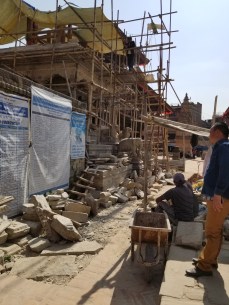
Here in Bhaktapur, things are no different. Workers may spend years repairing priceless structures important to Nepal’s heritage.


Daily offerings are part of Hindu practice. In many places throughout my trip, I saw offerings being made, or evidence of them.

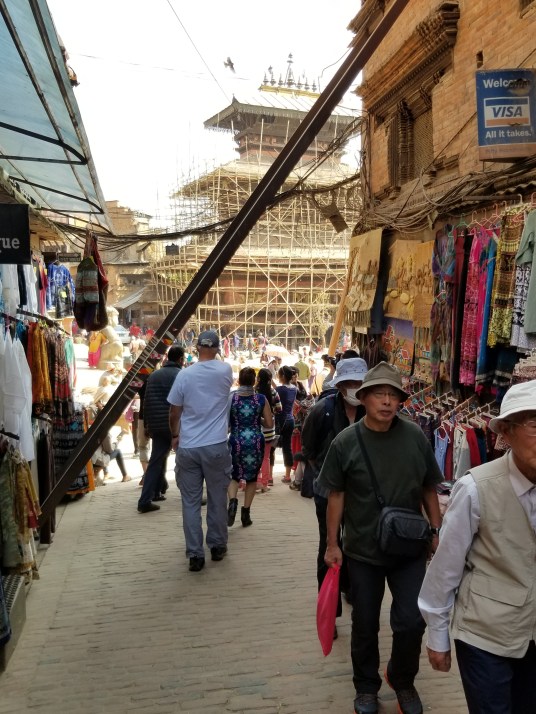
We then strolled down alleyways lined with shops to a square dominated by the Nyatapola Temple which dates to 1702.

20181105_122203.jpg

It is a beautiful square, and due to the Dipawali festival, sellers of festive goods and foods were allowed to create a market to allow people to stock up for Wednesday’s big night.

It was mid-afternoon, and we returned to the Shangri La Hotel for a rest-up before our kick-off dinner at a Vietnamese restaurant. Tomorrow we fly to Pokhara, where a bus will take us to the trailhead where we start our trek to Annapurna!


Kathmandu, Nepal: Hindu and Buddhist Influences

27 11 2018
20181117_123203

Approaching the Boudhanath

Prior to striking out on our trek to Annapurna, we spent some time in Nepal’s capital city of Kathmandu. Taken together with the surrounding valley, the greater Kathmandu area has a population of about 5 million. Although Nepal boasts the highest mountains in the world, including 29,029′ Everest, most don’t realize much of the country sits at lower elevation, and Kathmandu is at 4,600 feet.

20181105_152612.jpg

My flight to Kathmandu took off from Guangzhou, China, and I was fortunate to sit next to a couple from Kathmandu – now living in Sydney, but who were going home for the popular 5-day Hindu festival known in Nepal as Dipawali – the festival of lights. They told me how the whole city would be lit up like Christmas. And, on Wednesday night, the darkest night, the children go house to house like Halloween and sing songs and get offerings. It is a celebration of light over darkness – and knowledge over ignorance. They said that every household goes out of its way to be clean and beautiful. That got me really excited! Though we would be leaving the city before the climax.
20181104_133519

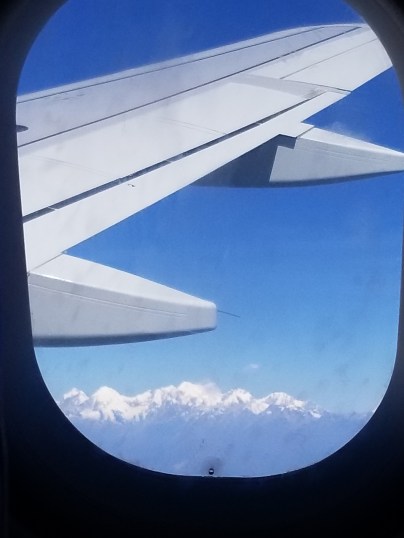
The giants come into view!

I was also fortunate to be seated on the right side of the plane, so I could see the Himalayas of Bhutan and Nepal! We even saw Everest.

Upon landing, the reality of life on the subcontinent strikes hard. Time slows, and strict schedules suddenly fall away. I knew about this, but jet lag was coming on strong.

Several flights landed almost at once, depositing some 600 jet lagged passengers to be processed by less than 10 officers. The lines didn’t seem to move. In my line, I looked up, and the officer went to lunch! I switched lines, only to have the last person in front of me have a problem and take 15 minutes.

And if that wasn’t enough, there was more! They require another X-ray of bags. And this time, the officer was too busy chatting with buddies to even look at the screen. Finally, I reach the passenger pick up outside the terminal and yell, “Cattara!” hoping a driver was waiting. One guy came over anxiously, but it turned out he was not my driver. Fact was, it took me TWO HOURS to get through immigration, so long my driver went to lunch. And this guy was there in his place. Not to drive, just meet me. About to pass out from jet lag and unable to untangle my brain, I just waited. And waited. And waited. Until I almost couldn’t stand it, and I considered getting my own cab. But then, experience told me, “No, let these people do their jobs. Don’t embarrass him by taking a cab. Save face. It will work out.” And just like that, Karin, my driver, showed up from lunch and I was on my way to the Shangri La Hotel.

If I hadn’t been to other cities such as Saigon, Denpasar, or Phnom Penh, I might have been completely overwhelmed by the rules of the road in Nepal. While it seems like a constant game of “chicken,” and maybe it is, and sometimes cars, buses, motorbikes, bicycles, cows and pedestrians seem to be going in all directions at once, including head-on at you, and sometimes they indeed are, there is some kind of orchestrated dance going on. How do you walk across the street? I remember my first Bangkok guide teaching us. She said, “Just walk, slowly, deliberately, through the traffic, and look at the drivers. Do not hesitate. They will move around you like a school of fish.” And they do.

We reach the Shangri La Hotel. It is a true oasis in the chaos. The rooms are lovely, and there is a wonderful 1/2 acre sized lawn/garden area out back.

The staff at the Shangri La are very courteous and prompt. I had several issues in my room, including a bad electrical outlet. When notified, the staff arrives promptly and takes care of the issue. But it’s more than that. The staff remembers who you are, and takes care to remember the little things. In fact this characteristic rang true for the entire trek as well.

One my rooms at the Shangri La was spectacular.

Kathmandu hosts some of Nepal’s holiest Hindu and Buddhist temples and World Heritage sites. So I began by heading to the Boudhanath and the Pashupatinath. I hired a guide through Cathy Ann to take me there.

The Hindu Pashupatinath Temple complex, reconstructed in the 1400’s, houses no less than 492 temples devoted to different rites. It was overwhelming, busy, and frequented by visitors from near and far. Brahman priests hold court for people seeking certain rites to be performed. Some of the interiors of the temples are off limits to non-Hindus.

One of the most important duties this temple complex carries out is the cremation of the dead. Hindu practice requires cremation by 24 hours of death. The complex is bisected by the Bagmati River, and it is on the banks of this river that cremation, and the drama of loss and grief, takes place. And I was there to witness all of it.

There are dozens of Hindu sects in Nepal, and each has its own cremation rituals. But for each, they take the body of their loved one to this place, where the body is consumed by fire, and the “spirit,” if you will, is allowed to leave and find a new vessel in which to live. There are perhaps 20 stone platforms along the river.

20181117_113225

A loved one’s body is turned 3x clockwise before laying down on the pyre.

A specialized Brahman is trained to carry out the rite. He lays specially cut logs on the platform. Then a body is carried to the site and spun three times clockwise, before laid down.

Once down, depending upon the sect, men, or men and then women, walk around the body three times clockwise.

I saw one woman ask to see the face of the dead. She was so shocked or grief stricken at what she saw that she fainted and had to be carried back to the steps to recover. This is the drama that is death.

Once the family has retreated, the Brahman can begin the process. He anoints the entire body with camphor oil. The first step in cremation is lighting the head. So I witnessed the priest removing the saffron colored body covering from a body’s head, and lighting it. After a short time, the priest continued lighting the logs underneath. I also witnessed the priests stoking the cremation, and then, when done, sweeping the ashes into the Bagmati River. It is very moving to witness this human drama.

20181117_123447

The next temple complex I was to visit was the Boudhanath, one of the holiest Buddhist stupas in the country. I knew it was also one of the largest stupas in the world. When I arrived, I was first amazed at the condition of the roads leading to it. They are just dirt. My guide Bir told me that the condition of the roads was due to bureaucratic gridlock. The clean water bureau, the sewer bureau and the transportation bureau all wrung their hands and nobody will move forward to get the street constructed properly. Until then, the street remains dirt. With some big sewer pipes just in piles!

This Buddhist stupa is very important to millions. And there were thousands here paying their respects. There are prayer wheels surrounding the stupa and many were walking around it, spinning the wheels in respect. The levels of the stupa represent the levels of attainment one must pass to reach nirvana. Only the very top represents attainment of nirvana!

We visited a school where students create Thankas, paintings usually depicting a Buddhist deity, scene, or mandala. In their finest and most detailed form, a Thanka can take many weeks to finish. My favorite is of the Tibetan Buddhist Wheel of Life.

Thanka Wheel of Life

I loved this because here, life is set up as a kind of “game” to get to Nirvana, represented by the figures on the upper right and left. Below, the spirit recycles through the six realms of existence of Samsara, some better than others. If you vary from the path, you might fall into the realm of animals, or jealous demi gods, or some other form of desire or suffering. Only by following the true path can you jump into the upper right of left.

So, what was Rod to make of this? It is a perfect pin ball game! Set it down, tilt it, and insert into a pin ball machine. Add flippers, and you get the point. Any mistakes and your pinball goes down the wrong hole, and back into Samsara. Only the exact correct combination of flipper flips can get that pinball into enlightenment!

Next up we pay a visit to some of the outlying temples near Kathmandu, Bhaktapur!


Nepal Annapurna Sanctuary Sacred Trek: Trekking in a Tutu for Breast Cancer Prevention

25 11 2018

20181106_173912

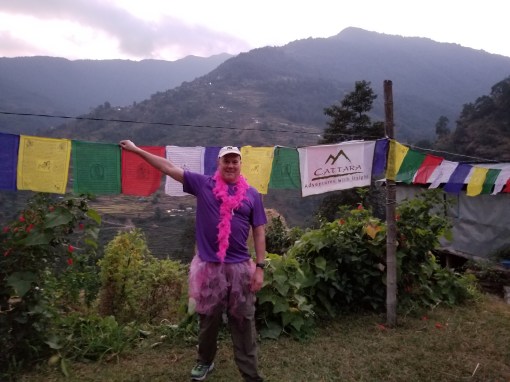
2018 has been a tough year. In February, I lost my brother John to cancer, after a two-and-a-half-year battle. But on the positive side, my friend Shari has come through a courageous struggle with breast cancer. I have watched and rooted, I’ve been lifted when they were on the mend and pained when the battle seemed for naught. I swear, cancer treatment often seems like witch doctor medicine. I was inspired by their courage to trek in a tutu Nepal’s Annapurna Region to raise funds for breast cancer prevention!

Ever since I completed my first Himalayan trek, the Chomolhari Trek in Bhutan, I’ve been yearning to return to the greatest mountain range in the world, with its spectacular views, ultimate challenge hikes, and its myriad cultures and faiths. So it was that in 2018 I signed up for the Annapurna Sanctuary Trek led by Cathy Ann Taylor.

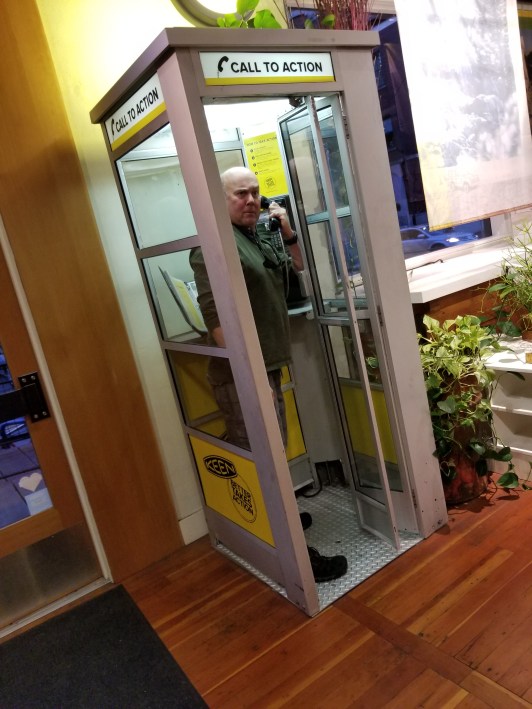
I love travel, discovering new cultures and perspectives, and I am hopelessly hooked on the outdoors. So this trek was in my wheelhouse. But what was in my wheelhouse, just for other causes was fundraising. I’ve been part of a number of non-profits, even been on the board of directors. So it was a surprise when maybe six weeks prior to the beginning of this trek, it became a “sacred” trek, to raise funds for Breast Cancer Prevention Partners. Cathy Ann named Joani Carpenter, a trekking peer from my Cordillara Huayhuash Trek as its honoree. Joani survived pancreatic cancer! My first reaction was OMG what have I signed up for? I’m already busy with fundraising! How can I add another? Then I found out fundraising was not a requirement. Still, over the subsequent days, I kept thinking about it. Then I was at KEEN Footwear in downtown Portland (one of my sponsors), and a heard a phone ring…I picked up the phone and the voice said, “Just do what you know how to do.” I heard a call to action!

20181011_183944

The next morning, I went to my gym, and as it was breast cancer awareness month. They had mannequins festooned with pink shirts, feather boas and tutus. As I did my abdominal routine a thought came to mind, “Trekking in a tutu!” And with that crazy idea in mind, I hatched a plan to raise funds by trekking in a tutu in honor of Joani, and of my friend Shari, who is a survivor, and in memory of my brother John.

At first I went out and bought pink stuff. That was all I knew. I got pink bandanas, a pink boa, pink shirts. Shari made a pink tutu. I made a pink social media post. I figured trekking poles, muddy boots, prayer flags and hash tags might do the trick.

20181011_153458

Shari and I even did a small barbecue and a photo shoot!

Then I learned the correct color is purple! Purple is the color for prevention. With only a week to go I got synthetic purple shirts and a purple bandana. If I got enough support, I’d get images of myself in that tutu in Nepal! I posted photos on social media, and sent personal ask letters. With just so little time I was surprised I was able to generate over a thousand dollars worth of contributions. And with that done, on trek, I needed to generate some content for the contributors! So, whilst in Nepal, I managed to get some images in that outfit, or wearing some of it!

OK, yes, there will be following posts of this trek! We managed to ascend/descend tens of thousands of vertical feet, take in views of the world’s giant peaks, meet people from dozens of countries, and laugh a lot. We struggled up or down tens of thousands of steps. We ? Me? Sweated a lot. We ate like royalty. We witnessed giant peaks and glaciers. We said “Namaste” a thousand times! We witnessed priceless sunrises. We bumped and grinded in 4x4s.


Wooden Ships, History and Paddling in Port Townsend, WA

21 09 2018
IMG_4749

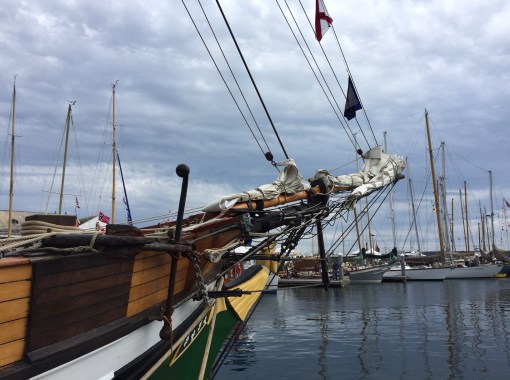
Schooner at the Wooden Boat Festival

My friends Suzanne and Bob Eggleston recently moved up to Port Townsend and I went up to visit. When you’re living in Portland, Oregon, it’s often easy to forget that a wonderful salt water recreational paradise lies a couple of hours north! Not only that, but many towns in the northern Puget Sound are in a rain shadow – they receive less than half the rain Portland or Seattle gets. This meteorological fact has attracted quite a few folks relocating or retiring.

Artsy Schooner 2

Port Townsend has quite a view. You can typically see not only the beautiful vessels in the harbor and the historic buildings, but Mt. Baker dominates the view east. Mt Baker is  10,781 ft and is very glaciated. But on this trip, smoke from wildfires in British Columbia obscured the view.

Artsy Schooner 1

Working every weekend in the outdoor recreation business, I looked forward to this mid-week visit. Just after Labor Day and before the Wooden Boat Festival. The early 20th-Century downtown was not thronged with tourists. To get there, I drove up the Hood Canal, and arrived in town about mid afternoon on Tuesday. The drive up Hood Canal was very pretty. Quite the transition to a saltwater culture. Lots of towns right on the water. Some seem to be harvesting oysters for income, and others making ends meet from the tourist industry.

Suzanne and Bob settled in a community named Kala Point. It’s very much peaceful once you pass the gate. Problems of the outside world are left behind. It even has its own pickle-ball courts and a beach where kayaks and rowing boats are stored.

In town, we walked the waterfront, glimpsing the wooden craft coming into port for the Wooden Boat Festival. Power Yachts big and small, schooners, ketches, yawls, sloops and dinghies all coming in.

Rod at dock

20180905_190620_resized

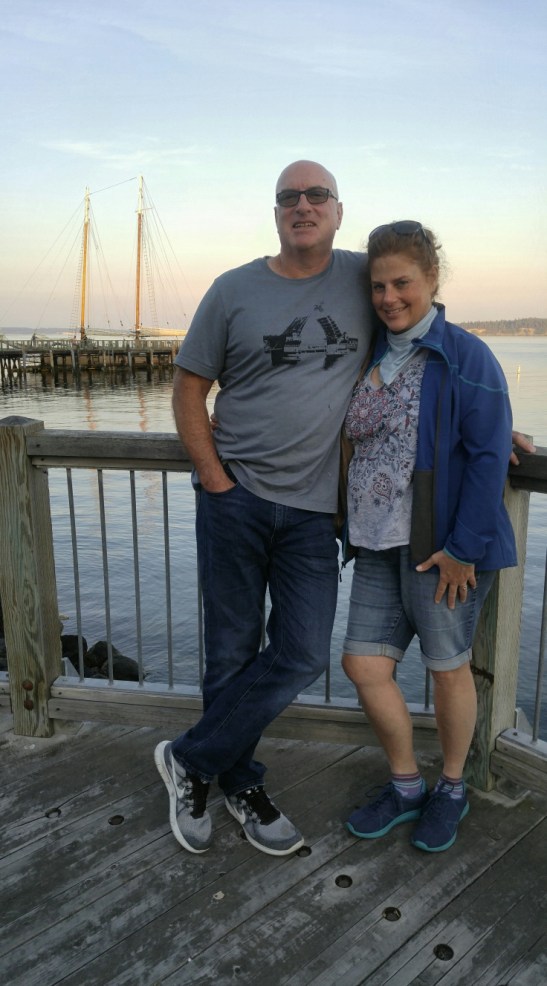
Suzanne and Bob on the docks.

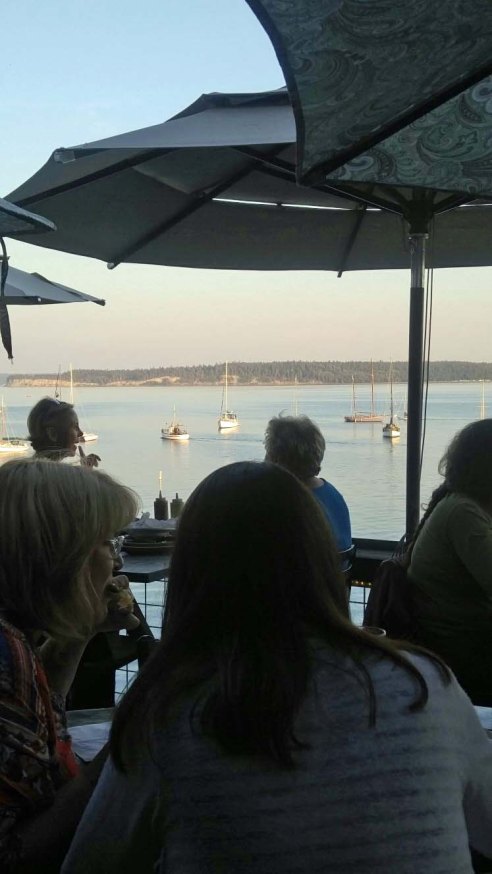
After walking the docks, we went to dinner at Sirens Pub, which has a to-die-for view of the docks. Not only that, but my Portobello Mushroom salad was really scrumptious.

One of our highlight activities was to be a paddle on the bay!

I brought up my kayak and Suzanne borrowed a Hobie pedal drive kayak from a kind (and trusting) neighbor.


View from Sirens

Dinner with a view at The Sirens Pub

Kala Point has its own beach so we headed down there. Perfect day for a paddle! Wind out of the North Northeast about 10-12 mph. Launching my Current Designs Sisu is a simple affair, even with the seaweed along the shoreline. Suzanne’s Hobie Mirage Drive kayak is a bit more problematic. It has these “fins” which move back and forth underneath the kayak and are driven by pedals up on deck. It’s got bicycle chains connecting, and anything that the fins/chains come into contact with can throw off the whole system. So launching Suzanne involved keeping “fins up” and moving out beyond the clogging seaweed. Either way we got ourselves launched and out into the bay.

Suzanne and Hobie

Suzanne about to go to sea!

We spent several hours out there. Super nice to get out on the water!


Sedona: Red Rock State Park and Cathedral Rock

18 06 2018

IMG_0119

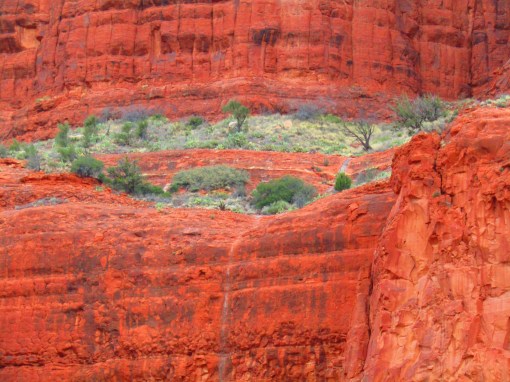
Ruth Ann, Tully and I managed to get through the traffic south of town, to reach Red Rock State Park. At this time, about mid-day, it was cloudy. Still, the mesas were very beautiful. And if one looked close, the struggle of life in the desert was there for all to see. Our shoes padded through dry, soft dirt. The flora around was very dry, and lots of it had protection like needles or prickers. Evolution created plants specialized to take advantage of whatever rain comes.

Many plants are succulents, evolved to hold onto and store water. And it’s true, the rocks there are red. Or, orange-red.

IMG_0112

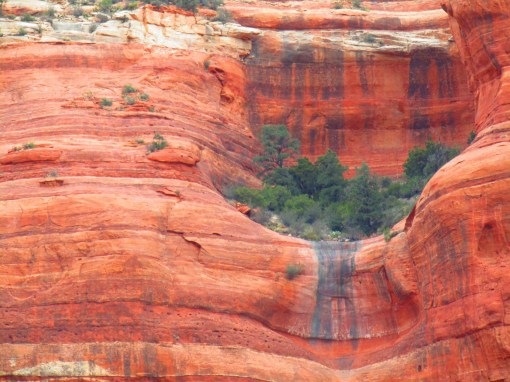
And where the rocks are eroded in such a way to capture water for any length of time, even way up on a mesa, oases of life have been created. Life finds a way. On these little places where water stayed on a bit longer, plants that normally grow elsewhere created a miniature ecosystem for themselves!

IMG_0110

IMG_0114

Great picture with Ruth Ann. Up above you can see life has taken advantage of every place water has collected.

IMG_0105

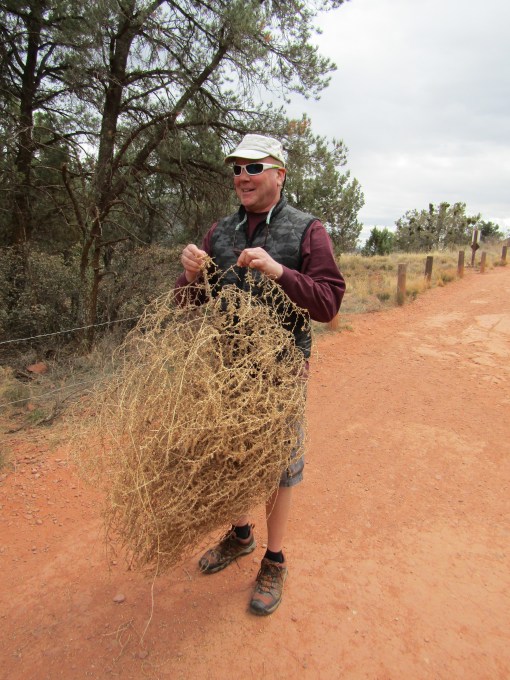
I’m holding a nice tumbleweed!

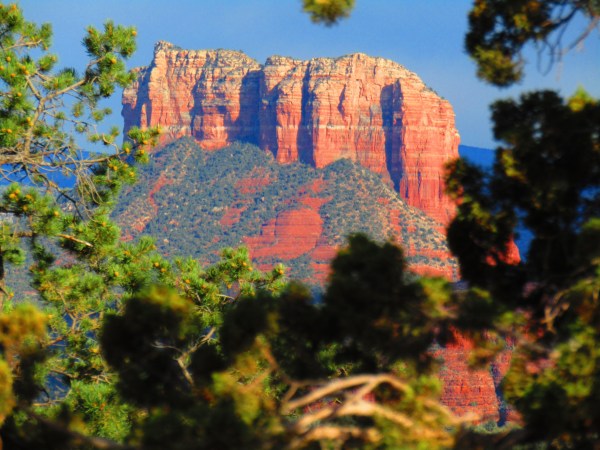
After having our fill at Red Rock, we journeyed further to find Sedona’s famous Cathedral Rock. Using our GPS was of limited use. We kind of futzed around down where we knew it was to be, and eventually found a park and trailhead. During our walk, I kept watch on the sky, and I noticed an upcoming clearing was pending. We waited for it to happen, and it paid off!

20180420_164155_HDR

I suck at selfies but this one worked! The sun breaks through!

20180420_164718

On our way out it continued to clear and the red rocks glowed brightly!


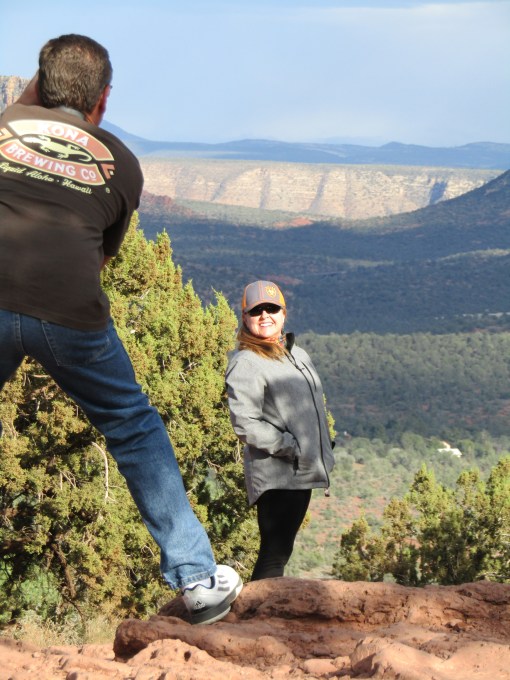
And what would a day be without a great picture of Ruth Ann!

IMG_0124

So, our day down at Red Rock State Park and Cathedral Rock was a good one! For Tully and I, it was going to be back to Albuquerque. On the way we’d visit the Painted Desert, Petrified Forest, and Meteorite Crater.


Sedona, Arizona: Reuniting with Friends

17 06 2018

Our next destination was Sedona. I’d been there back in 2003 with my girlfriend Tonya. We stayed out in Jerome, about 25 minutes away. I remembered hiking the Oak Creek Canyon section, and spending a few hours by the river looking at Cathedral Rock.

Sedona’s big draw is its beautiful red rock canyons and rock formations. This time we’d be doing some hiking but I’d also meet up with some friends I’d not seen in ages. My friend Ruth Ann, who’d moved to Arizona from Portland and I hadn’t seen in 9 years would meet us. And my high school friend Kim Kroeger Miles lives in Sedona. I had not seen her since the mid 1980’s! We all had a cookout at Kim’s house, which is surrounded by the red rocks. I was a little nervous seeing people I hadn’t seen in so long! So much history has gone on since last we met. Children, marriages, near-death experiences, travel, and triumphs.


It turned out to be a lot of fun. Kim made a unique Caesar Salad, whipped up some burgers for the grill, and created an amazing dessert made with some of the fruit from her orchard. So good to visit!

The following day Ruth Ann, Tully and I set out to get outside to see some of Sedona’s outdoor attractions. What I discovered is that Sedona is an international magnet for tourists, so much so that it might not be possible to visit on a budget. And its roads are jammed with tourist buses and cars. The main road just cannot handle all that traffic! And while beautiful, every trail we visited charged a fee, from $5 to $20! It was so busy the Oak Creek trail was “sold out.” I imagine locals know other less busy trails to get out on.

The first park we visited was Slide Rock State Park. It was open, and not busy. We learned it really doesn’t have trails, just a swimming area and picnic area on the river. It would be busy in warmer weather!

Next, we decided to visit Red Rock State Park and Cathedral Rock. We’d be driving through downtown Sedona to get there. Wow, what a traffic jam! On the single-lane on the other side of the road, it was bumper to bumper for a couple of miles. Lucky for us, our side wasn’t so bad. I’ll cover those parks in the next post!