Egypt: Karnak Temple Complex

26 11 2023

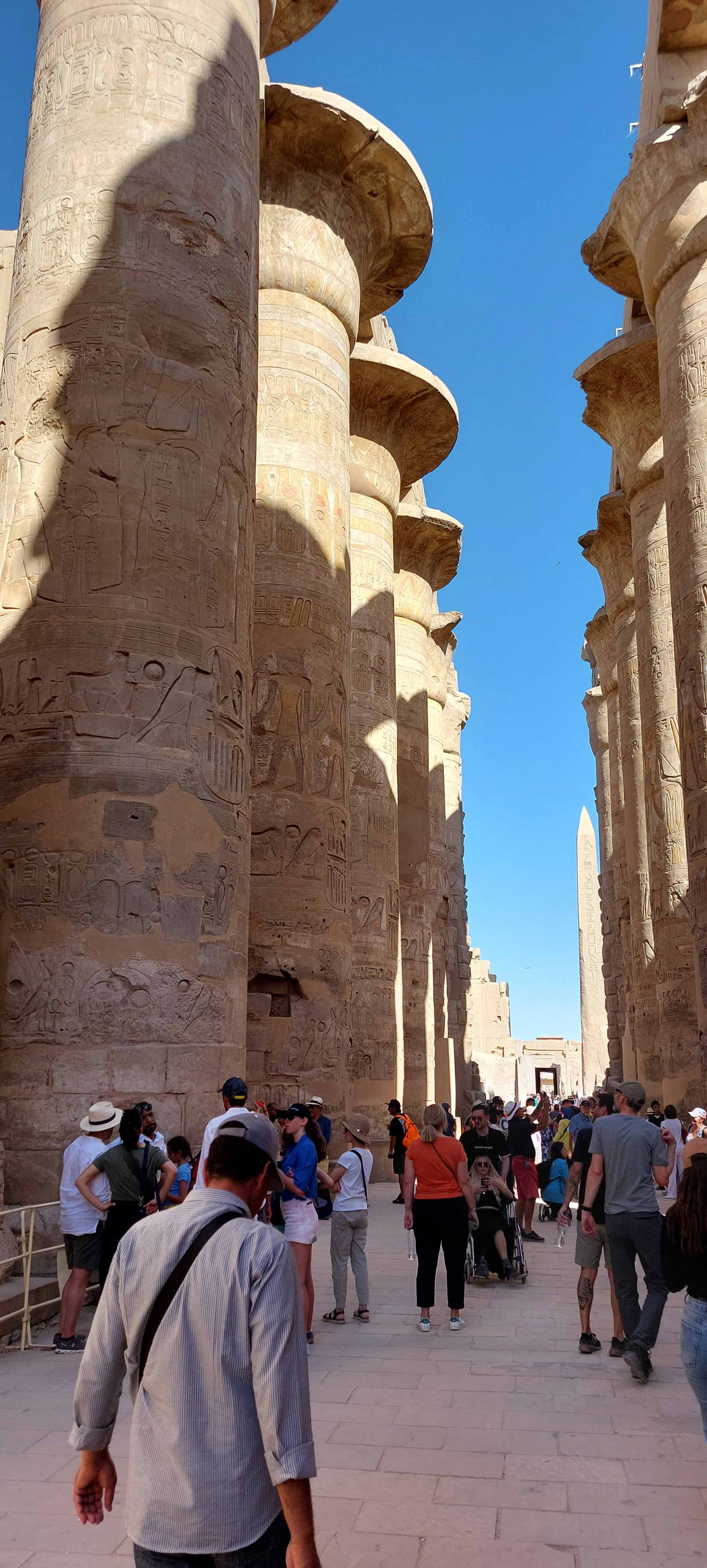
Our final visit in the Luxor region was the Karnak Temple Complex. Taken together with its connection to the Luxor Temple, is said to be the largest in the world. It is dedicated to the King of ancient Egyptian gods, Amun. Over several thousand years, it was expanded by pharaohs Thutmoses I, Queen Hatshepsut, Amenhotep III, Ramses II, and the Ptolemys. It is generally thought that it was started during the Middle Kingdom, about 2040 BCE. Its construction continued through the centuries into the Ptolemaic era which ended 30 BCE. It is estimated that during the New Kingdom 80,000 priests worked at Karnak.

The ancient Egyptians referred to this place as “the select place,” “the origin,” etc. They believed this was the place where the world emerged from the chaotic soup that was, in effect, the Big Bang, and the creator god Atum started the work of creation. They also believed this was the place they could communicate with Amun. Egyptian mythology says that Atum and Ra merged to create the supreme Amun.

Each year the ancient Egyptians held the Opet Festival here. They’d carry statues of Amun, Mut and Khonsu in a barque to Luxor Temple, celebrating the god’s guiding the souls of pharaohs to renewed life.

It was believed Amun was a protector of pharaohs. Here, this is specifically spelled out with the ram-headed sphinxes, which can be seen guarding pharaohs under their chins.

Karnak is so iconic that a number of films and film scenes were shot here. Death on the Nile, The Spy Who Loved Me, Valley of the Kings, Poirot, an episode of The Love Boat, and more.

The interior galleries and chapels are full of heiroglyphs. There are 134 columns 65 feet high.

There’s also a number of obelisks. Historically there were hundreds around Egypt but many fell over and many more were taken to places like New York, Paris, Rome, the Vatican, and London. Today there are more obelisks in Rome than Egypt.

Egypt is without question the world’s most archeological rich region. It was one of mankind’s first civilizations, and due to the desert weather, it’s incredibly well preserved. Karnak is a pinnacle of the sites.


Luxor – Luxor Temple, A Photographer’s Dream

19 11 2023

Our ship docked at Luxor, on the east bank of the Nile. We reluctantly left the ship and checked into a riverside hotel for the next two nights. This hotel had a really nice pool area which was perfect for relaxing on hot Egyptian afternoons!

The Luxor region is probably the most archeologically rich in the world. It contains mind blowing temple complexes like Luxor, Hatshepsut and Karnak, plus the Valley of the Kings. Add the palm treed Nile to the mix and you have a recipe for an unforgettable experience!

The city is one of the oldest in the world. In ancient times, it was known as Thebes.

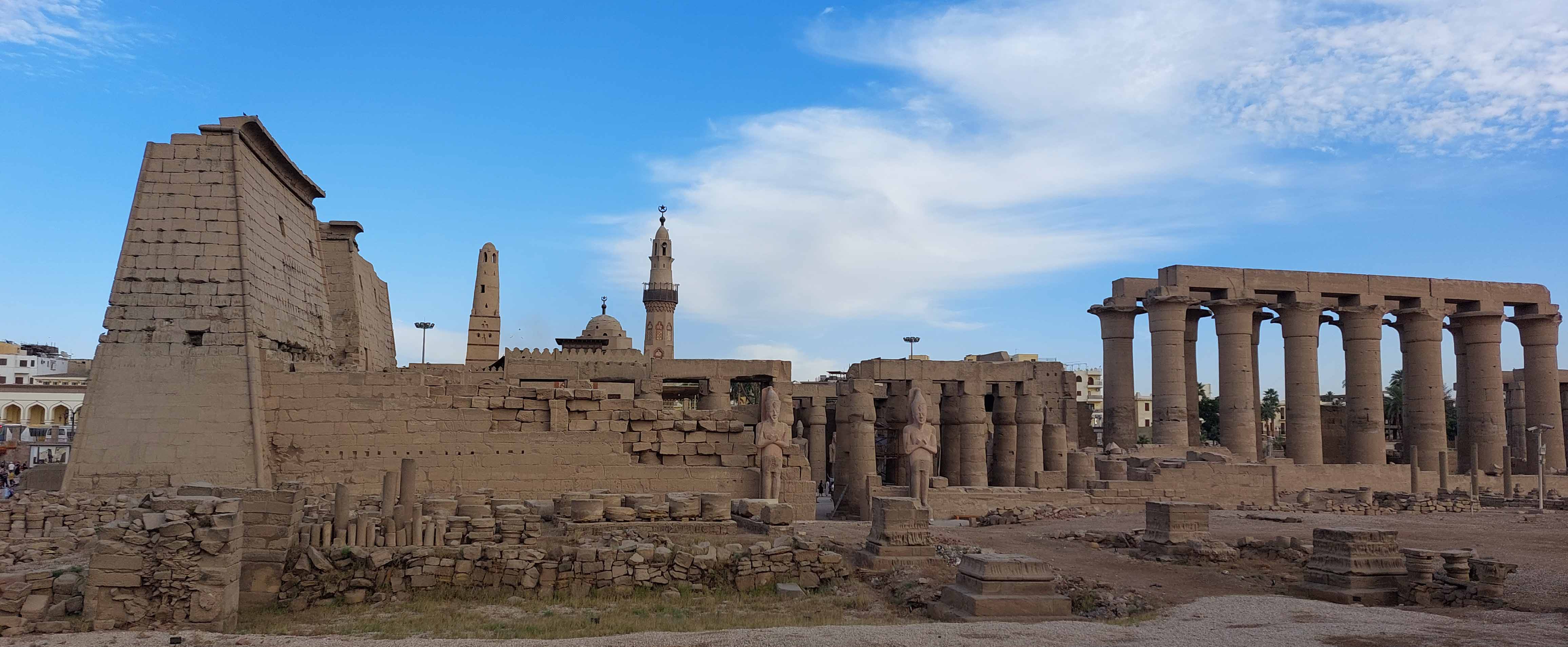
Our guide Ahmed encouraged us to get some pool time in during the hottest part of the day and then head to Luxor temple for the sunset. WOW was this a perfect choice. Luxor is said to be a location where pharaohs were crowned. Alexander the Great said he was crowned here. A number of them contributed to its construction. Amenhotep III, Ramses II, Horemheb, Queen Hatshepsut, and Tutankhamen all are represented.

We were struck with something awesome before we entered the temple. There is a 2.7km long “Avenue of the Sphinxes” with literally hundreds of sphinxes connecting Luxor Temple to Karnak Temple!

We turned around to face the temple. Also, walking along the outside, you can glimpse most of it.

Once inside, there are a number of chapels dedicated to various gods and goddesses.

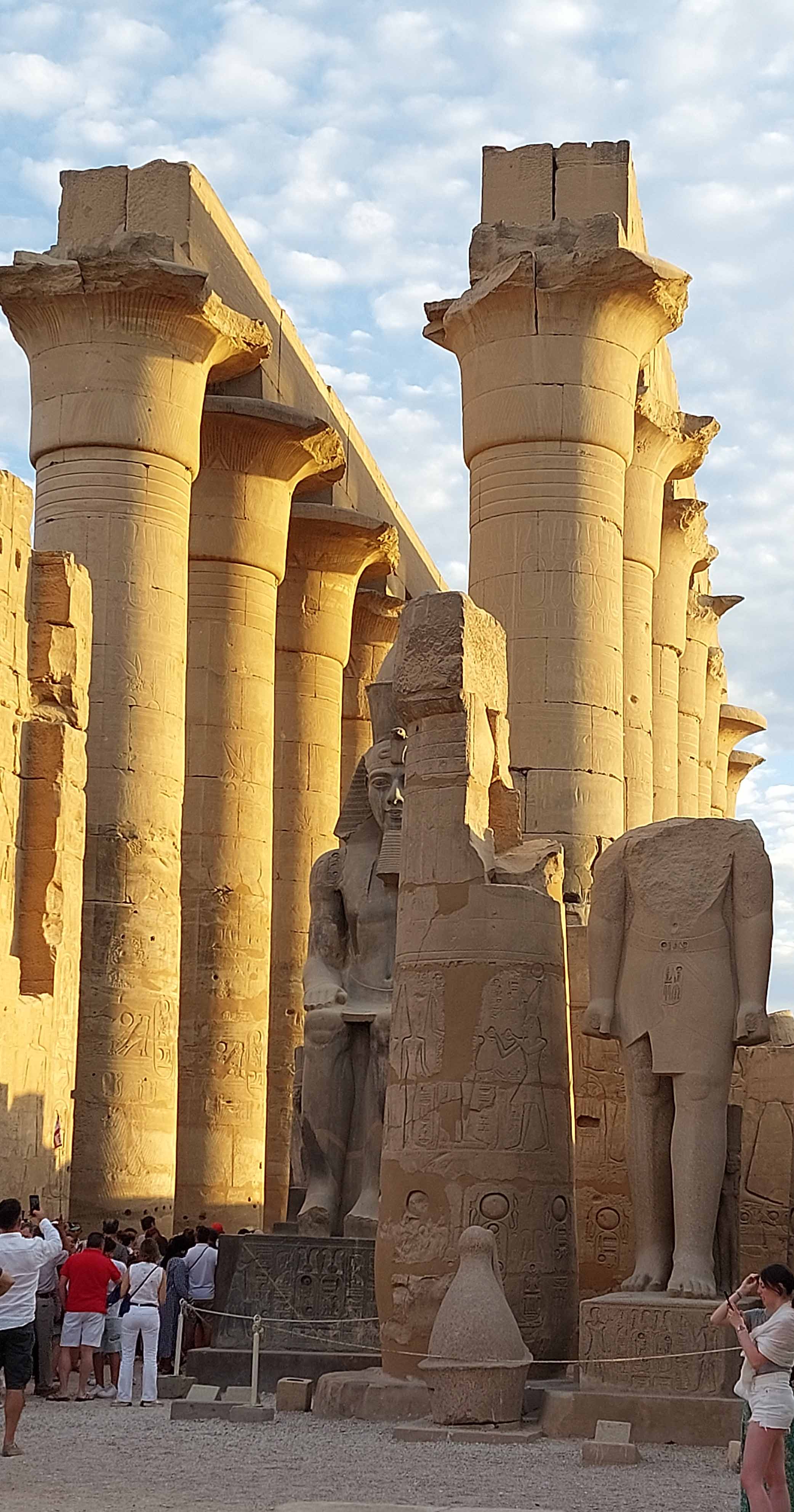
There are beautiful columns, which, in the late afternoon, were eye catching!

The blue Saharan sky, puffy clouds, the amber glow of the sunset. The columns. And these statues of Ramses II were, well. You decide!

The place is SO old. Of course it was used by the Egyptians. But then Romans. Then Christians. And now, Muslims. Here is some evidence of Christianity.

Once the sun set, the most incredible images came out. I just love love love the facade with the lights!

From here we could walk back to the hotel. Next morning, in the cooler temperatures, we’d head to Queen Hatshepsut’s Temple, and the Valley of the Kings.


Egypt: Abu Simbel – The Warning by Ramses II to All Travelers

11 11 2023

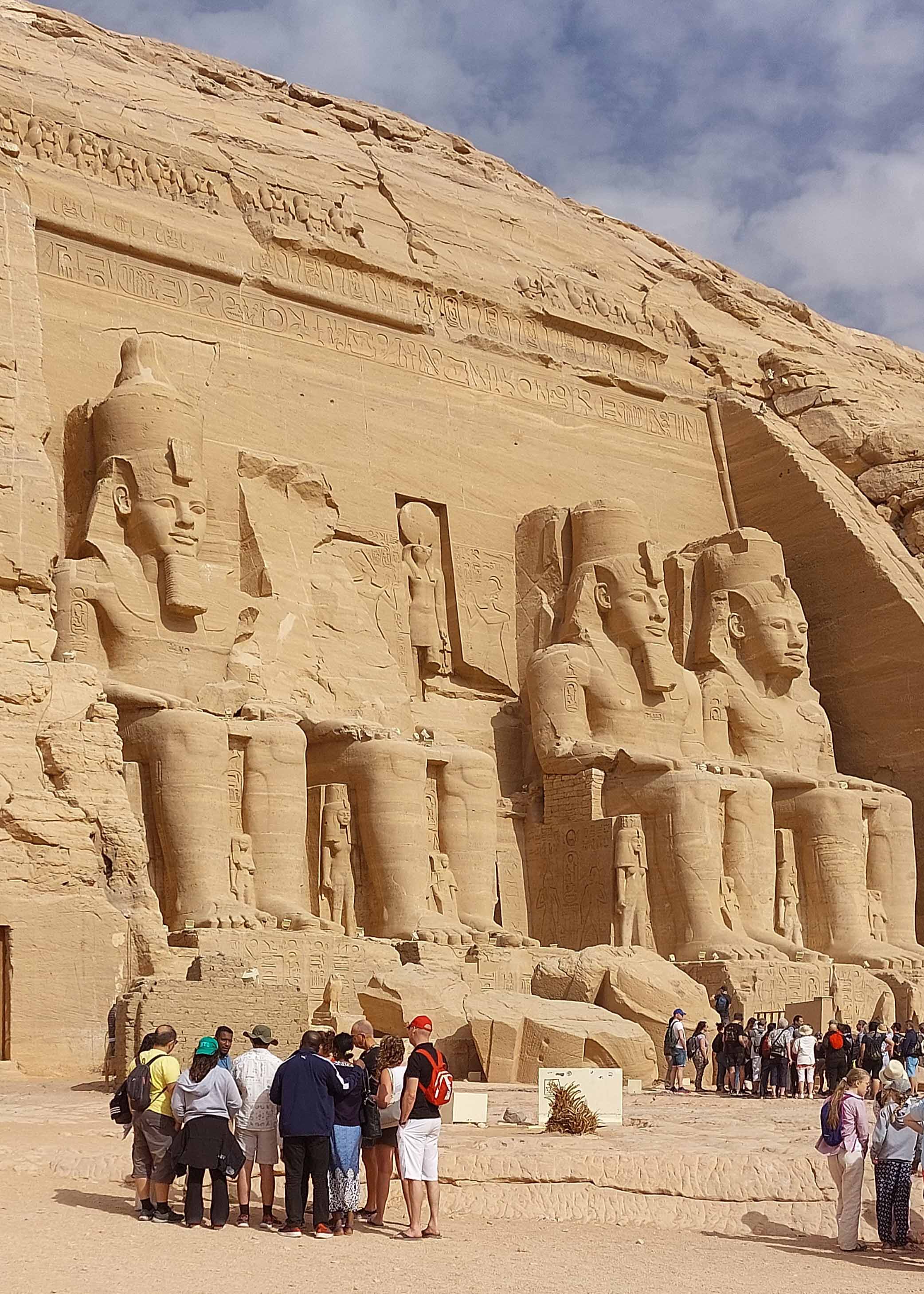
Abu Simbel stands tall as one of the ancient world’s most amazing achievements. Carved into a mountain, for thousands of years it has stood as an emphatic notification to all sailing north on the Nile that this is the border of Egypt, a powerful kingdom. And, during the 66-year rule of Ramses II, 4 giant statues of him informed all comers that this was his country.

It takes a 3+ hours drive south to reach the site from Aswan. It’s close to the border with Sudan. We departed from our hotel at 4:30 a.m., with boxed breakfasts from the hotel. The drive is very flat across Sahara scab land, dusty and rocky – not full of dunes. Little did we know that whilst we were away at Abu Simbel, a dust storm would overwhelm Aswan! But it was gone when we returned. The site sits next to Lake Nasser.

Ramses II cartouche

Before I delve into the fascinating ruins themselves, I think it’s important to tell you about the amazing modern-day achievements at Abu Simbel! In the mid 1960’s, impending completion of the Aswan High Dam threatened submersion of many important ruins including Abu Simbel. This site was considered so important to world history that UNESCO orchestrated a campaign to move the entire site away from the rising waters.

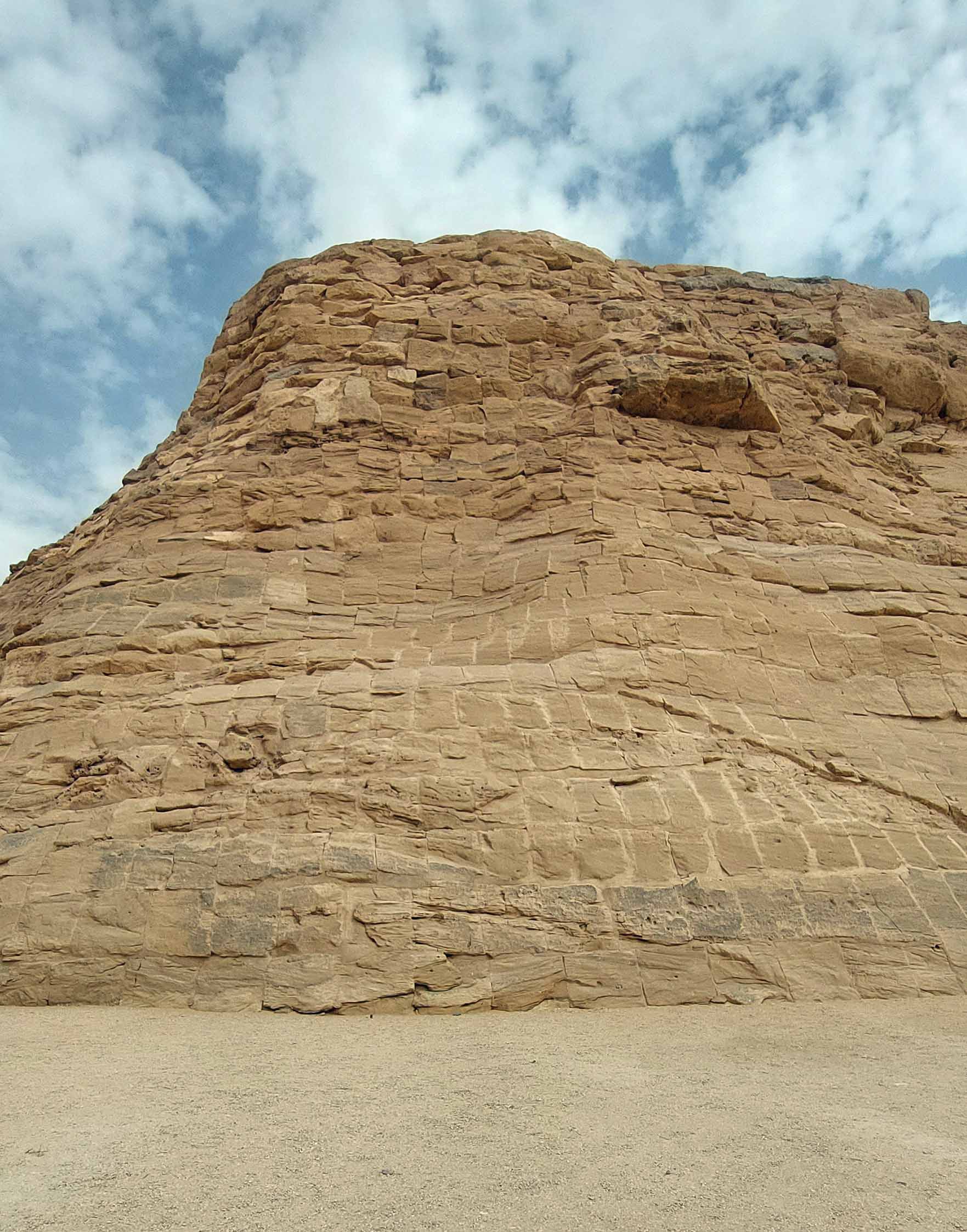
Re-assembled block by block

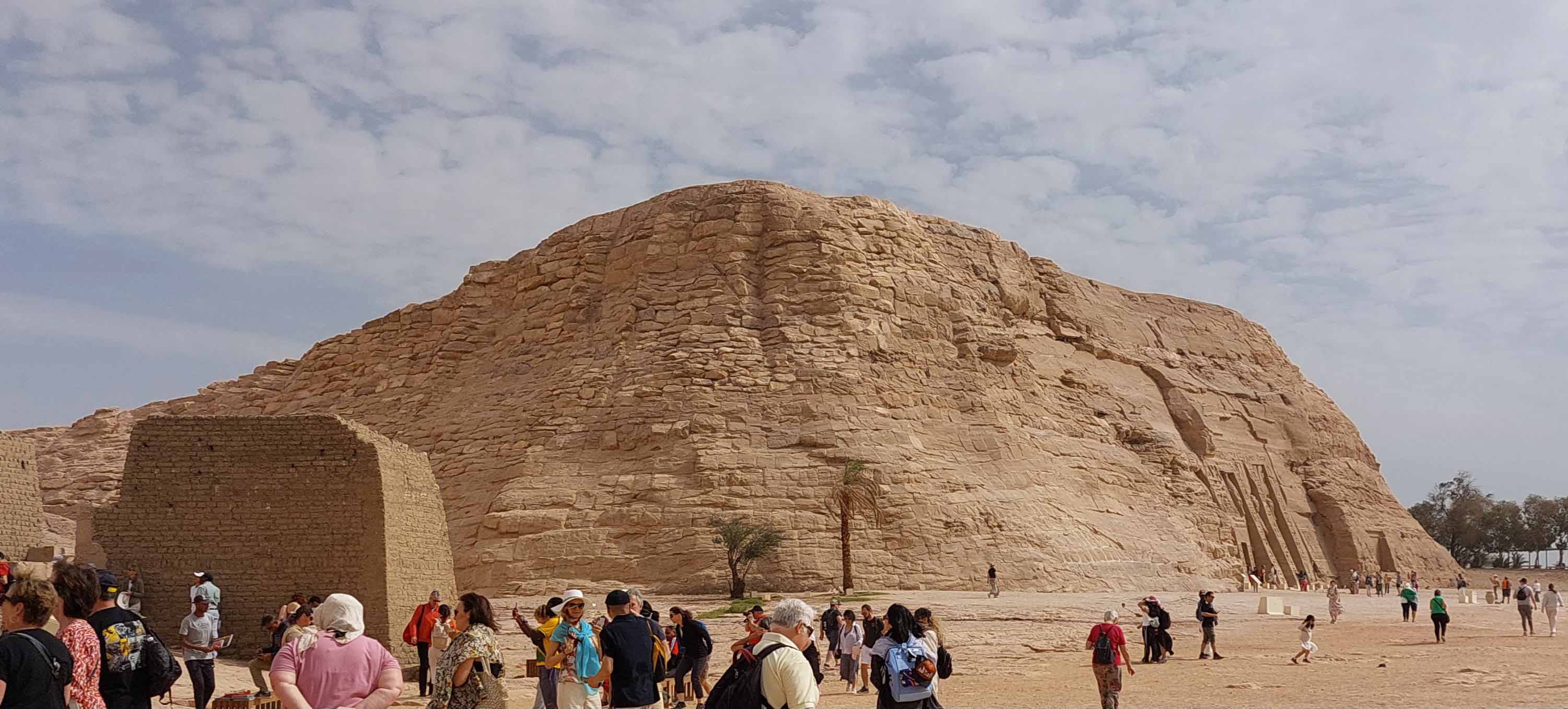
With such a gargantuan task, a multi-country effort spared no expense to move this monument. The entire mountain, with Abu Simbel outside and inside, was carefully mapped out, precision cut, with the location of each piece recorded, moved, and then re-assembled on higher ground. Today, visitors can witness this incredible achievement up close!

Abu Simbel overwhelms in how it comes into view. Visitors arrive behind the mountain. You can’t see the face. One must walk around the mountain, because it’s on the opposite side. So I got an up close view of the reconstruction.

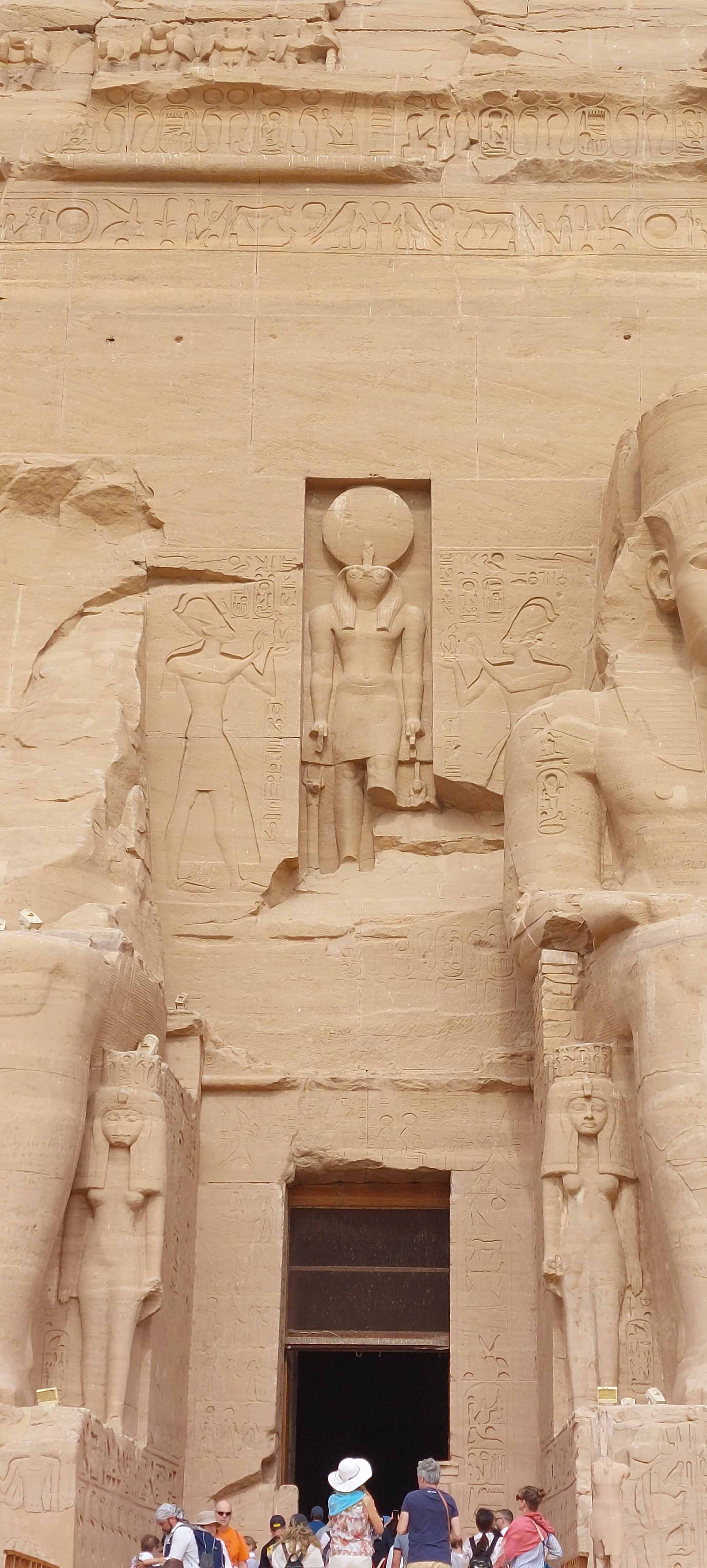
Then, you view the enormous lake, and then, coming around, these 66-foot high seated likenesses of Ramses II carved into the mountain overwhelm the senses!

And that is only the first image one sees. There are lovely carvings of his lovely wife Nefertari. Her tomb, in the Valley of the Kings, is probably the most magnificent of all.

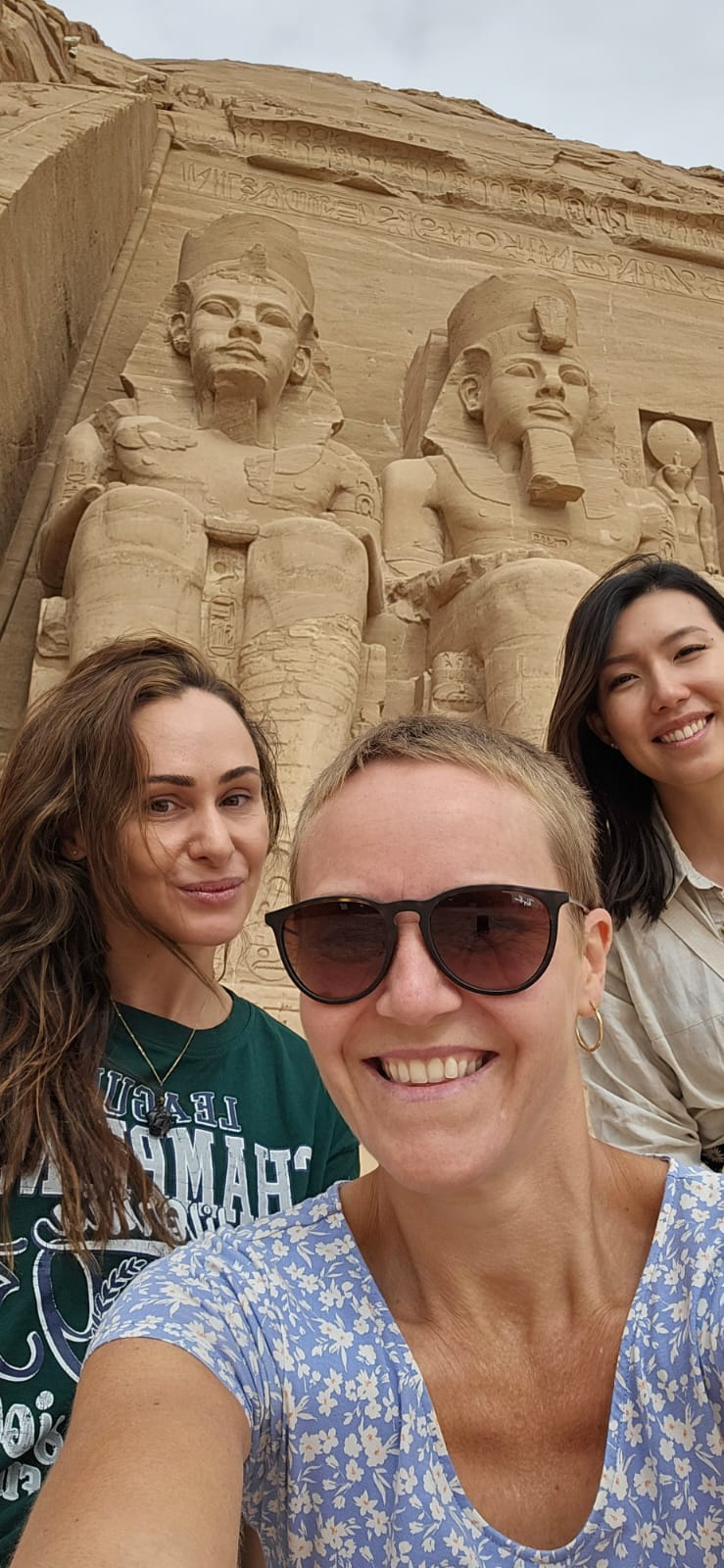
The site is intended as a warning to those coming to Egypt that they are entering a superpower capable of laying waste to armies of enemies. We took images of ourselves at the entrance.

The walkway just preceding the entry door is lined with further reminders of who is dominant here. For 40+ feet prior to entry, on either side, one passes scenes of those Egypt had conquered. Hittites on one side, and Nubians on the other. From what I could see, these Nubians did not look like Egyptians typically depicted on other ruins. And they are tied up and tied together.

Inside, one is immediately in the presence of more of Ramses II. Giant statues line the first hallway.

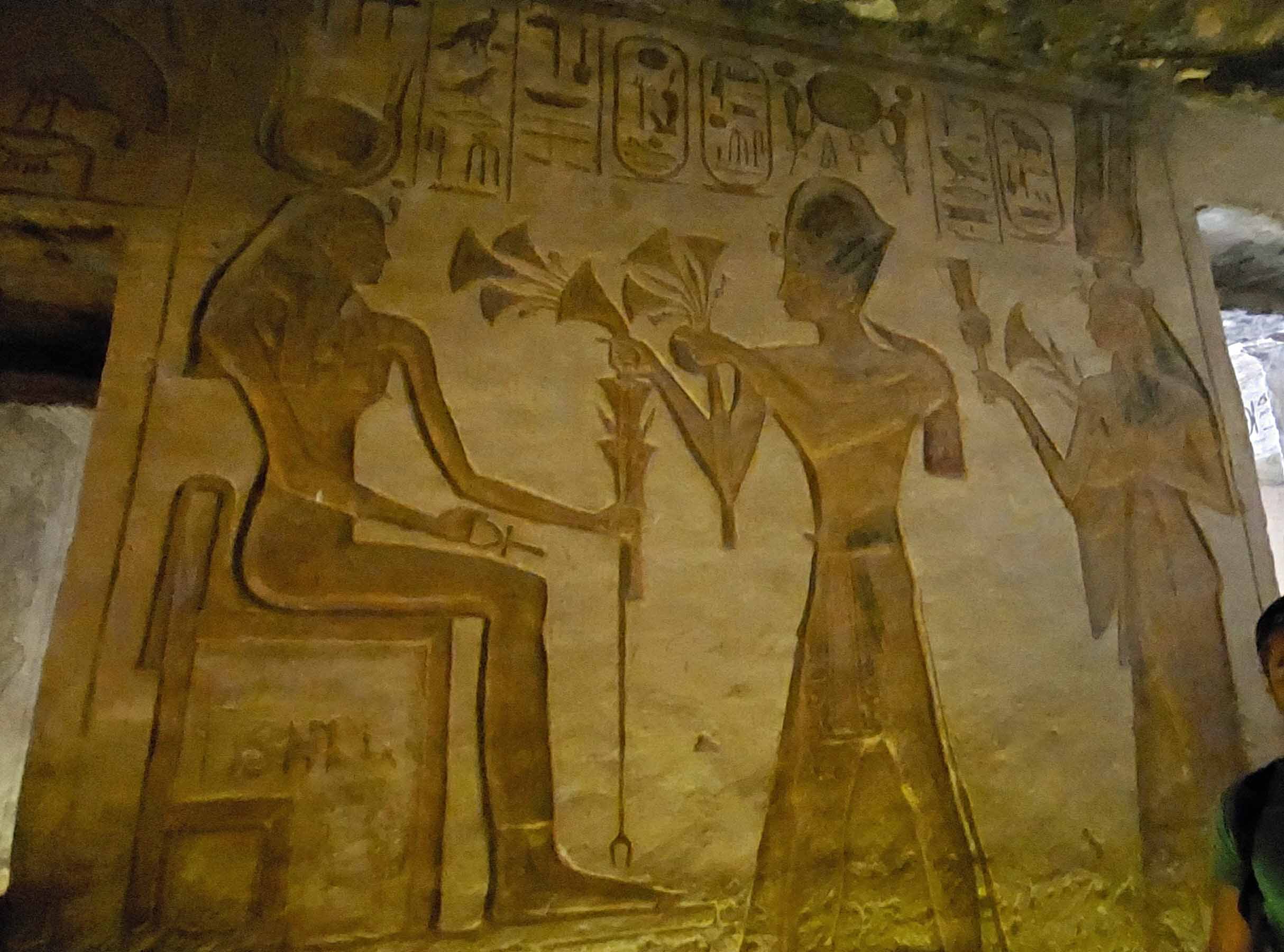
Every single square inch of wall space inside is covered with images. Scenes of gods, goddesses and the pharaoh.

Throughout Egypt, these scenes of the many deities are common, and they’re often associated with after-life rituals. Ancient Egyptians spent their entire lives believing that this life was nothing more than a temporary state on the way to the next world. And to make that transition, they needed to adhere to the lifestyle dictated by Maat. Maat was both a goddess, and a set of principles to live by. This seemed to pervade ancient Egyptian art, which for the most part doesn’t stray out of the bounds of standards set by the priests. However, there are a few times I glimpsed examples of illustrations by artists actually showing emotion, such as terror. Or action – and that was the case at Abu Simbel.

The wall art at Abu Simbel contains more proof of Ancient Egyptian super powers. Not just of the country but of the pharaoh himself. There, I could see the Pharaoh in action slaying a terrorized enemy soldier. Or taking down many enemies with his bow and arrow whilst riding a chariot.

Ramses II stomping on his enemies and slaying an enemy soldier!

Taking down several simultaneously. No mercy!

Above, leading a brigade of chariots. Abu Simbel is a must see in Egypt!