To Ghorepani at 9,429′ we Climb More than 3,000 steps!

5 12 2018
20181107_164516

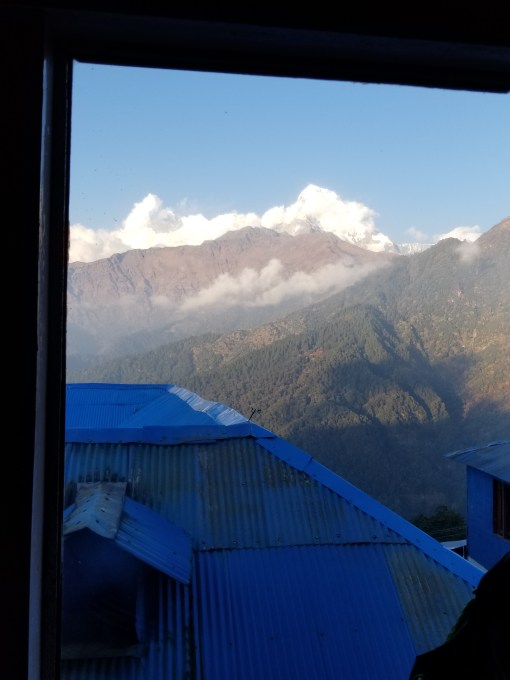
Nilgiri South 22,462′ and maybe Nilgiri North 23,166′ from my tea house room

My sleep went well at Tirkhedunga, for at 5,067′, it was warm enough that I just lay my unzipped sleeping bag over myself. At this location, we had some very noisy cicadas! In fact, they made sounds unlike any cicadas I’ve ever heard. I’d seen locals tending their crops and watering. Honestly, I thought the noise was from sprinklers! But nooo, that noise I heard was cicadas!

Our tents were quite large by backpacker standards. They were 3 person Mountain Hardware expedition tents. Inside, we had sumptuous 3″ foam pads, and pillows. All of us were singles inside these tents, and I can surely say that I, for one, made use of every single inch. I also brought along a backpacking clothes line which I stretched across the tent for my very wet from sweat clothes. So each afternoon we’d arrive at camp. The tents would already be set up, with our duffel bags inside. I’d pile into my tent, set stuff up, lay wet clothes out, and then get on with socializing or on some afternoons, write my journal, or indulge in a portable shower which was made available.

This morning, after a multi course breakfast, we set out on what was promised to be one of our most arduous hikes. When done, we would climb over 3,000 steps and ascend 4,362 feet. We’d climb into a bit of oxygen deprived air. I was wondering how I’d do, because I have a friend in Park City, Utah, which is about 8,300 feet, and every time I go there, the 1st day I can really feel the altitude!

On this day I was to learn that on the Annapurna trek, the end-of-day “altitude gained” does not reflect the actual feet climbed! That is because in this region, there are many, many steep valleys to descend and climb before the end goal is reached!

We walked the steps, the thousands upon thousands of steps leading up and down, but ultimately up, to Ghorepani. We passed many other trekkers and Nepalese, greeting each with a hearty and sometimes breath-challenged “Namaste!”
Steps2 72345741-treking-in-annapurna-circuit-nepal-

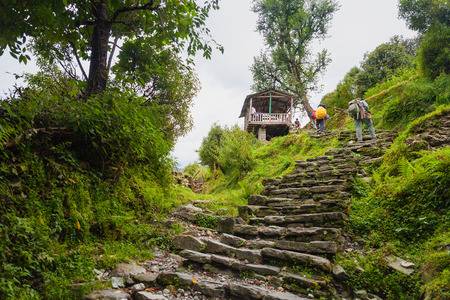
Oh yes. And no description of an Annapurna trek would be complete without a note on the steps. The Nepalese have chiseled out steps, which they have laid all along these trails, to keep the trails from eroding – due to the heavy monsoon season rains. These steps vary in condition and in length and height. Heights vary from 4″ to as much as 18″. And to complete a day’s hike, you just might do several thousand over 6 hours! We called each other “buns of steel!”

At certain zig zags, we’d see beautiful flowering trees, or images of the giants!

Climb and descend, and climb again! With views of 23,000+ foot giants and flowering trees all along the way.

We lunched at a tea house along the way. Our kitchen staff had arranged for a dining room to be held for us – they made and served our lunches. For a few days, I indulged in a Nepalese Coca Cola. The tea houses are constructed with the trail going right on through. So, any commerce, including freight trains of horses, come right on through!

With lunch done, it was time to tough it out to Ghorepani! As with many of these hikes, sometimes I think I’m going to give up and then all of the sudden the end has arrived!

DSCF2203

Notice the precision of the stones. Sometimes the steps were very tightly laid as if they were trying to imitate the Incas. Anyway this was kind of a “false summit,” because our tea house lay several hundred feet further up in elevation from here!

And soon we reached Ghorepani, where we’d try a real tea house lodging. The hike was very worth it. From here we could see Dhaulagiri, at 26,795′ the 7th highest mountain in the world! And what spectacular weather! It was quite literally clear and CALM up on the peaks.

We enjoy a truly boisterous evening and dinner. But we need to bed early, because tomorrow is not only another big hike day, but we need to climb 1,200ft at dawn to catch the sunrise at Pun Hill! Pun Hill is at about 10, 200 ft and from there, one can see a nearly 360 degree view of Himalayan giants!

We will arise extra early to grab some coffee and then ascend to Pun Hill, then descend for real breakfast, before our day’s big hike! We will see the world’s 7th highest peak, Dhaulagiri at sunrise!


Annapurna Sanctuary Trek: Let the Trek Begin!

1 12 2018

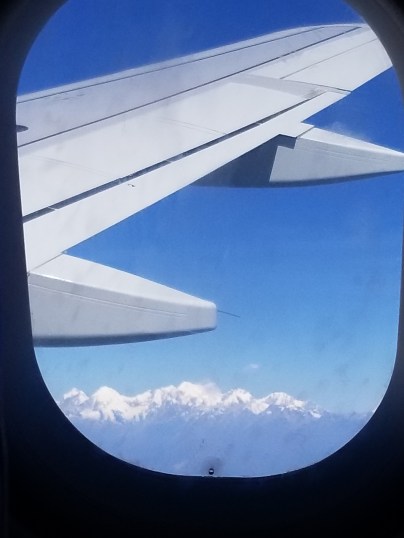
After breakfast at the Kathmandu Shangri La Hotel, we took an early flight to Pokhara, the beginning and ending city of our trek. Our 30-minute flights on Yeti Airlines were on a smallish, twin-engine turbo prop. As we rose above the pollution in the Kathmandu valley, the Himalayan giants dominated everything! And while our flights were uneventful, Don and I noticed rivets missing on the right engine cowling, and one more twirling itself out of its hole. Some prayers were offered about the outcome…

Emerging from the plane in Pokhara all one needs to do is look up. My favorite mountain, Machapuchahre, or Fish Tail, at just under 23,000 ft, dominates the view! This mountain would be prominent during the next two weeks. We would do base camp right underneath.

Once aboard our transfer vehicle, it was maybe a 90 minute ride to our trailhead. Along the way, we passed by Nepalese settlements and through a town where we briefly tried to exchange currency.

Our Annapurna Sanctuary Trek officially began at the trailhead at Nayapul. This spot was a Grand Central Station of sorts, all sorts of 4 x 4 vehicles and taxis dropping off and picking up trekkers! We’d walk a couple of hours to a tea house lunch and then end the day at Tirkhedunga, at 5,067 feet.

We had several novice trekkers on this trip, and a few novice campers as well! And so it was that guests like Tara were introduced to the luxuries of “glamping,” and also Annette and Amee as well.

We slung our day packs over our backs, donned our walking sticks and set off. It was a sunny day, with this first walk mostly on a road, and part on a trail. The sun was hot. I relished the shade. We passed through our first series of Nepalese Himalayan hamlets with their tea houses and restaurants.

As the trail wended up into the hills, the road ended. And just when we began to need a relief (and to relieve ourselves) it was time to stop and lunch! It was time for some of our newly minted trekkers to have their experience of glamping on the trail!

I had this experience before, so I knew what to expect. But Tara had no idea how sumptuous just something like lunch on the trail can be! We sat down and the table service began. First beverages, then soup, then a main meal (which might be a few courses) and then dessert! Oh yes. This is lunch on the trail! So Tara exclaimed over and over THANK YOU! It’s hard to get used to this level of service. But let it happen!

And there was dancing. Local children were practicing local dances and some of us, so (Tara and Cathy Ann) tried their part! Super cute. OK, then we put our packs back on, and continued our hike. This hike wasn’t that long, though, and we reached our “perch” by late afternoon.

20181106_161359

We had a nice level spot for our tents outside a tea house and it was perfect. Since several of our trekkers were “newbies,” (Tara, Annette, Amee and Uli) I offered some suggestions on how to “vent” one’s tent, and arrange their sleeping bags, so they were more comfortable. Take note: Venting, regardless of the temperature, is really important! You don’t want condensation building up inside the tent. And, it’s important to resist the temptation to go to sleep inside your sleeping bag with too much insulation. I mean don’t get into that bag with a down jacket and down pants. If you do, the bag cannot do its job. The jacket will “insulate” the bag from being able to “activate” its down to warm you. Instead, go to bed with less insulation. My advice was proven over and over on the trek. Oddly less is more inside your sleeping bag!


Kathmandu, Nepal: Hindu and Buddhist Influences

27 11 2018
20181117_123203

Approaching the Boudhanath

Prior to striking out on our trek to Annapurna, we spent some time in Nepal’s capital city of Kathmandu. Taken together with the surrounding valley, the greater Kathmandu area has a population of about 5 million. Although Nepal boasts the highest mountains in the world, including 29,029′ Everest, most don’t realize much of the country sits at lower elevation, and Kathmandu is at 4,600 feet.

20181105_152612.jpg

My flight to Kathmandu took off from Guangzhou, China, and I was fortunate to sit next to a couple from Kathmandu – now living in Sydney, but who were going home for the popular 5-day Hindu festival known in Nepal as Dipawali – the festival of lights. They told me how the whole city would be lit up like Christmas. And, on Wednesday night, the darkest night, the children go house to house like Halloween and sing songs and get offerings. It is a celebration of light over darkness – and knowledge over ignorance. They said that every household goes out of its way to be clean and beautiful. That got me really excited! Though we would be leaving the city before the climax.

20181104_133519

The giants come into view!

I was also fortunate to be seated on the right side of the plane, so I could see the Himalayas of Bhutan and Nepal! We even saw Everest.

Upon landing, the reality of life on the subcontinent strikes hard. Time slows, and strict schedules suddenly fall away. I knew about this, but jet lag was coming on strong.

Several flights landed almost at once, depositing some 600 jet lagged passengers to be processed by less than 10 officers. The lines didn’t seem to move. In my line, I looked up, and the officer went to lunch! I switched lines, only to have the last person in front of me have a problem and take 15 minutes.

And if that wasn’t enough, there was more! They require another X-ray of bags. And this time, the officer was too busy chatting with buddies to even look at the screen. Finally, I reach the passenger pick up outside the terminal and yell, “Cattara!” hoping a driver was waiting. One guy came over anxiously, but it turned out he was not my driver. Fact was, it took me TWO HOURS to get through immigration, so long my driver went to lunch. And this guy was there in his place. Not to drive, just meet me. About to pass out from jet lag and unable to untangle my brain, I just waited. And waited. And waited. Until I almost couldn’t stand it, and I considered getting my own cab. But then, experience told me, “No, let these people do their jobs. Don’t embarrass him by taking a cab. Save face. It will work out.” And just like that, Karin, my driver, showed up from lunch and I was on my way to the Shangri La Hotel.

If I hadn’t been to other cities such as Saigon, Denpasar, or Phnom Penh, I might have been completely overwhelmed by the rules of the road in Nepal. While it seems like a constant game of “chicken,” and maybe it is, and sometimes cars, buses, motorbikes, bicycles, cows and pedestrians seem to be going in all directions at once, including head-on at you, and sometimes they indeed are, there is some kind of orchestrated dance going on. How do you walk across the street? I remember my first Bangkok guide teaching us. She said, “Just walk, slowly, deliberately, through the traffic, and look at the drivers. Do not hesitate. They will move around you like a school of fish.” And they do.

We reach the Shangri La Hotel. It is a true oasis in the chaos. The rooms are lovely, and there is a wonderful 1/2 acre sized lawn/garden area out back.

The staff at the Shangri La are very courteous and prompt. I had several issues in my room, including a bad electrical outlet. When notified, the staff arrives promptly and takes care of the issue. But it’s more than that. The staff remembers who you are, and takes care to remember the little things. In fact this characteristic rang true for the entire trek as well.

One my rooms at the Shangri La was spectacular.

Kathmandu hosts some of Nepal’s holiest Hindu and Buddhist temples and World Heritage sites. So I began by heading to the Boudhanath and the Pashupatinath. I hired a guide through Cathy Ann to take me there.

The Hindu Pashupatinath Temple complex, reconstructed in the 1400’s, houses no less than 492 temples devoted to different rites. It was overwhelming, busy, and frequented by visitors from near and far. Brahman priests hold court for people seeking certain rites to be performed. Some of the interiors of the temples are off limits to non-Hindus.

One of the most important duties this temple complex carries out is the cremation of the dead. Hindu practice requires cremation by 24 hours of death. The complex is bisected by the Bagmati River, and it is on the banks of this river that cremation, and the drama of loss and grief, takes place. And I was there to witness all of it.

There are dozens of Hindu sects in Nepal, and each has its own cremation rituals. But for each, they take the body of their loved one to this place, where the body is consumed by fire, and the “spirit,” if you will, is allowed to leave and find a new vessel in which to live. There are perhaps 20 stone platforms along the river.

20181117_113225

A loved one’s body is turned 3x clockwise before laying down on the pyre.

A specialized Brahman is trained to carry out the rite. He lays specially cut logs on the platform. Then a body is carried to the site and spun three times clockwise, before laid down.

Once down, depending upon the sect, men, or men and then women, walk around the body three times clockwise.

I saw one woman ask to see the face of the dead. She was so shocked or grief stricken at what she saw that she fainted and had to be carried back to the steps to recover. This is the drama that is death.

Once the family has retreated, the Brahman can begin the process. He anoints the entire body with camphor oil. The first step in cremation is lighting the head. So I witnessed the priest removing the saffron colored body covering from a body’s head, and lighting it. After a short time, the priest continued lighting the logs underneath. I also witnessed the priests stoking the cremation, and then, when done, sweeping the ashes into the Bagmati River. It is very moving to witness this human drama.

20181117_123447

The next temple complex I was to visit was the Boudhanath, one of the holiest Buddhist stupas in the country. I knew it was also one of the largest stupas in the world. When I arrived, I was first amazed at the condition of the roads leading to it. They are just dirt. My guide Bir told me that the condition of the roads was due to bureaucratic gridlock. The clean water bureau, the sewer bureau and the transportation bureau all wrung their hands and nobody will move forward to get the street constructed properly. Until then, the street remains dirt. With some big sewer pipes just in piles!

This Buddhist stupa is very important to millions. And there were thousands here paying their respects. There are prayer wheels surrounding the stupa and many were walking around it, spinning the wheels in respect. The levels of the stupa represent the levels of attainment one must pass to reach nirvana. Only the very top represents attainment of nirvana!

We visited a school where students create Thankas, paintings usually depicting a Buddhist deity, scene, or mandala. In their finest and most detailed form, a Thanka can take many weeks to finish. My favorite is of the Tibetan Buddhist Wheel of Life.

Thanka Wheel of Life

I loved this because here, life is set up as a kind of “game” to get to Nirvana, represented by the figures on the upper right and left. Below, the spirit recycles through the six realms of existence of Samsara, some better than others. If you vary from the path, you might fall into the realm of animals, or jealous demi gods, or some other form of desire or suffering. Only by following the true path can you jump into the upper right of left.

So, what was Rod to make of this? It is a perfect pin ball game! Set it down, tilt it, and insert into a pin ball machine. Add flippers, and you get the point. Any mistakes and your pinball goes down the wrong hole, and back into Samsara. Only the exact correct combination of flipper flips can get that pinball into enlightenment!

Next up we pay a visit to some of the outlying temples near Kathmandu, Bhaktapur!