We had Sunday afternoon to ourselves to explore vibrant Buenos Aires, a city of 13 million situated on the muddy colored Rio de la Plata. Residents refer to themselves at Portenos, or “people of the port.”
It was a warm, sunny late spring day. Saskia gave us our roommate assignments and we settled in. My roommate was Christof, from Belgium, and I was thankful as he is a great traveling companion! During the journey he earned the moniker “Universal Translator,” as time after time, he could communicate on a number of linguistic levels. After making acquaintances, some of us agreed to meet in the Hotel Castelar lobby and head out.
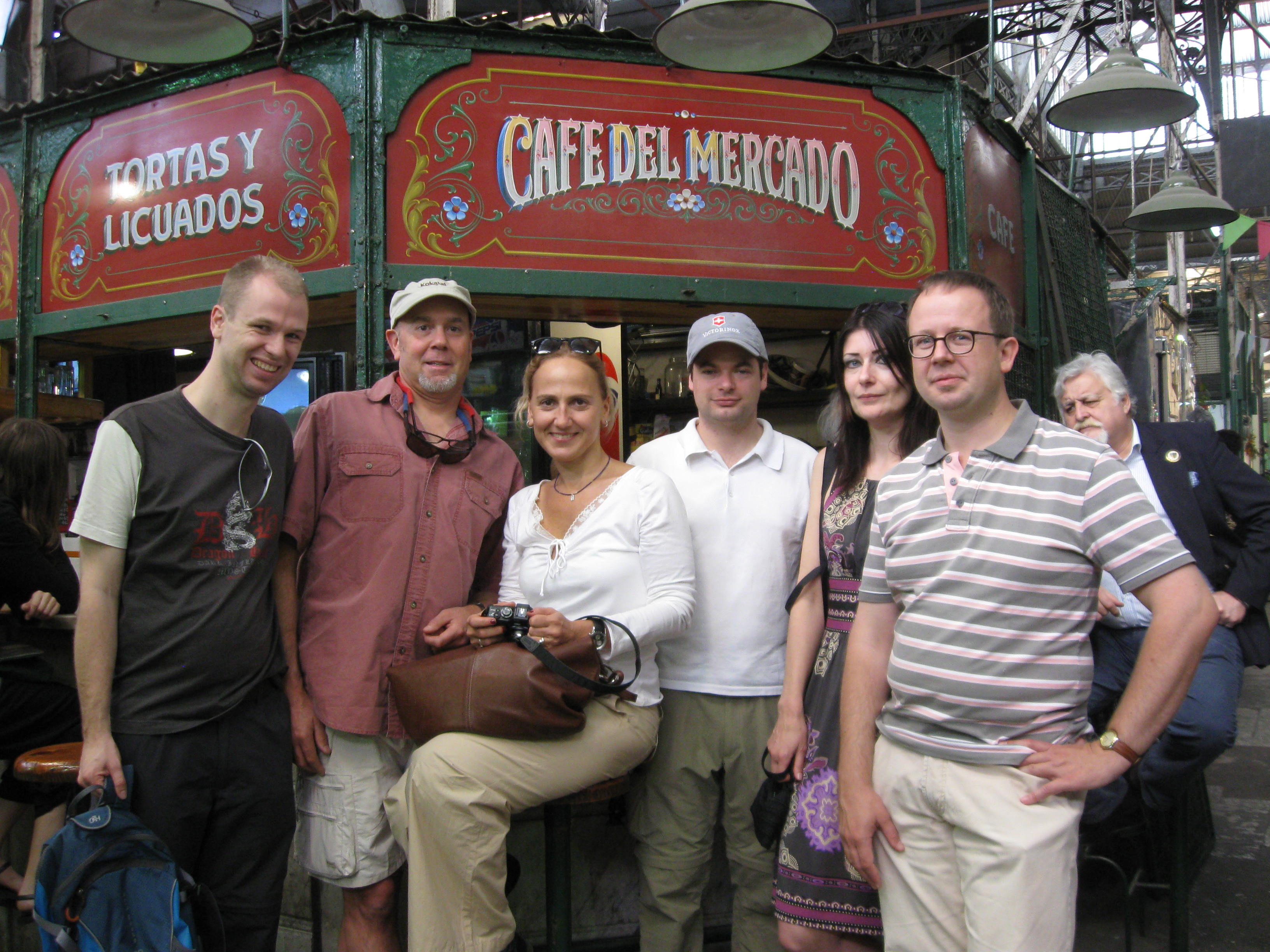
Ivo, Rod, Eray, Elwyn, Angelique and Christof
Those of us that explored that first day would stick together the rest of the trip. We were myself (American), Elwin (Dutch), Eray (Turkish), Christof (Belgian), Angelique (Dutch), and Ivo (Dutch). All single. As a side note, aside from two not-married couples, the whole group was there as singles!
The one plan for the day was to meet for dinner to experience the famous Argentine beef. But for the afternoon, Saskia suggested a walk to a classic Beunos Aires barrio called San Telmo, to check out the Antiques Market.
The area around the hotel had me concerned at first, as did some of the area home to the older French-style government buildings. Signs of political unrest abounded. First story shops on the buildings were not just closed, but armored shutters protected them – and these were mostly splattered with graffiti. All the graffiti and lack of people gave it an apocalyptic feel. One place that was open was actually a political party action center.
I reassured myself it was Sunday. On Monday businesses would open.
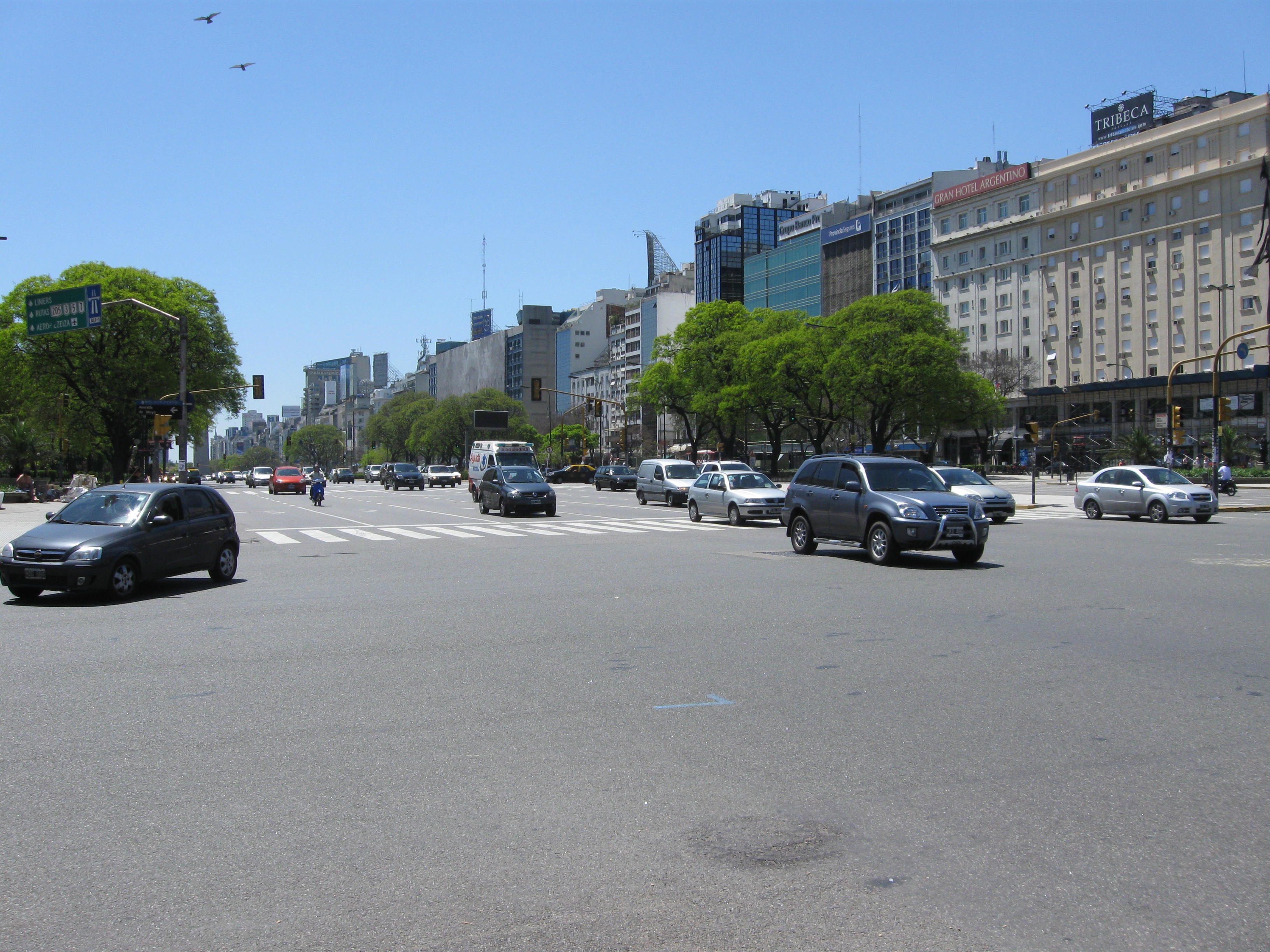
First, we check out the nearby district, which is full of French style architecture and is home to government buildings. On the way we pass some kind of “Occupy Buenos Aires” on the Avenue 9 de Julio.
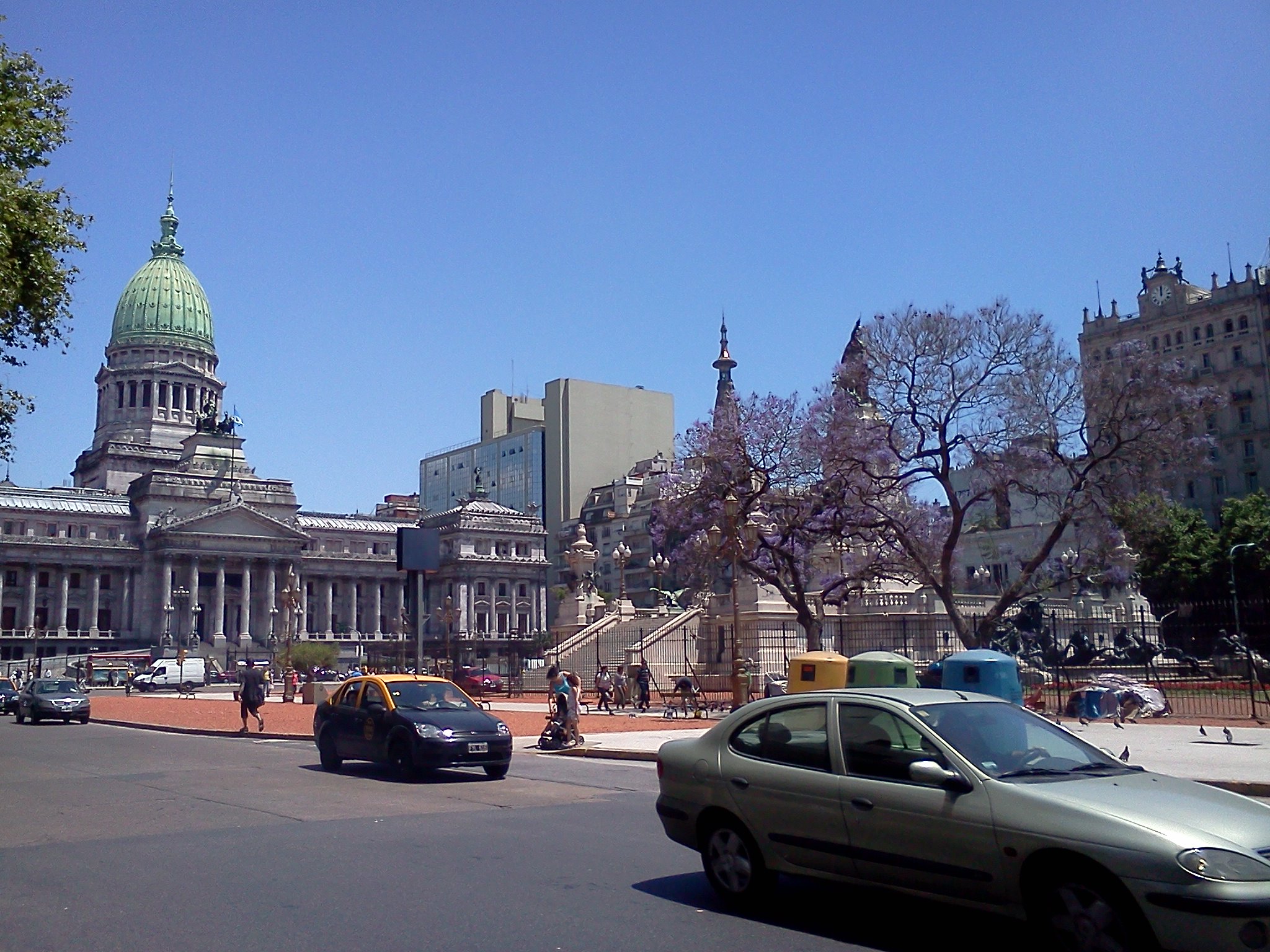
 We see the Congress, Justice Ministry, Finance Ministry and the Casa Rosada, or “Pink House,” where heads of state used to live, and make speeches from the balconies. This area demonstrates clearly the ambitions of Buenos Aires a kind of Madrid or Paris in the new hemisphere.
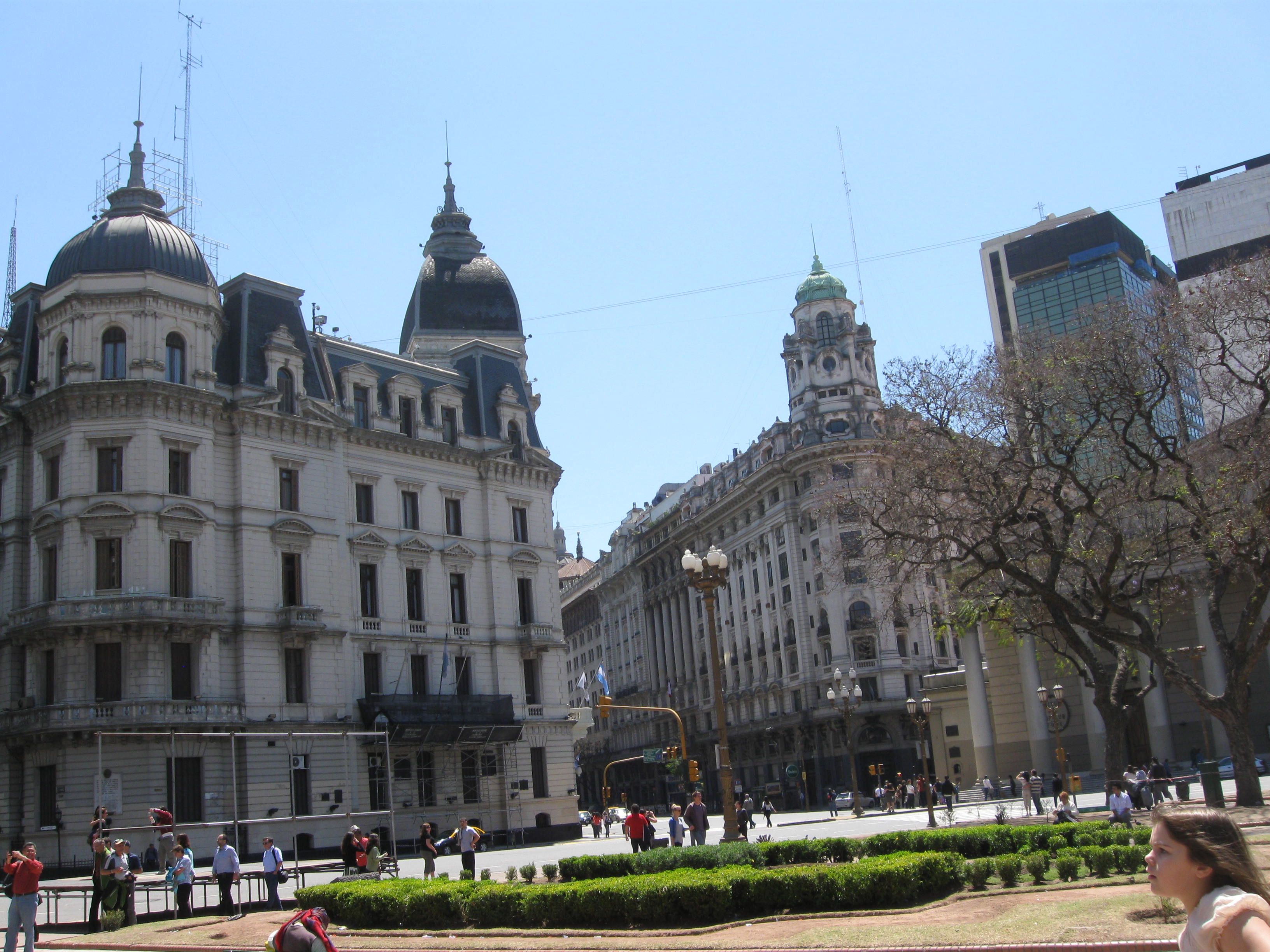 Indeed, one cannot help but feel it is truly a Euro city in America.
 The Plaza de Mayo is surrounded by government ministries, and at one end is the Pink House. The area surrounding is called microcentral.
Eva Peron would deliver her famous speeches from the balcony of the Pink House. It’s the official seat of the executive branch of government, though the president lives elsewhere. It is open for the public to tour.
We stepped inside but the wait to tour was too long, especially for an English guide.
Inside, the walls are covered with images of famous, or infamous, Argentine political figures such as Evita or Che Guevara.
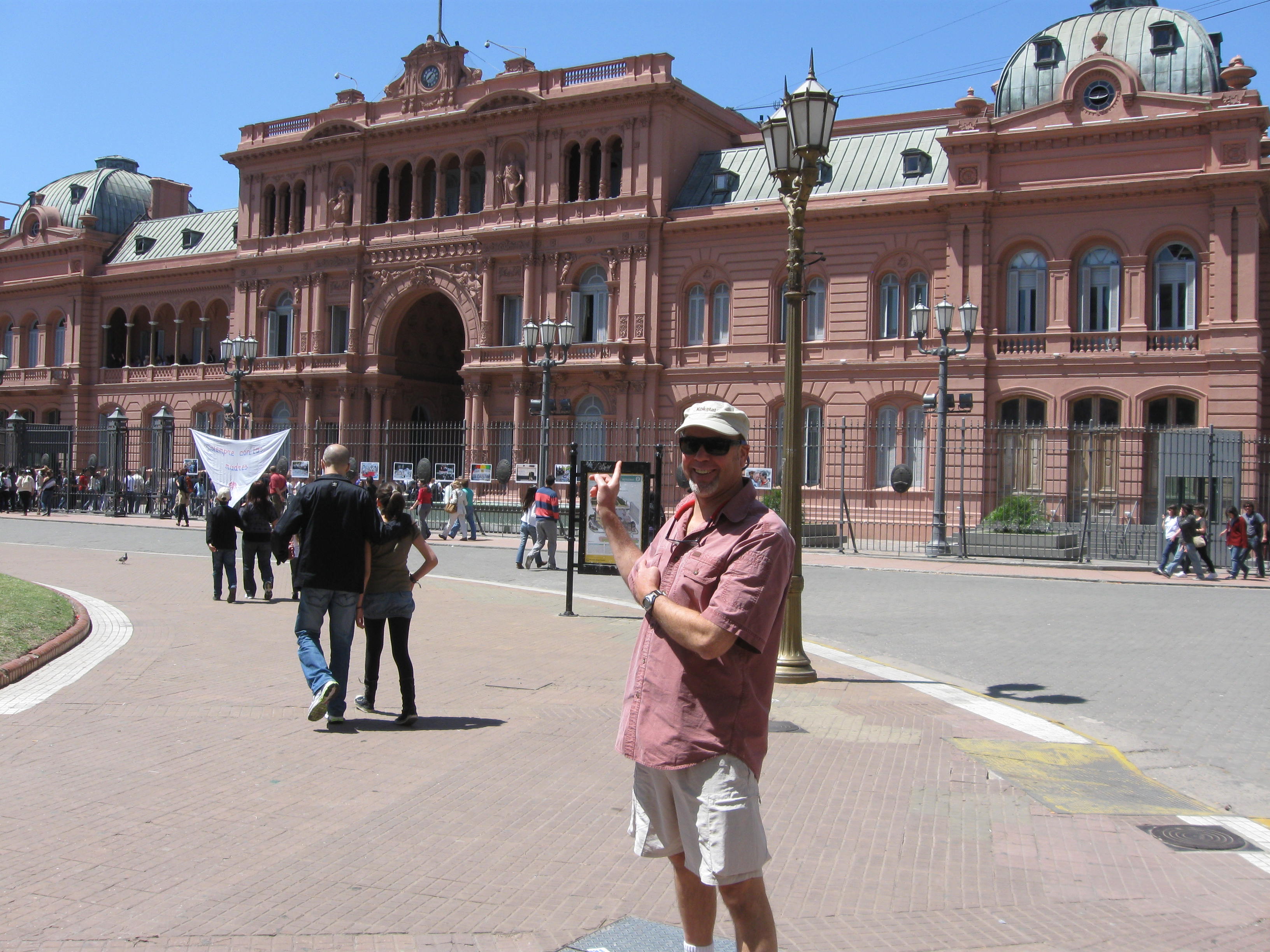
"Don't cry for me Argentina!"
San Telmo is the oldest barrio in the city. In its early days the waterfront was not far from here. I felt like I was in Europe. Narrow, cobblestone streets are lined with southern European style buildings. First stories are usually cafes, antique shops or restaurants with apartments above. Not everything is in good shape – and there is a fair amount of graffiti. Yet it’s got a seasoned feel to it – definitely authentic, tons of character!
 Sidewalks are challenging to negotiate anywhere in the city. They are not always smooth, and often riddled with gaps. You need to be looking down as well as forward!
I enjoyed these narrow, cobblestone streets. Tucked in amongst were various churches of varying levels of ornateness.
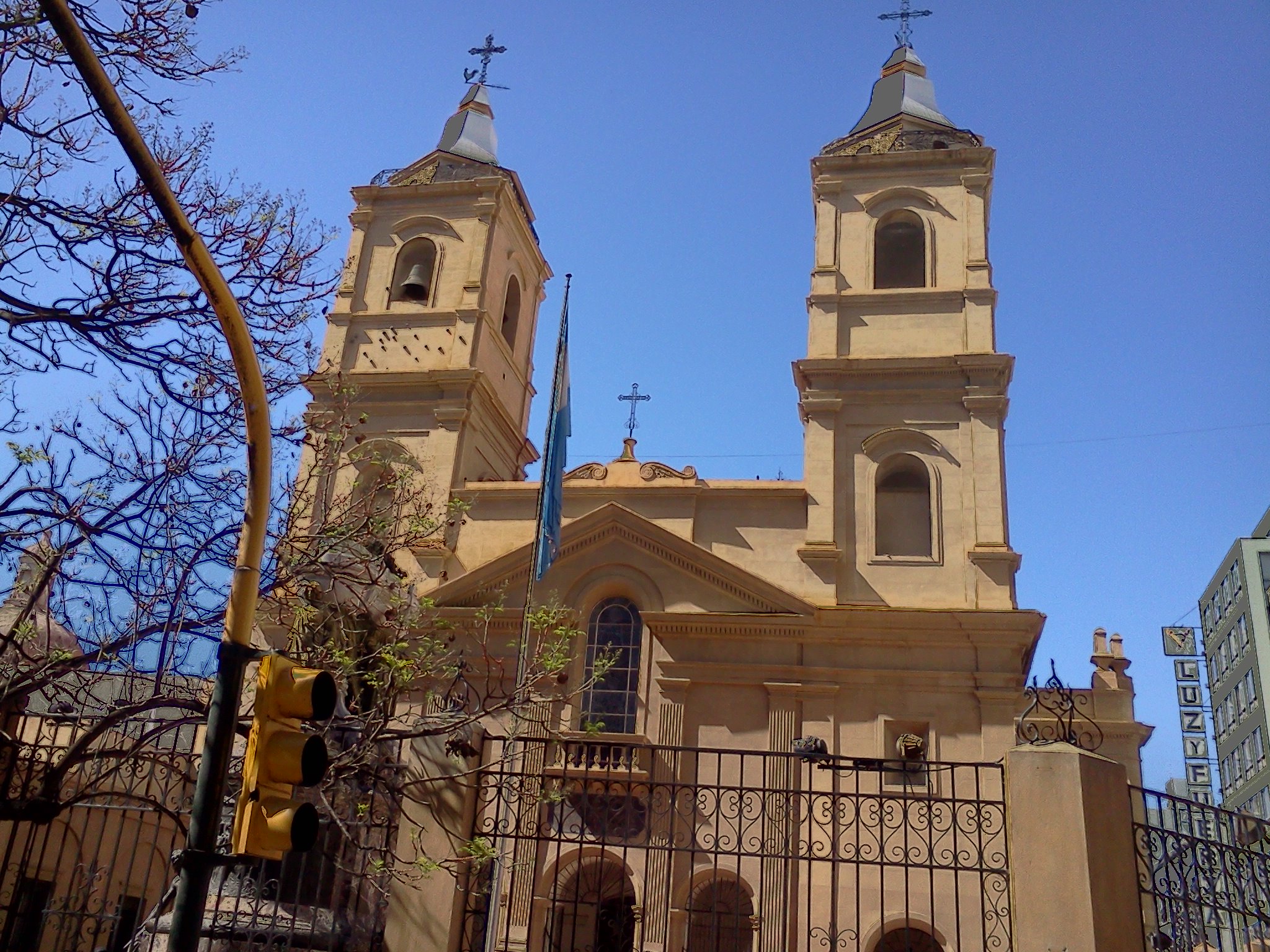
All along you see lovely European style apartments, but often some are in
bad need of repair. 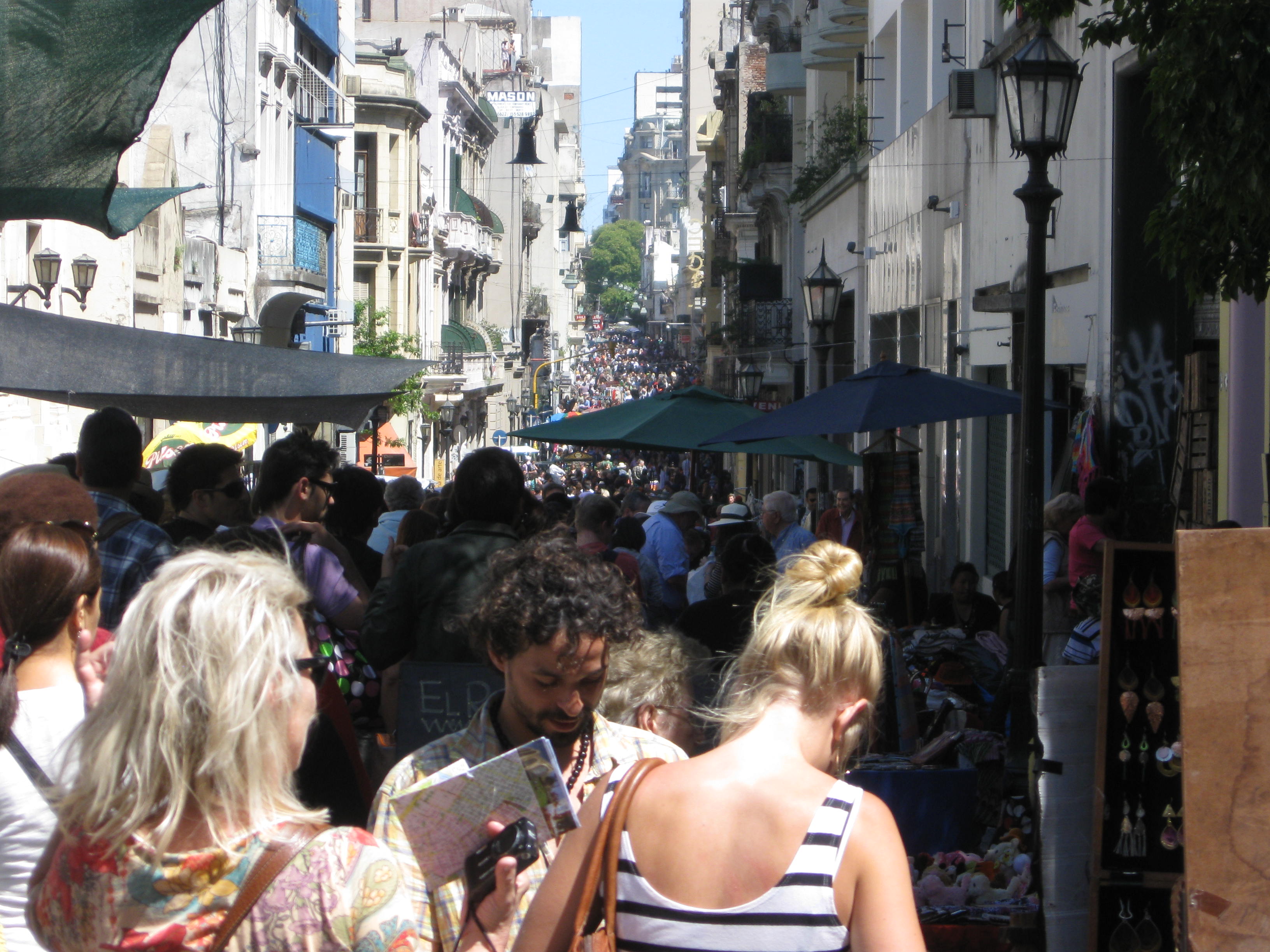 Soon we came to the antiques market. It seemed to stretch forever and I think it’s the busiest/biggest one I’ve ever seen. Although the shops in the buildings sold antiques, the vendors on the streets mostly didn’t offer much more than touristy or souvenir stuff. There were the few selling some old Argentine collectibles, though.
No matter, it was fun to people watch and take in the lovely neighborhood.
People were in a generally gregarious mood! One thing I noticed this first day was something I’d heard about. I’d heard Argentina was ethnically European. This was borne out by what I saw this day and elsewhere. Though everybody speaks Spanish, ethnicity showed the Italian, Welsh, Spanish, and general European roots. Lighter skinned, tall and lots of blonde and redheads! Argentina encouraged immigration in the 19th and 20th centuries and it shows.

TLC needed!
We stopped first for a refreshment at a coffee house inside an indoor food market. Later, we got a table at a cafe on the street near the antiques market. It was here we had our first experience with the Argentine ham and cheese sandwich. I didn’t get one, as I don’t eat ham and cheese. Little did I know this is some kind of national “dish”…we were to encounter it in virtually every corner of the country, it is even served on the airline! I distinctly recall Christof and Elwin remarking, “This bread is awfully dry, and it’s only got one piece of ham and one cheese?” We thought it must be the restaurant, little did we know that IS the way they eat them! I think one of them didn’t even finish theirs and offered it to me but I don’t eat ham & cheese. I ordered a dessert, but the waiter forgot about it. I just held off for the sure-to-be gigantasaourus dinner!
That evening we were to partake in an Argentine ritual – the bife de chorizo – served no earlier than 9:00 p.m. This is a grilled cut of beef, quite huge, most of the time. It does not come with sides. You must order your sides separately. Argentinians consume 56kg of beef per year per citizen. That’s a lot of red meat. And not just the steaks. They consume other parts of the cow as well. They say one reason the beef is so good is because the cows are raised “free,” meaning they roam the flat Pampas region and eat the pampas grass. Nuff said. How do they eat so much red meat and not have all kinds of cancers and diseases? Saskia said studies have shown that one other Argentine indulgence, Yerba Mate, may actually ward off the ills of the un-balanced diet. More on Yerba Mate later!
We sit down and are immediately confused by the menu. The beef comes in various cuts, all written down in Spanish. “Chorizo, Lomo, de ancho, de costilla.” Then there is the matter of how one wants it cooked, but of course the server can’t translate. This is where Saskia came to the rescue, as she knows all the local terms for these issues! When my meal comes the meat is so big, it overlaps my plate. A quarter of it was so raw as to be inedible. Truthfully, I did not find mine all that memorable, except for its size! At the end of the trip, I did have a heavenly steak, however! It was very interesting watching Portenos at the restaurant…passionate, talkative, all indulging in the late-night over eating experience.
A good meal in Argentina is best accompanied with in-country wine. The ubiquitous Argentinian beer, Quilmes, comes in several varieties, all forgettable (click for the Beer Advocate Reviews). For reasons unknown to me, imported Stella Artois seems to be present everywhere, but for this author, who’s become spoiled by the robust packed-with-flavor Pacific Northwest microbrews, it just cannot satisfy. So wine it would be. Argentinian wine is produced in the region of Mendoza, and it’s often Malbec or Malbec blends. It’s delicious, and super cheap! The grapes arrived from France in the 19th Century and spawned a burgeoning wine industry! We did not see Mendoza, but its wineries are certainly hot spots for many visits to Argentina! As an aside, the region is also boasts Aconcagua, at just under 23,000 feet; it’s South America’s tallest peak.

 Cabin Fever Chronicles - Getting Outdoors with Rod