No memoir of this trip would be complete without a narrative of my travails with an Argentine favorite: Jamon (Ham), and especially Jamon y Quesos (Ham and Cheese sandwiches).
First off, I must say upfront one of my favorite things about travel is trying new food! But in Argentina, one thing I was unable to avoid is a food I do NOT eat, and which is not new to me, which is ham. I do NOT eat ham or ham and cheese sandwiches, and if I do, they certainly have something on them to complement the ham and cheese.
But in Argentina, one runs into ham and ham and cheese at every restaurant or lunch spot. These are dry sandwiches. They are almost ubiquitous – north, south, east or west, you’ll see them. They are on a dry bread that looks like, but does not taste nor has the texture of, a hoagie roll. They typically put exactly one piece of ham and one piece of cheese on the sandwich. Nothing more. You are not likely to be offered mustard, mayonnaise, a tomato or any lettuce! You are expected to “enjoy” this dry concoction without anything.
I saw them on menus, in cafeterias, on a ferry, in grocery stores, package stores, liquor stores, and on the national airline served as an in-flight meal! When we ordered trail lunches, they included this same ham and cheese sandwich every time, with one exception. And that one time, the alternative was tuna, but again, served on a dry piece of bread.
At breakfast, you will not see eggs on the menu. But you will see ham (jamon) accompanied by any number of other things. Never chicken. Never bacon. Never sausage. Just ham. It is possible to get eggs, but you have to plead hard to get eggs!
The trail lunches that were the best for me were ones I made myself. Even then, though, there were challenges. That is because fresh vegetables and fruits are in short supply in Patagonia. Even in some markets, I had to hunt to find something fresh. I wondered if supplies were delivered weekly? That shows it really is a “frontier” region.
One of my travel companions is Jewish, and I found out she’d tell the people preparing the food she couldn’t eat ham. They made alternatives available. I should have thought of that! It would have made my lunches much more pleasant.
I’ll never understand the passion for ham. And, I never saw one pig in 24 days in Argentina. Nor did I see a chicken!
I am not the only one noting this phenomenon, for Internet research reveals others have suffered the same as I!
“You fly between Argentinian airports and the standard fare on the plane will probably be a ham & cheese sandwich. You go into a supermarket to get a sandwich and all that will be …ham & cheese. You ask for a lunch box from the hotel and you get, you’ve got it, a ham & cheese sandwich. It become a standing joke with our tour group that if we were due a lunch anywhere, then it was likely to consist of a ham & cheese sandwich…… It got to the point where it seemed that if an Argentinian was asked what was in a meal and they did not understand the question, then they said “ham & cheese” because that would be accepted, regardless of what was actually in the meal!”
This is not to say I had no good meals in Argentina! I sure did, some excellent dinners and certainly the ice cream is special. But the lunches, and breakfasts, were really difficult!
We depart El Calafate on a public bus. It is several hours on the road to El Chalten. The route takes us along Lago Argentino and then Lago Viedma. I am overwhelmed with the sight of the steppe, these enormous lakes, the emptiness, and the mountains visible north to south for hundreds of miles. It’s not something we’re used to in North America. As before, it looks like the American West, so desolate and dry. Except for no vehicles on the road.
El Chalten is a frontier town. It was established in the 1980s by Argentina to resolve a border dispute. It sits underneath two of the world’s coveted climbing prizes, 10,262 ft Cerro Torre and 11,070 Cerro Fitz Roy. These vertical fangs are renowned for vertical difficulty combined with abominable weather. They’ve claimed a lot of lives. The town is renowned as one of the windiest in the world, and we are about to experience it for ourselves. It’s not cold right now. But the wind is supposed to be epic. It sits at the gateway to the north entrance to Los Glaciers National Park. El Calafate was at the southern end. It contains world class hiking and opportunities to climb on the Viedma glacier, largest in Argentina. We will do it all!
All during the drive I keep an eye peeled for the Fitz Roys. Something catches my eye, and I cannot believe it! I am seeing a river of ice which ends in the desert. It is the Viedma Glacier! I never imagined anything was possible. It makes its own lake, but everything around it is desert! Click on the image to see all of it.
And to the right of the glacier, this sight also made my jaw drop! It is the Fitz Roy Range! We will hike it!
For the umpteenth time in as many days my eyes tear up with what I am seeing. I just cannot imagine. We get closer. The road stays empty. This afternoon, we will be hiking in these incredible mountains!
El Chalten (Cerro Fitz Roy) front and center!
We reach town, where it’s windy beyond belief! The entire town seems to be under construction. It’s a magnet for adventure travelers. Wind blown backpackers can be seen walking the streets. We stay at the Ailen Aike hostel, six to a room. It’s got a small common area with flat screen TV, a bar, and tables. The whole time we’re there, the wind is moaning, trying to lift the roof off!
It’s mid day. We hit the trail for Laguna Torre.
This trail is perfect for an afternoon. It climbs steeply out of town, but after the first mile, begins a more rolling climb, much more tolerable. The wind up on the trail isn’t so bad.
In fact the sun is out, and things are pretty nice! But up above, Cerro Fitz Roy is in the thick of a maelstrom. Its other name is Cerro Chalten, meaning smoking mountain. The wind runs vertically on all sides of the peak, creating a constant cloud which blows off of it. It looks like it’s smoking!
I’m sore from the climb at Torres del Paine. We have a big hike in two days, and I don’t want to overdo it. So my plan today is to get to the first viewpoint, lunch, watch the mountains, and head back to town. The others are going to go all the way to Laguna Torre, to the lake where a glacier ends. This way it’s like a workout.
This is a truly lovely park. And not as busy as Torres del Paine.
Yours truly, on the trail
There are glaciers cascading down from the mountains. And of course pretty azul colored rivers flowing from them. There’s also a small plain below everything, which looks great for walking.
We reach the viewpoint and have lunch.
The others depart and I stay put watching the scenery.
What is apparent is the violence of the winds aloft. There is a stationary cloud behind the peaks – It’s formed by the permanent ice sheet above. The unpredictable, violent weather here is driven be four factors: 1) Latitude – we’re not far from Antarctica; 2) the bottom of South America is not all that wide – we’re simply a giant finger in between two oceans, so the trade wind blows across; 3) factors 1 and 2 combine to create the ice sheet, which makes the air so cold above; 4) the desert is lower and drier…so the cold air rushes downward off the mountains to the desert all the time.
As I sat watching, an upside down atomic bomb mushroom cloud explodes downward over Cerro Torre! Holy cow. I wouldn’t want to be on ropes climbing! Here is a video I took as I was watching Cerro Chalten. In it, you can see the cloud moving downward over Cerro Torre, if you look carefully!
After an hour, the wind begins to pick up so I decide it’s time to head back. I think I’m walking a good pace. But then, I hear some footsteps behind, and it’s a woman jogging down the trail! Down she runs, at a good pace, dodging the rocks, and passes me by. My goodness! She made me look like a slug!
After two hours I reach the top of the beginning of the trail. From here, there is a good view of El Chalten.
I think that part of the reason it’s so windy in town, is that it’s in a valley. The wind must get funneled through there!
From Torres del Paine we head into Argentina, across the empty Patagonian steppe to El Calafate. It’s the lodging headquarters for those visiting the Perito Moreno Glacier. El Calafate is the biggest town for hundreds of miles around.
We stay in the centrally located Calafate Hostel. Its guests are all visiting the outdoor spectacles in the area. Lago Argentina, a 1,640-ft deep, twenty mile wide glacial lake sits to one side of this town. This lake is as deep and much larger than Lake Tahoe. It is 566 sq miles in surface area, and Tahoe is 191. This morning, we head to the dining area and things are not going well. The coffee is just about un-drinkable, the milk is hot. There are not enough coffee cups or cereal bowls or anything. Yaap complains to the staff. And again, the fruit is canned. I make up my mind to bring my own stuff tomorrow, I cannot stand it. I love breakfast and this is hard. Still, a surprise! An attractive young woman comes to sit at my table. We introduce ourselves, and she is from my home town in NY! Her name is Andrea, she works in Australia. She’s really excited to see the glacier today and will be on my bus! We talked all the way to the glacier.
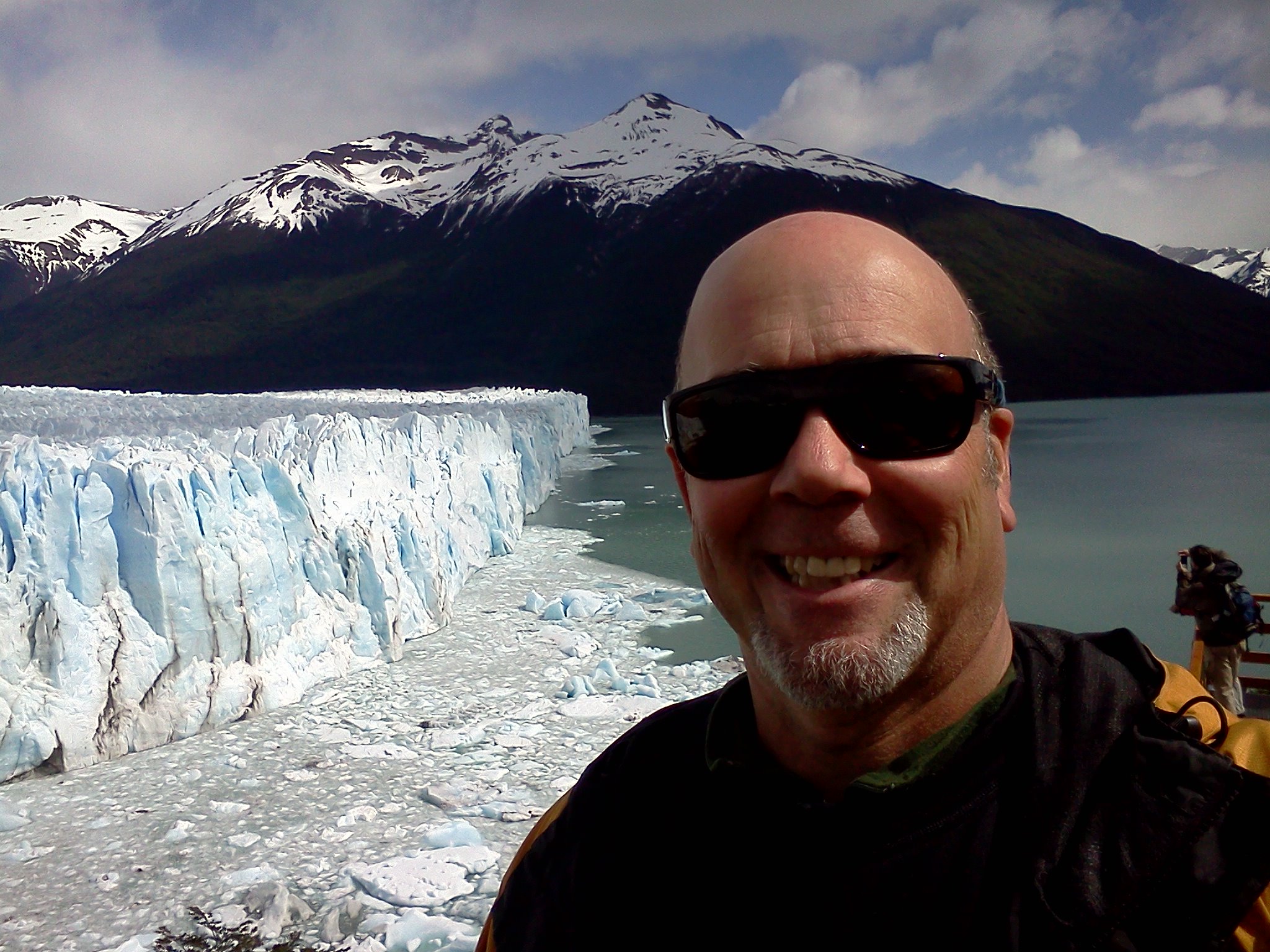
I’ve never seen a glacier of this magnitude. The Southern Patagonian Ice Sheet feeds 300 glaciers in Argentina, including Perito Moreno. This is a famous glacier because it moves 10 feet per day, and calves ice bergs all day long. It’s also got viewing decks built along its face so you can see it up close. Saskia, our guide, says it’s really exciting to watch.
So without further adieu, here are some nice photos of this magnificent force of nature!
This is the left half of the mile-wide glacier terminus.
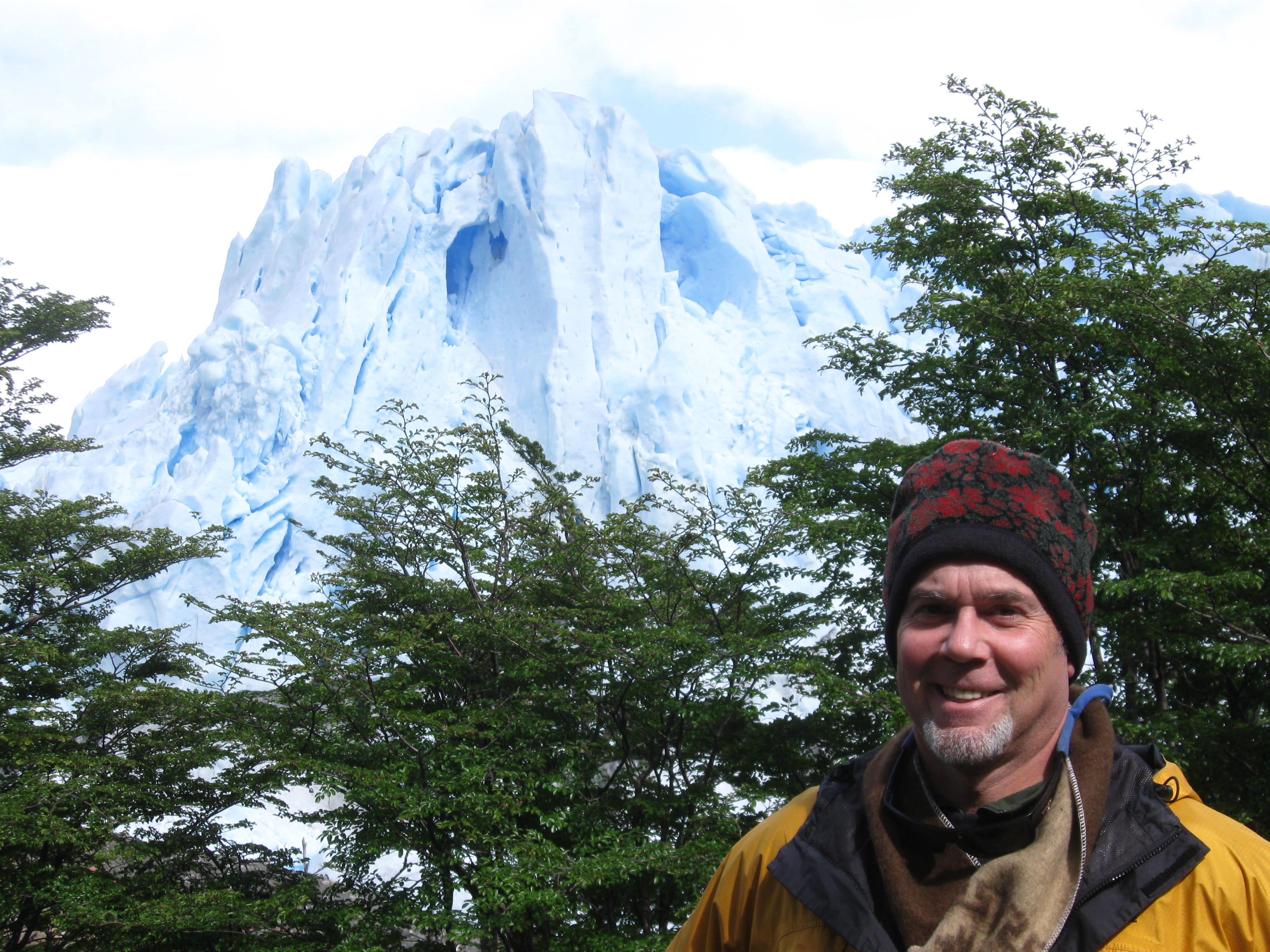
The terminus of the glacier is three miles wide, and 16 stories tall. It dwarfs tourist boats coming to view it. It’s one of three in the world that is growing. It’s 580 feet thick. It’s a sky blue color! Riddled with dirt. The front is 16 story tall saw tooths of ice. Utterly un-walkable. We take walks all along the decks built to people can view. It’s incredible how tall the wall of ice is.
I can see down more than 100 feet and yet the glacier towers above me.
A view along the north side of the glacier shows how wide it is. On the viewing platform there are places to sit. Many are having lunch, some writing, but most are watching the glacier, because this one is known to send off ice bergs all day long. I sit down and wait. I can hear explosions all around. Those are cracks in the glacier which appear as it moves over the ground.
Several times I see ice falling off the glacier, and it slams into the water, as if in slow motion, and then bobs up only to reveal maybe 10% of itself once it floats. Ivo was able to catch one of the moments with a fast action camera, and put together this compilation! Enjoy! It’s fantastic.
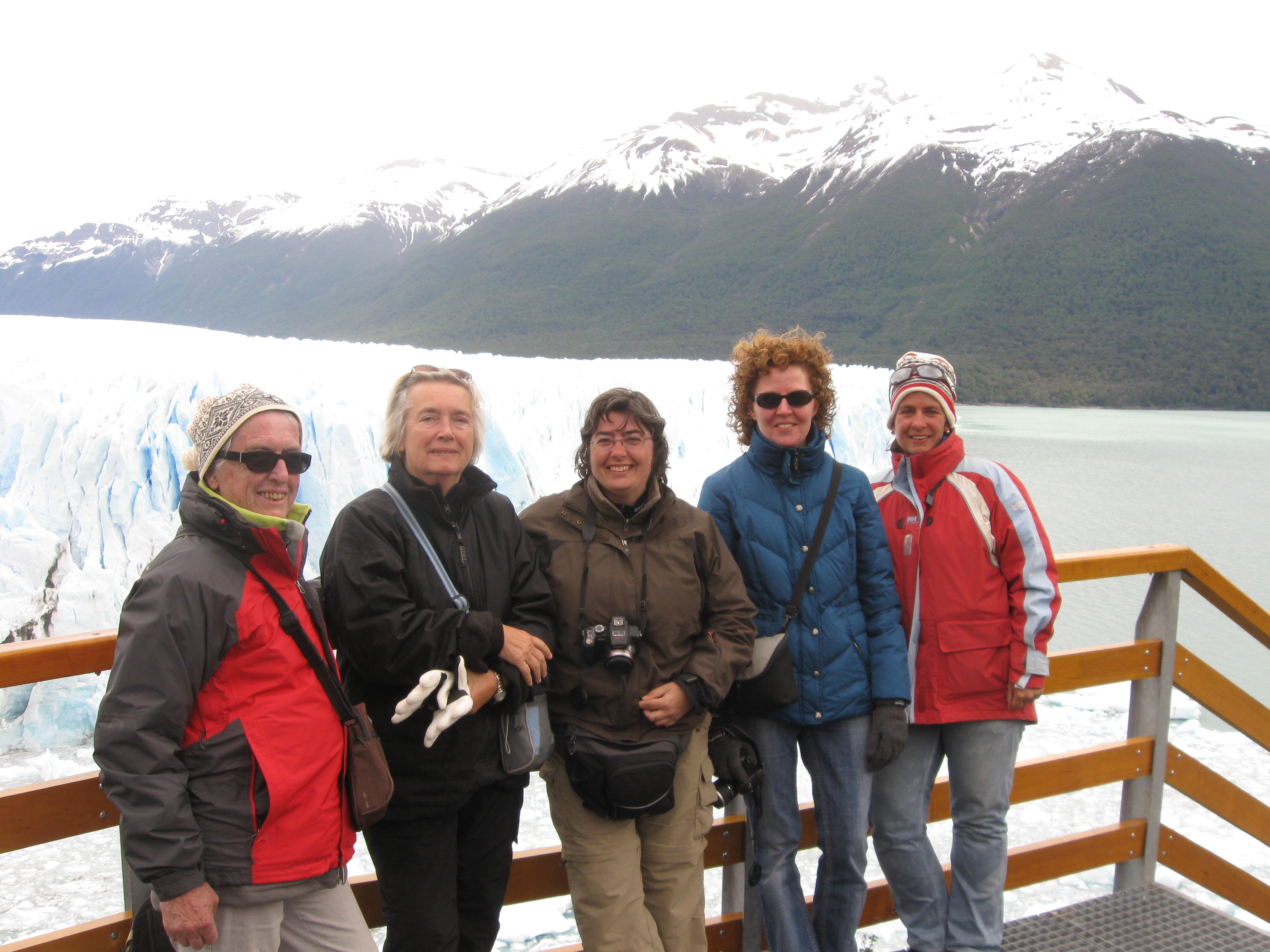
Ans, Margaret, Monique P, Anne Marie, Monique
The ice field behind the glacier, and the glacier itself, make their own weather. Several miles away from the glacier, the weather turns sunny again. In the days to come we’ll see again and again how the ice sheet affects this part of South America.
The lake, which is probably a hundred miles long,
is peppered with ice blue glaciers from these glaciers.
Amazing!
At the parking area, I see some friends from Bariloche! It’s Matt and Rob, our British friends who are doing the walking tour! They took a ride down here, but plan to walk back to Bariloche. Nice to see them!
After we get back to Calafate, we stroll the town in search of dinner and a drink. It takes a while, but we find an outdoor table in the sun. Of course, it’s popular, but we manage to grab a table. As this town is a magnet for the outdoor seekers in Patagonia, it’s got visitors from all over the world.
We meet two guys at the next table, who are from Reunion. If you know where Reunion is, you are a geography buff! It’s off the coast of Madagascar, in the Indian Ocean!
During our journeys through the steppe, our walks along the ocean, hikes in the mountains, or time spent on the lakes, we witnessed a lot of birds, and a fair amount of other wildlife. So this post is dedicated to the fauna! Most of these photos are courtesy of Monique Poesiat.
Often seen where other colonies of birds lived, and flying low, this caracara could sometimes be approached on a perch within 10 feet of the trail.
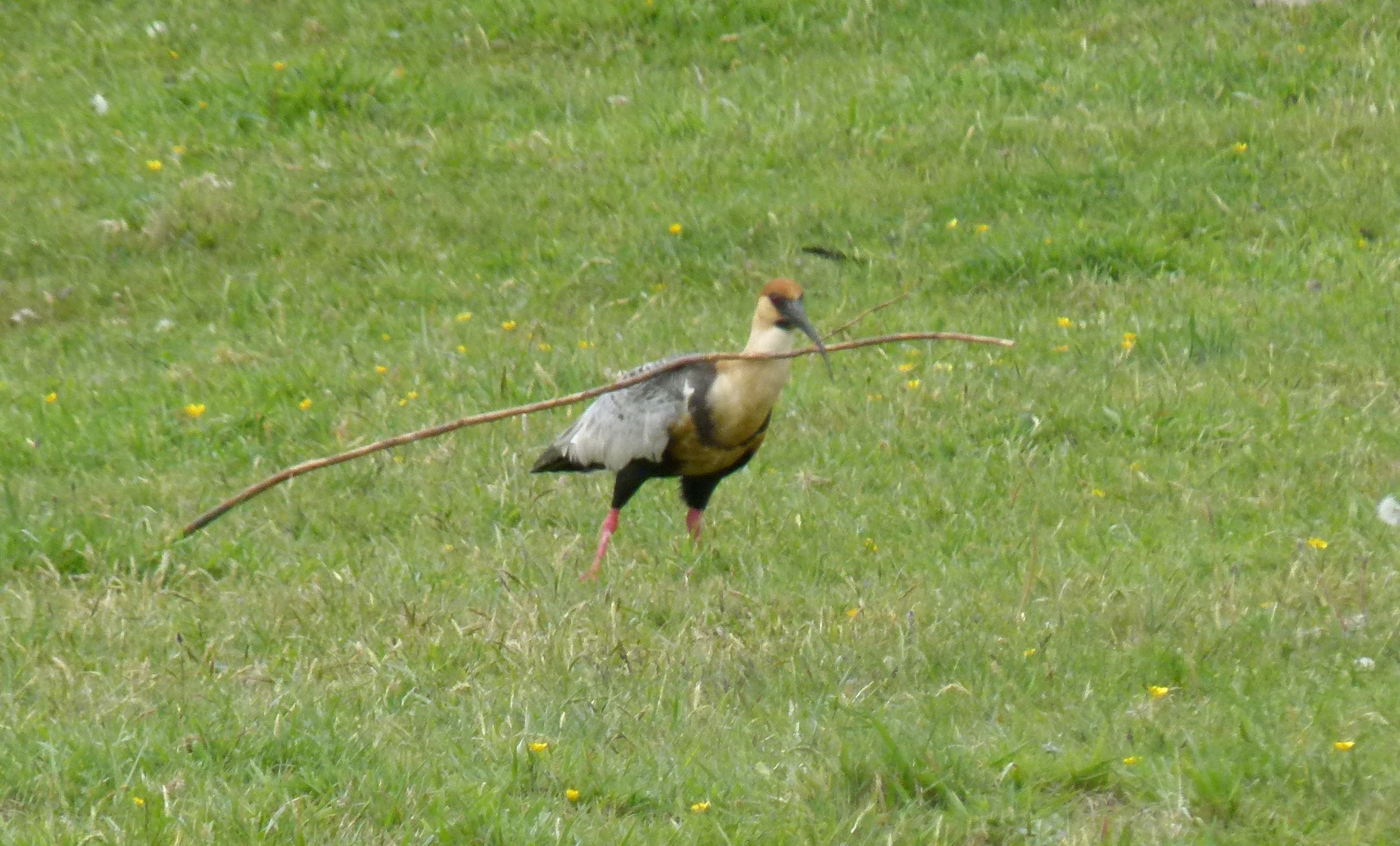
Another bird which was our companion from Buenos Aires to Tierra del Fuego was the Black Faced Ibis.
Black Faced Ibis
These Ibis are gregarious, and I saw several raucous colonies! They also fly in groups. They don’t seem to have any trouble surviving in this part of South America!
No narrative of our trip would be complete without the pink birds – Flamingos. We saw them high in the Andes and down on the steppe.
Flamingos seem to congregate wherever there is a brine type of water. But we also saw them in marshes right next to some of the huge glacial lakes down on the steppe, near El Calafate, so I’m not entirely sure what attracts Flamingos to a place.
That doesn’t matter, because they are so beautiful. And, their pink color is always a pretty contrast to the green or brown environment where they forage.
Torrent Duck
On a hike along a steeply sluicing river Nahuel Huapi National Park, we noticed a duck diving in and out of the steepest rapids! It would dive right in, and stay in, only to re-appear somewhere else along the rapid. Or, well, waterfall? This amazing duck is called the Torrent Duck, and it is not a good flier. Rather, it is an Olympic swimmer!
Quite the singer!
Along a glacier, the Rufus Collared Sparrow was declaring his territory, and his call would be answered by others within earshot!
And when a mate is secured, they are busy. This Sparrow, and other birds we’ll cover, were often fanatically working to build nests and raise families!
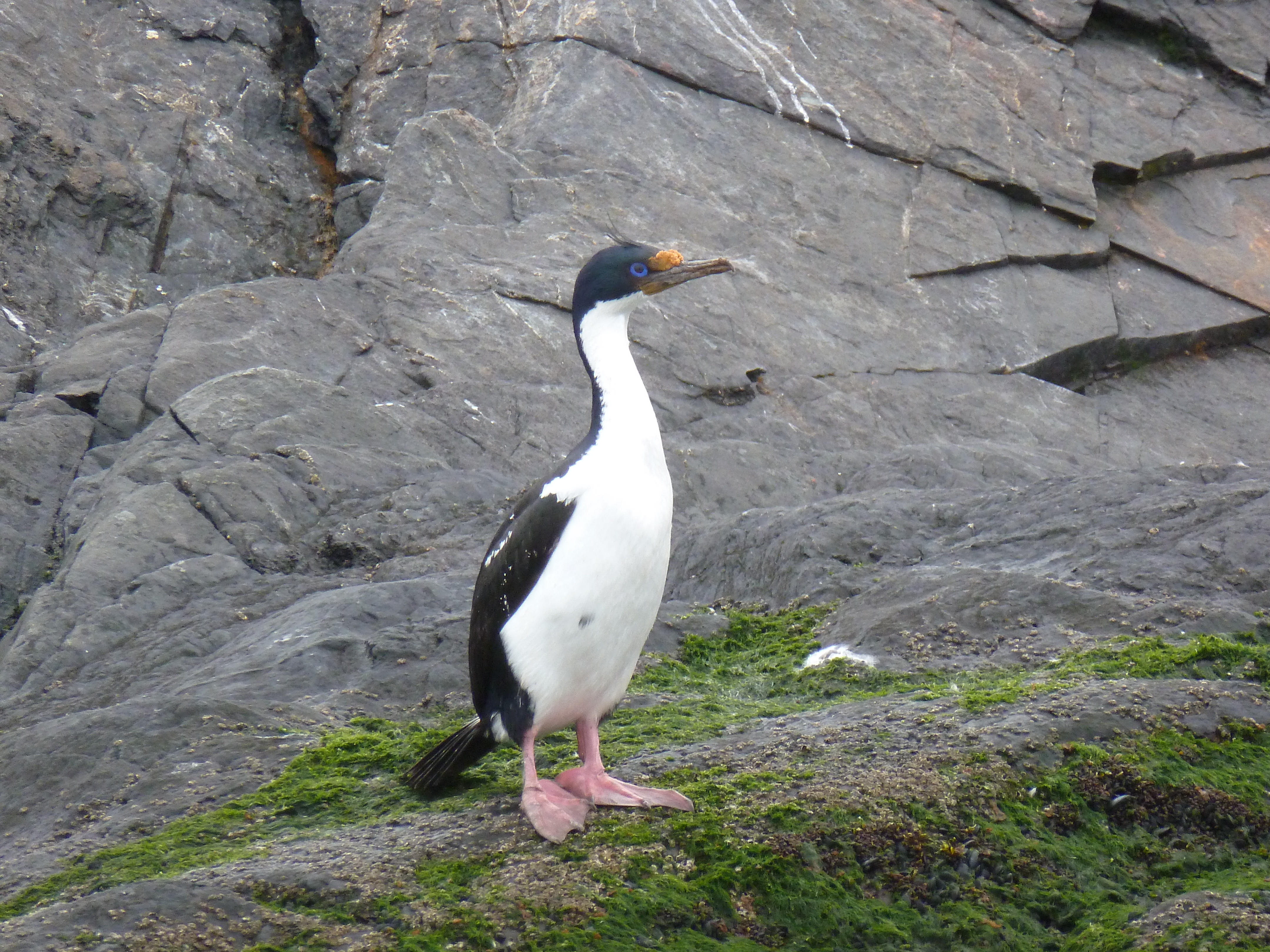
In the mountains or in sea colonies, all are set about bringing up the next generation. Some of the most industrious were the Cormorants.
Another time, a flash of yellow caught our eye, and it’s the Sierra Finch.
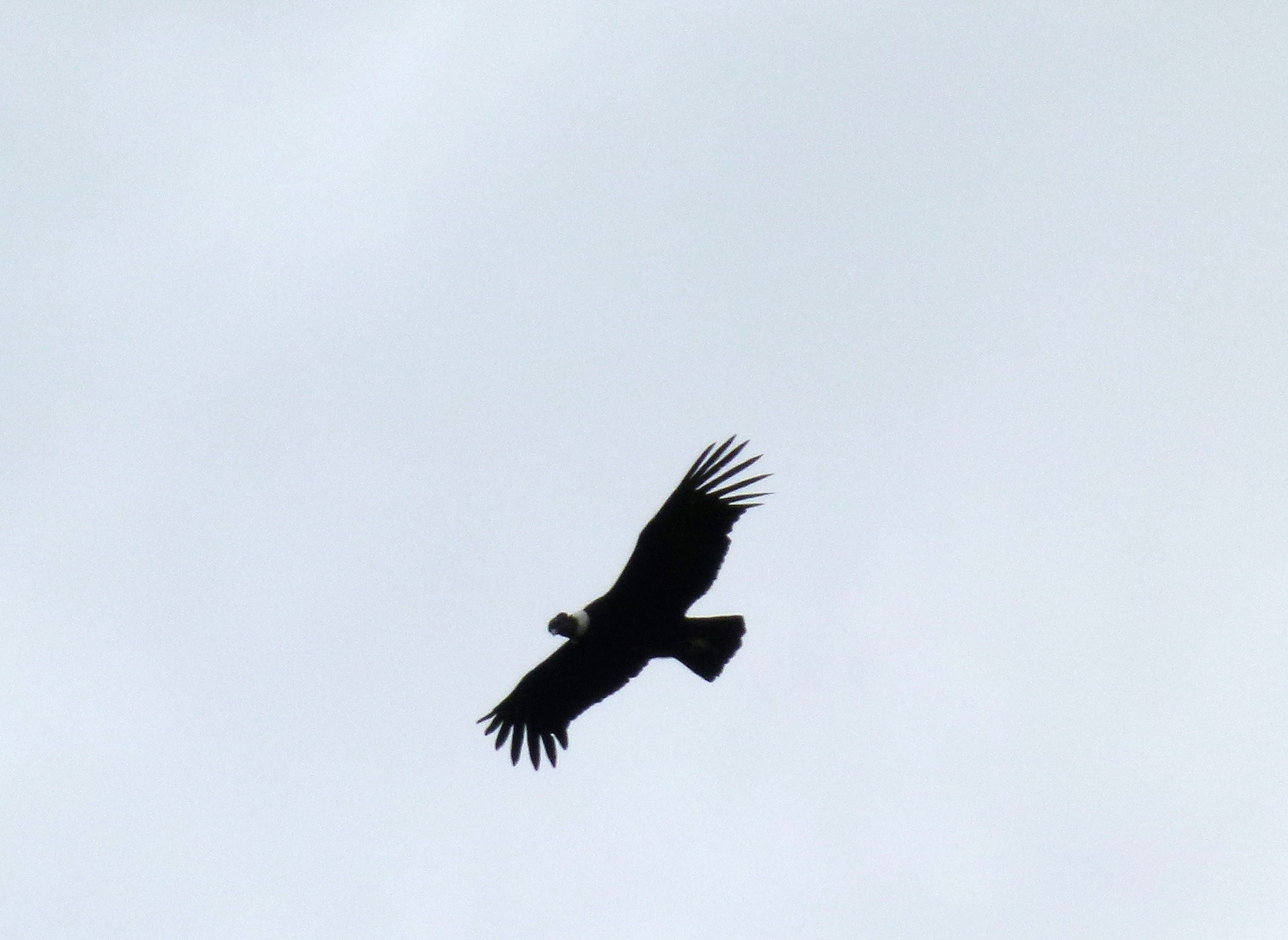
And throughout our time in Patagonia, whether we were out in the steppe, which is flat, or in the mountains, we would witness one of the largest land birds on Planet Earth. And that bird is the Andean Condor.
The Andean Condor
In Patagonia, Condors do not require mountains and steep aeries to fly from. It is so windy, they can often be seen perched on hummocks. They rest, and when the wind picks up, all they need to do is spread their enormous wings to get aloft.
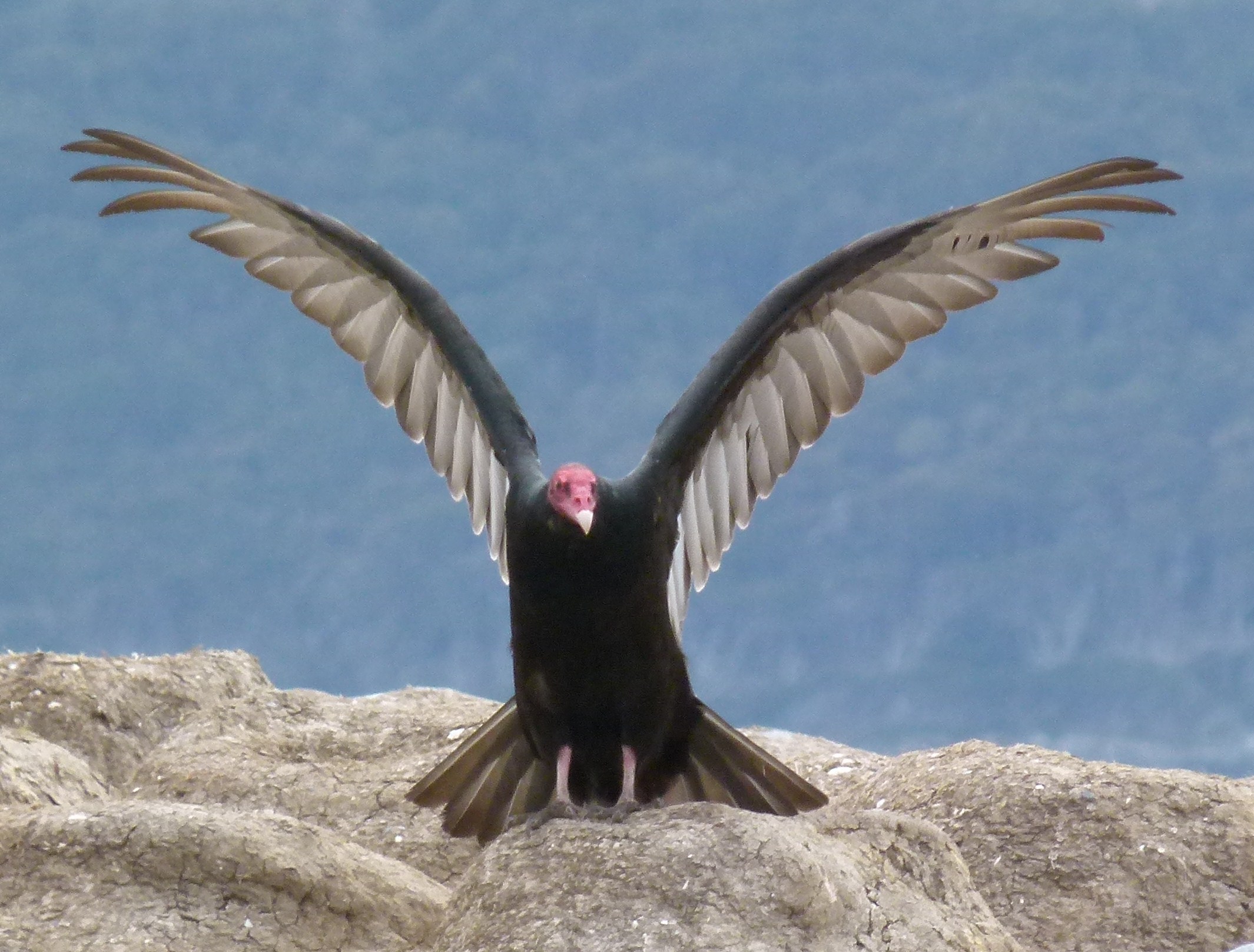
Another bird seen soaring everywhere is not quite as revered, yet its eating routine is not unlike the condor-the lowly turkey vulture.
A common sight was a relative of the woodpecker, a flicker.
They could be seen seeking insects in the hollows of trees or even on the ground sometimes.
More rare was the fire eyed Diucon.
Down in Tierra del Fuego, the busiest birds of all were Arctic Terns and Cormorants.
They build island-colonies solely occupied by their species.
When one arrives by boat, all you see are busy birds flying back and forth with nest building materials!
They are simply fascinating!
The islands where the terns and cormorants nest remind me of WWII aircraft carriers, with “aircraft” constantly coming and going. Noisy and smelly, too.
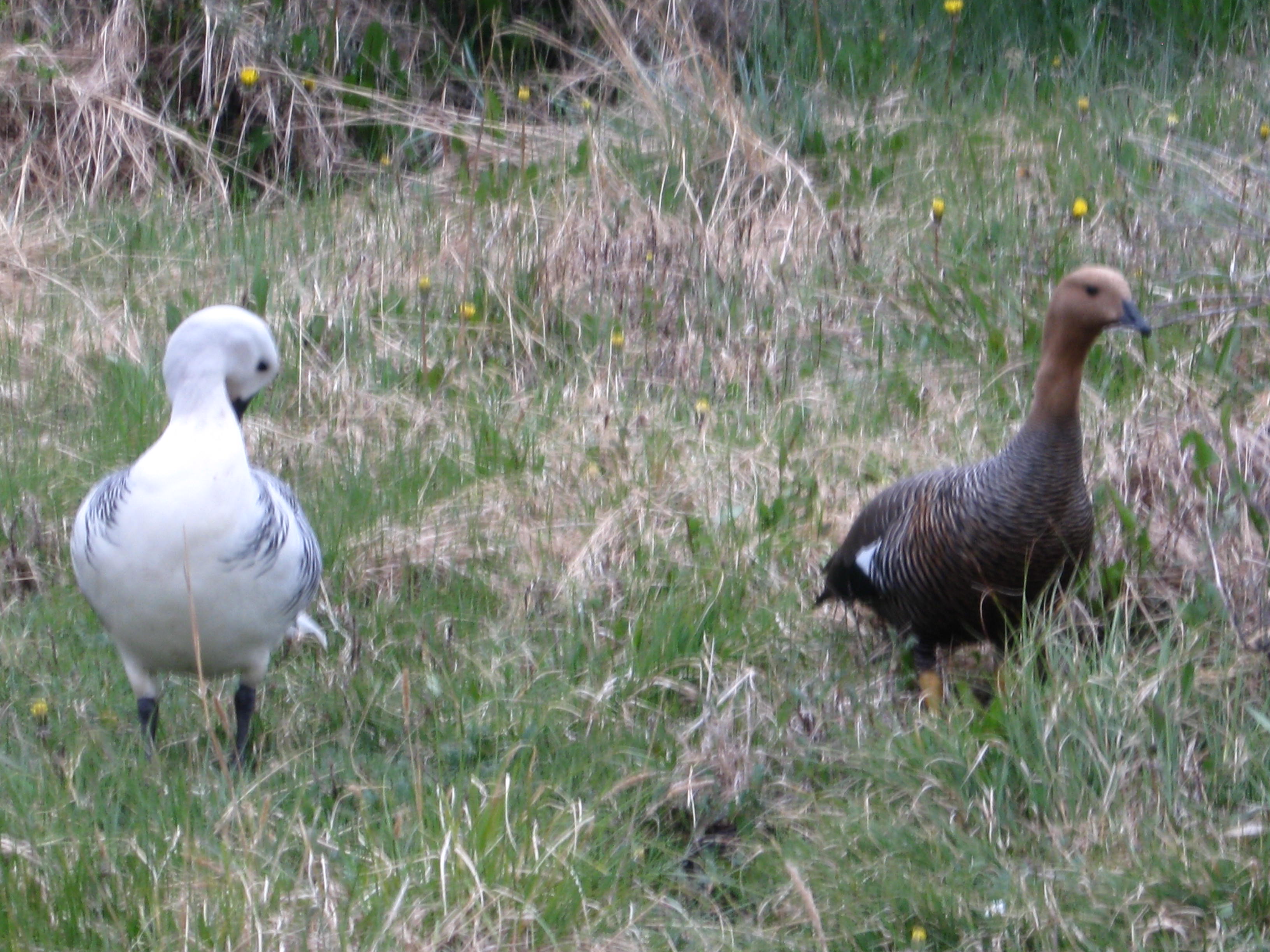
Another constant companion is the Patagonian Goose. Instead of living in gregarious flocks like Cormorants, Terns, Ibis or other geese, these are almost always seen in pairs.
Back in Buenos Aires, we saw some more warm weather birds.
The gregarious, festidious green parrot could be seen, and heard, whilst foraging or socializing in the parks around the city.
But we saw some other creatures that are notable!
One of a pair of iguanas that scampered across our path...
We also witnessed some iguanas being chased by parent birds defending their nest.
And, down in Tierra del Fuego, there is an invasive species, famaliar to Oregonians. Yes, Beavers were introduced, and they have wreaked havoc on the environment down there.
But, they are interesting, I guess. Like the cormorants, these fellows never stop working overtime!
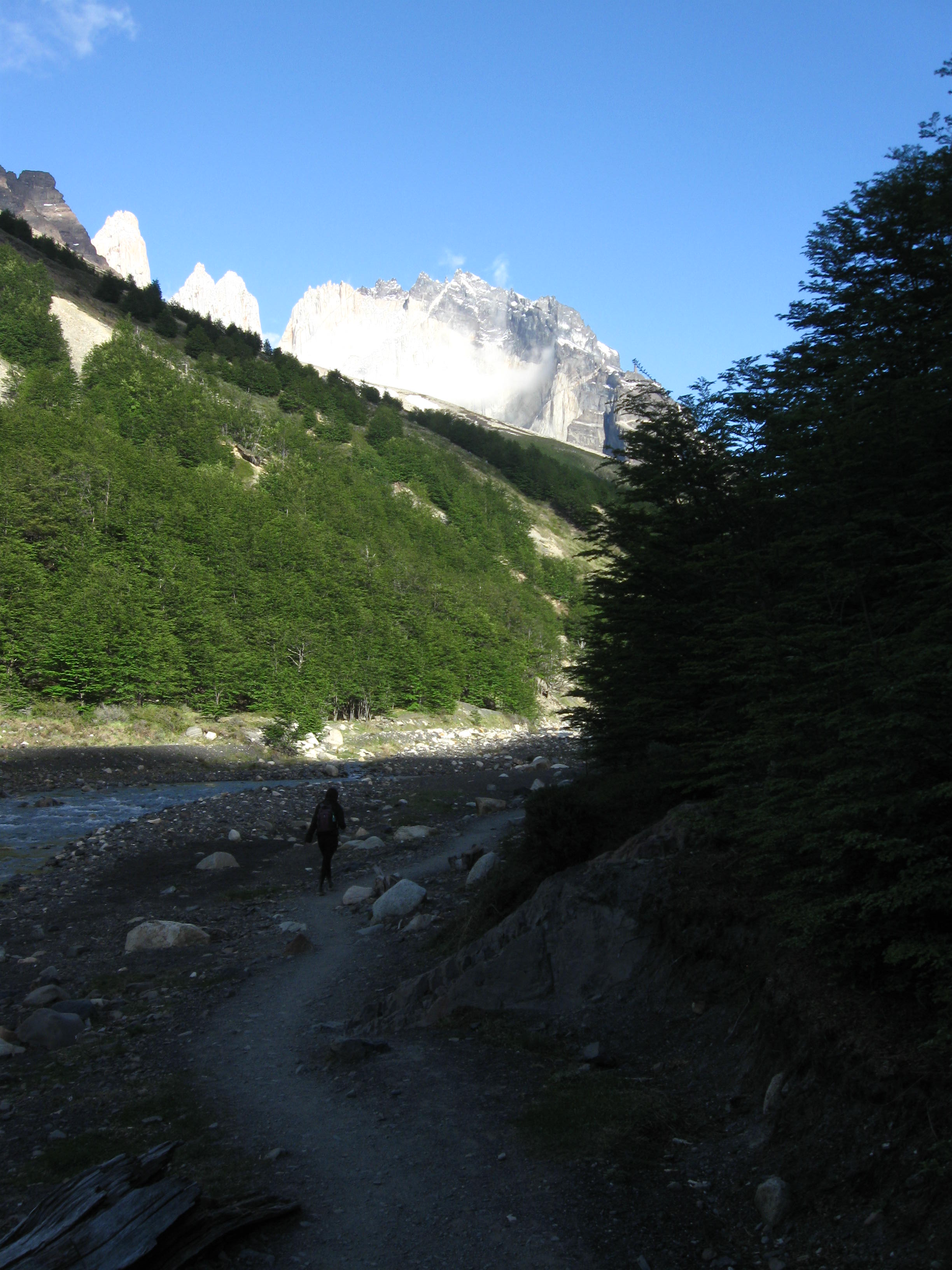
Awakening at O’Dark Hundred, it’s pitch black and the Southern Cross is sparkling. We’re up early because Saskia wants us hitting the trail at 7:00 a.m.! Little did we know, but this was a brilliant decision for hiking Torres Del Paine.
We force down some more dry bread, orange colored water and cheese at the refugio-cafeteria. Today we could pre-order a “trail box lunch,” and this time a tuna sandwich was a choice – I picked tuna over the standard dry ham and cheese!
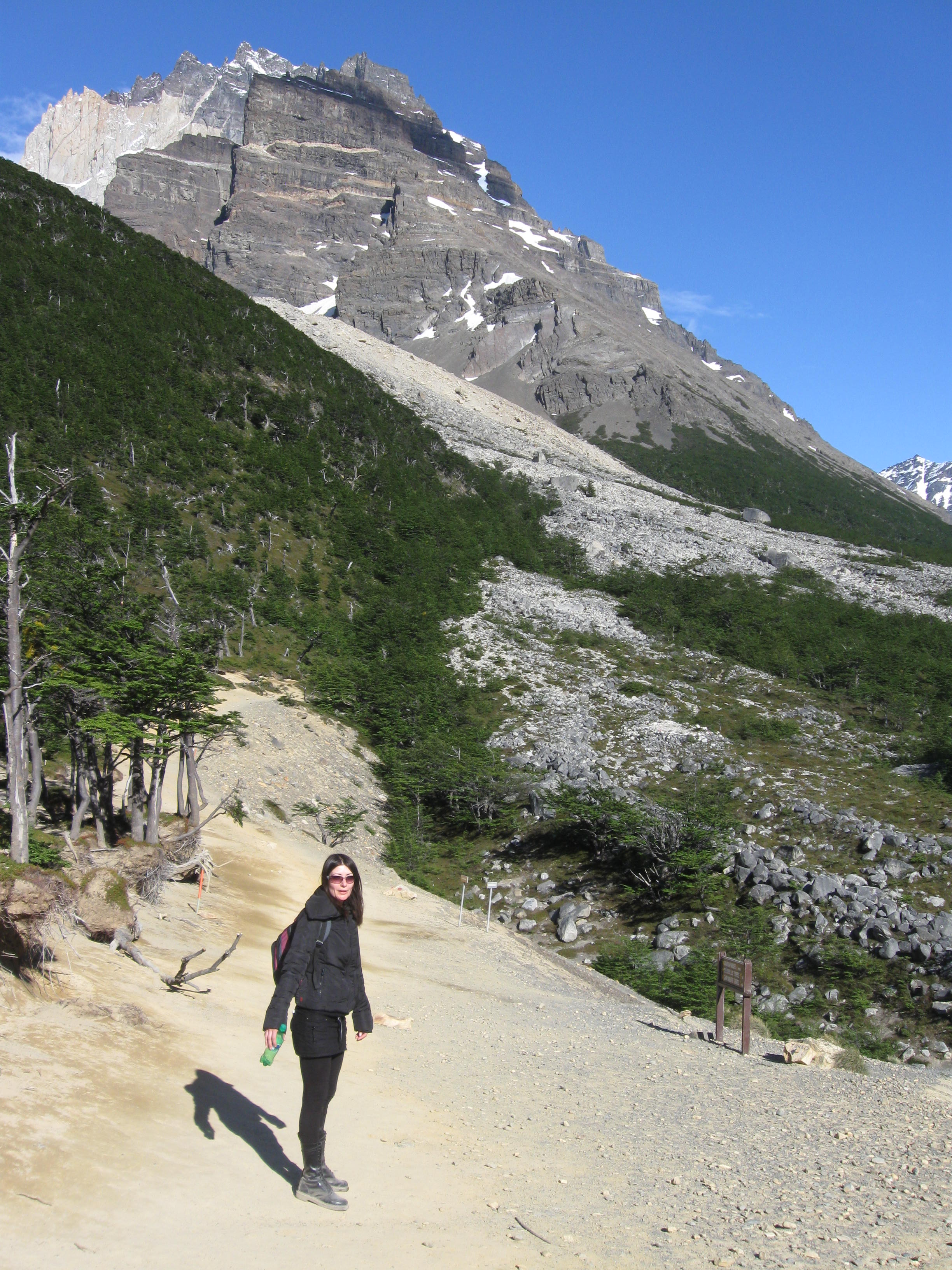
All suited up and booted and ready to to, we were all set. Almost. You see, our Refugio had an outdoors “boot storage box.” Inside, we were to walk in our stocking feet. We were to leave boots outside in the box. Being that we are in the Andes, low nighttime temperatures could be at freezing. I knew from past experience to NEVER allow boots to be stored outside if it is that cold. That means putting on COLD boots in the morning, and who wants that? So I took off my boots and brought them into my bedroom for the night. I was just fine. But some of my peers didn’t take such precautions, in particular Angelique! Hmmm, we’ll be hearing from Angelique today…Angelique did not pack hiking boots. Rather, she had Dr. Martens-calf-high boot style. She’ll find out if those work on the trail!
Our luck holds as it’s not windy, and the sun is out. Locals say it can blow a constant 4o mph around here! It’s cold but the athletic effort will no doubt have us losing layers before long.
We embark, hiking at a brisk pace along the flat plain below the towers to the trailhead. We come across bridge over a river, and like yesterday, there is a limit on how many can cross at once. Rickety for sure, but it’s kind of like Disneyland! What would a hike down here be without a rickety walk over a skinny bridge? It’s not too long past this bridge where the real trail begins, which will end at the base of the world-famous pinnacles of Torres del Paine!
The hike should challenging. It’s about 12 miles round trip, and 3,000 ft elevation gain. The beginning has a steep climb. The middle is up and down. The end is a 40-minute scramble up a boulder field, to a spectacular view of the towers. The climax will be a view of 9,000 ft vertical towers, with a glacial lake underneath! In 2011 I have done so much kayaking for work, and been so busy with outdoor recreation / kayaking work that I have not done much hiking. But I know how to hike efficiently. And, I am so much looking forward to being outside and the workout!
My strategy is to start at my own pace, slowly, let my body warm up, and once the trail reaches the rolling section, take off like a madman, like a workout. Let the legs run on the downhills. Then, at the scramble at the end, have enough energy to make a push to get there in a respectable time! I’m the only American, so I can’t allow myself to look like a slug. I’ll make a respectable hike for myself and for America…how patriotic…silly.
I take my time on the initial part. I can see Eray and Elwin moving on up ahead, and out front there is a group trailing Saskia, pushing out at this first part of the hike. Partly I want to hang back so I do not perspire too much. I’m kind of hoping if I relax a bit, I will not sweat and won’t have to change layers. That thought doesn’t work out. As the trail climbs I’m inevitably swamped with my own sweat and must do away with layers! At about this time Behrend walks past me going down, and he says he is seeking his girlfriend who’s behind.
But this strategy works. As the temperature rises and the physical effort builds, the layers peel off. I started with gloves and a hat, which are gone. Then the gore tex jacket. I’m warming up, I’m perspiring, I’m totally immersed in the physical element! I LOVE the physical aspects of hiking. Especially since we have spent so much time on the road! Breathing. In, out, in, out, my legs and torso warming up.
The ascent leads beyond the dry steppe and into an alpine forest. It winds along the slope of a valley, with a river cutting through. Every so often I can see the towers.
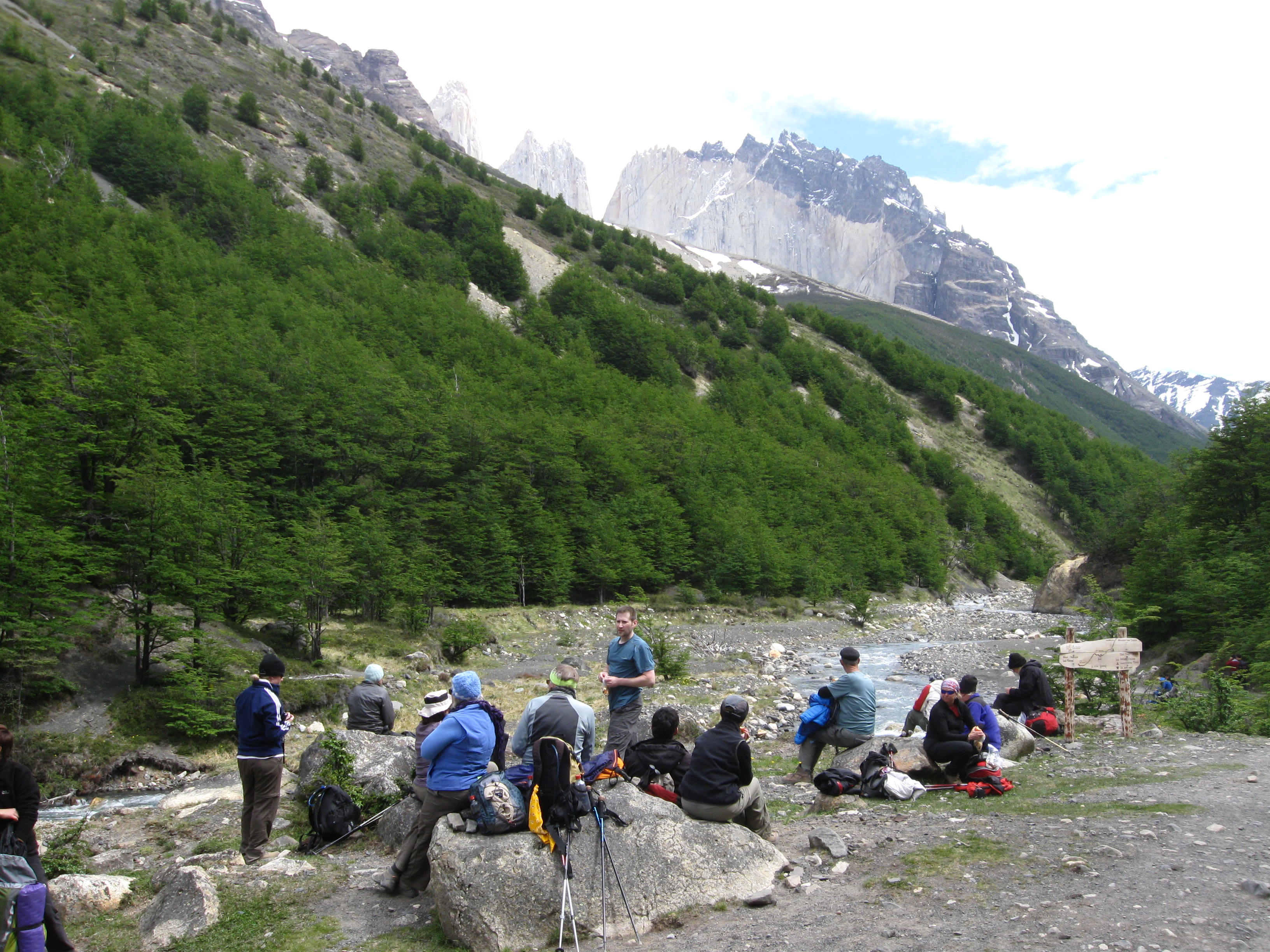
Up and down, I chug up and then fly down. I’m one hundred percent in this moment, breathing in the air, taking in the scenery, feeling the blood flowing, marveling at the views unfolding. I catch up and pass my peers Flores, Ivo, Stephanie, Ed…and on a bend there is another bridge with a trailside rest stop/lunch spot, which I pass by. Filled with endorphins, I just concentrate on my pace and breath…and I catch a glimpse of Angelique up ahead! More and more, backpacker couples pass me by coming down. I hear Ola! Cheers! G’Day! Gutte Morgun! It’s clear Torres Del Paine is a global magnet for outdoors enthusiasts. Further, I am struck by how many young couples are backpacking. This is a romantic Mecca!
Some of the woods reminds me of the movie “The Lord of the Rings,” and I can’t help myself.
When I catch up to Angelique, I’m so excited I have trouble containing myself. I say, “WOW, isn’t this fantastic! I’m so in my element, FINALLY! Wow, hiking in Patagonia!” Angelique retorts, “I hate it! I cannot stand it! My feet are blistered because I put on cold boots this morning, and I never thought it would be so long!” With my elation it was hard to understand. But I’m an experienced outdoors enthusiast and Angelique was not in her element. Yet she continued on. I asked, “Who’s up ahead?” “Behrend, Saskia, and Elwin” was the response. So passed all the other people? Wow! They must have paused at the rest stop. So, somehow Behrend passed me going down, and passed me going up but I missed that. How? Either way, that’s impressive!
Angelique: OUCH!
We keep going, and Angelique keeps up a good pace! All along this hike I encounter backpackers going this way and that.
The report on this trail says the end steepens. This is borne out as we are still in the woods, yet the trail’s upward trajectory becomes ever higher. Then the trees disappear and we’re in broad daylight.
The trail winds through a boulder field, and the Torres Del Paine towers begin to come into full view.
Rather than fall victim to the ever steepening burden of the trail, Angelique and I double our efforts. The “trail” begins to fade, and the way to the top is only found by carefully watching red blazes on rocks up above.
Here, we’re truly scrambling. A sign says, “30 minutes” meaning we have to scramble for 30 minutes! Well, at least we know.
That sign means one thing to me! We are NEARING the summit! It stokes my adrenaline, powering me up. Right then, Eghbert suddenly shows up. He’s also on the attack! He’s half my age. I’ve got to give it everything I’ve got to keep my position!
Somewhere along this flight to the finish, I move way ahead and Angelique gets lost amongst the boulders. I d0 not know it, but Angelique has lost her way and has gotten panicked, not knowing which way to go.
When I’m near the summit, I grab my camera and film the end in video mode. So here it is, without any further description. Imagine you are there yourself!
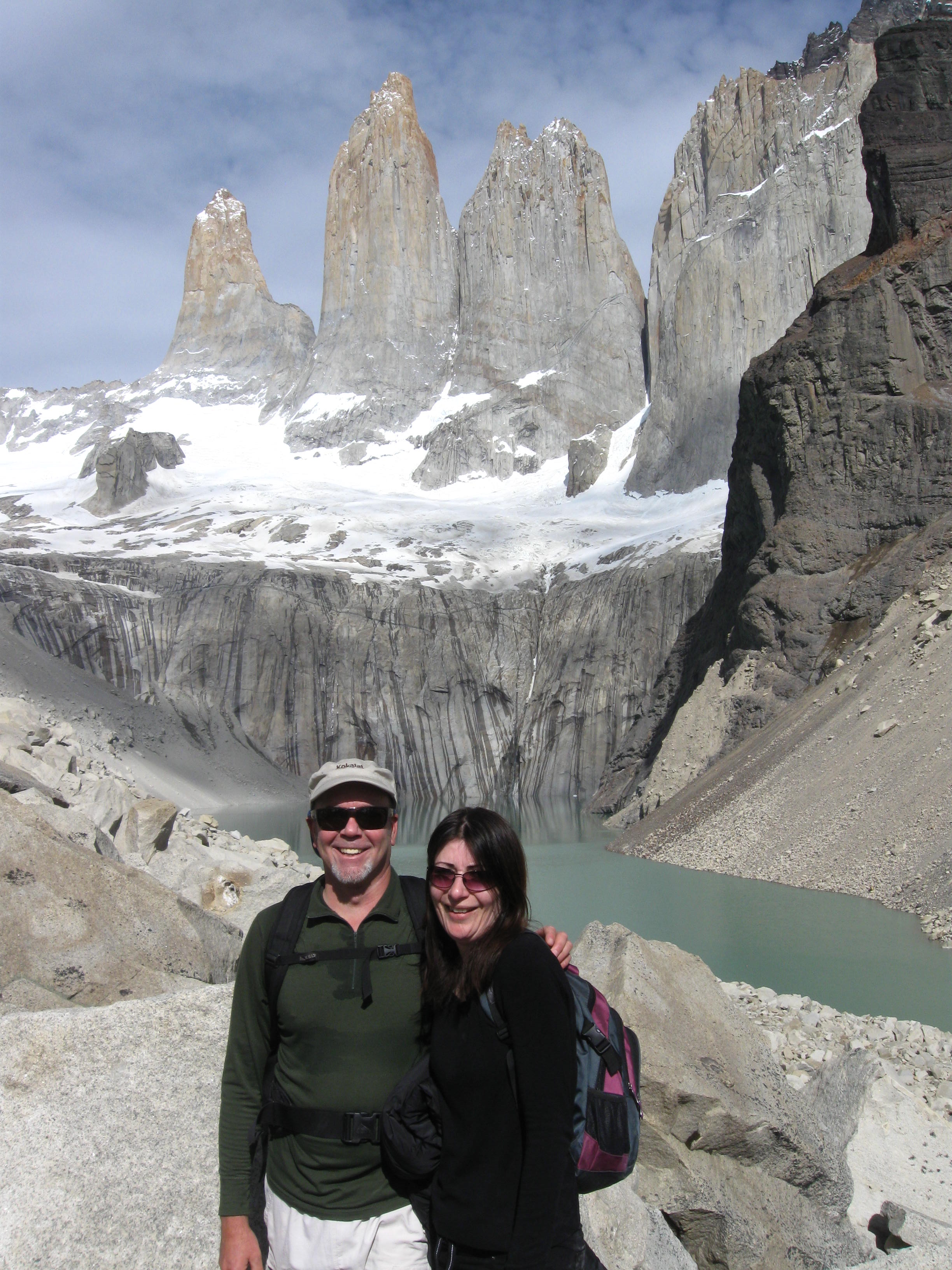
What can I say! No wind! Blue sky! WOW HOLY COW! Nothing could surpass this, could it? The fact that we left at 7:00 a.m. was killer! Clouds rolled in as we descended. We SCORED! It was surely a challenge and worth every single step! We take lots of photos. My other compadres make it to the top. Yaap, Ed, Stephanie, Eray, Ed, Christof, and more.
Behrend,Stephanie,Ed,Yaap,Ivo,Angelique,me,Eray…
Everyone savors the view and a bit of calm settles over. But after about half an hour, after we have had a chance to refresh ourselves, it’s time to head back.
Poor Angelique! On the way up she lost her way and practically had a panic attack finding us!
She wasn’t familiar with the markings showing the way. I felt bad that I got so excited I just kept going.
On the way down, I fell victim to the same issue. Before I knew it, I was in “no man’s land,” with no markers and everything unfamiliar. I had to scramble back up and find the trial markers.
Much of the descent, I was with Christof. We made good progress through the forests. At one particular bend in the trail, I glanced to my right, and WOW! I glimpsed a creature so rare, the park rangers want us to report it if we see it. It’s called a Hemuel – an Andes deer!
As Christof, before me, passed, I quietly signaled him to stop! He turned around, and me, without a peep, pointed to my right, and Christof saw the deer! WOW! I can’t believe it. What we are witnessing is one of the rarest creatures in Patagonia.
An endangered Hemuel
And, it has no problem with us. It’s a stout creature, with early season antlers, and losing its winter coat. It totally knew I was watching, but it didn’t mind that I was there.
Another romantic backpacker couple shows up, and I put my index finger to my mouth, signalling “quiet!” and pointed in its direction. Instantly they fell to their knees and watched, slowly bringing their point-and-shoots to capture the scene.
It was priceless!
The hike down was characterized be the day becoming more cloudy, and wind building. I was so thankful Saskia had planned to have us on the trail early. Otherwise, our pictures wouldn’t be as fantastic.
Also, the number of international outdoors addicts built during the day. All during the descent we saw more and more people coming up the trail, signaling how much of a magnet this place is!
I need to mention that about ten of our group gave up and never made the summit. Some actually planned to only hike part of the route. This whole day was a success. On our return, we walked again past the bottom of the plain, and this time we walked through one of the campgrounds at that lie at the base of the trails. These are car campgrounds. I was amazed at the sheer number of campsites. At this early part of the season, I counted less than ten sites occupied. But there are over 100 campsites! If this were December or January, this place would be packed! So we are SO fortunate to be here in early season. We had no idea. I would have to day that November is a great time to be in Patagonia.
At long last we arrive back in our Refugio, where we can get showers. We are to depart today, and tonight we’ll be in El Calafate, another few hours to the north in Patagonia. We are all desperate for the warmth and cleansing of a shower. We find it back in our Refugio. Oh man, it feels FANTASTIC! And we have some time to kill before our transportation shows up.
Eray and I know the best way to spend that time. Which is, to lounge on the grass, with an Austral beer and watching the sun pass over the nearby mountains, right?
At this moment, I don’t know how anything could be improved! We’ve hiked, accomplished, and we are relaxing following an incredible experience.
Well done!
Our drive will take us across the steppe, another lonely highway, and we’ll find ourselves in El Calafate, another magnet town for international outdoor addicts!
We take a minibus across another rickety bridge to a “transfer point,” where we’ll all board bigger buses to take us to El Calafate.
It’s a nice sunny afternoon.
And Angelique’s Dr. Martens, hanging from her bag, stand testimonial to her ordeal today! Check out the dust!
Well, tomorrow is another day. We’ll be face to face with a huge glacier!
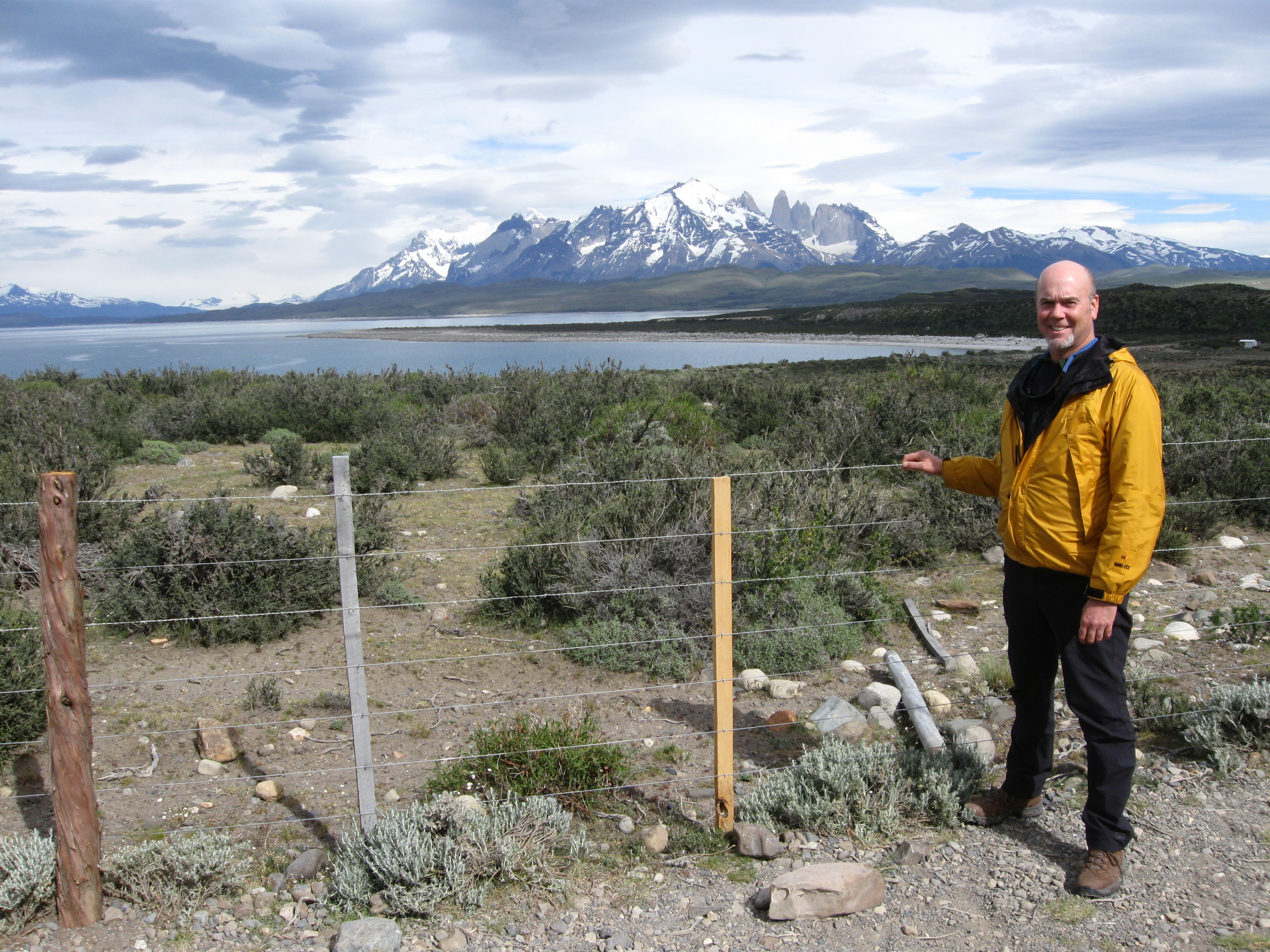
Just to get the scale perspective, see the road by the lake?
Today, the highlights of our trip step up and will just keep on coming!
We drive two hours from Puerto Natales, Chile to Torres Del Paine National Park. Torres Del Paine, which appears on countless calendar photos year after year, just doesn’t disappoint! This 600,000 acre park is South America’s Number One most visited national park. And for good reason. The Torres Del Paine massif is incredible, the hiking is unparalleled, and it’s got lots of jaw-dropping scenery in a compact area. Contained within its boundaries are 9,000 ft horns and spires, plus innumerable glacial lakes, and even the Grey Glacier, a 40-mile long river of ice wrapping around the west, visible from trail side. And behind it lies the Southern Patagonian Ice Cap. This cap of ice is the largest continental ice sheet outside Antarctica, and feeds no less than 300 glaciers! All of this comes right down to the steppe, which looks like Eastern Oregon. It makes its own weather. It is truly a spectacle bey0nd imagination.
One thing about Patagonian highways that’s got to be said is that they are empty. You can drive for a long time, during which you see the road for miles ahead, and there are no other vehicles around. You see dry desert steppe, and when you do see trees, sometimes entire hillsides have been blown down by the wind. But today, it’s not very windy. We have clouds, though. There are mountains all around, sometimes contorted in unimaginable shapes.
As we near, I keep thinking the mountains we see are the Torres Del Paine massif. They are all magnificent, but when the real thing comes into view, it’s something else. Vertical, 9,000 ft. spires dug out by glaciers, but then to one side, there is something only suitable to the Lord of the Rings – several vertical towers, and below the whole thing, many blue lakes dwarfed by the spires reaching to the sky.
We come by a herd of guanacos; in fact we’ll see a lot of these camel-relatives during our stay here!
We come to a trailhead and we’ve got the afternoon to explore. This trail wends between Lago Pehoe and Lago Nordenskjold. In front of us lies one of the “W” valleys Torres Del Paine is known for. If you think about it, a “W” is how this park is generally laid out. The left is a trail along the Grey Glacier, the middle goes up the horns, which we’ll witness today, and the right of the “W” we’ll be exploring tomorrow! WOW. The park is so popular, it’s got a system of vans which can transport backpackers between the trailheads at the bottom of the “W”.
Well, it’s time to get into the thick of it!
We hike, and bring our picnic lunch along. It’s only about 30 minutes before we come along what can only be described as a jaw dropping scene, one which will be duplicated over and over in the days to come! We lunch by this waterfall. Check out this video:
The lakes all over Patagonia, blue/gray with minerals from glaciers, often drain into each other in this fantabulous fashion.
We watch for what seems an eternity. But we move on, to the trail’s end. Along the way I see lots of special birds, and flowering plants only found here. The view is of Valle del Frances, surrounded by those glacier-topped vertical horns, and Lago Nordenskjold underneath. Glaciers unfold, wrapping and warping over the rocks.
The glacial lakes below the scoured valleys bear witness to timeless geological forces. The tops of these horns are sedimentary rocks heaved up from the ocean bottom, and the grey underneath is solidified granite which intruded from the earth’s liquid mantle. All to be cut down by ice! Wow. Holy cow. When we get back to our transportation, we are shepherded to Refugio Las Torres, which is a hostel at the base of one of the valleys at the right side of the “W.” We travel over bridges so rickety that our van must go over them empty. Everybody has to exit the vehicle as it goes over. The hostel “refuge” is six people to a room. It’s got a central eating “lodge” where we have dinner, and tomorrow, breakfast.
Our place for tonight
A bottle of Malbec costs only $7 here. I’m not complaining. But maybe I ought to complain that we are to hit the trail tomorrow at 7:00 a.m.!
In keeping with the theme in this blog I ought to mention we are here in early season. The park’s campgrounds are only 10% full. Our “refugio” has been open only two weeks. As such, our lodgings need some work when we get there. The heat needs to be turned on. But all is OK. It all works out. We get heat and HOT fantastic showers. We are ready for the assault on the Towers tomorrow!






















 Cabin Fever Chronicles - Getting Outdoors with Rod