Coastal Patagonia: Valdes Peninsula and Puerto Madryn – Penguins!

6 12 2011

Photo by Monique Poesiat

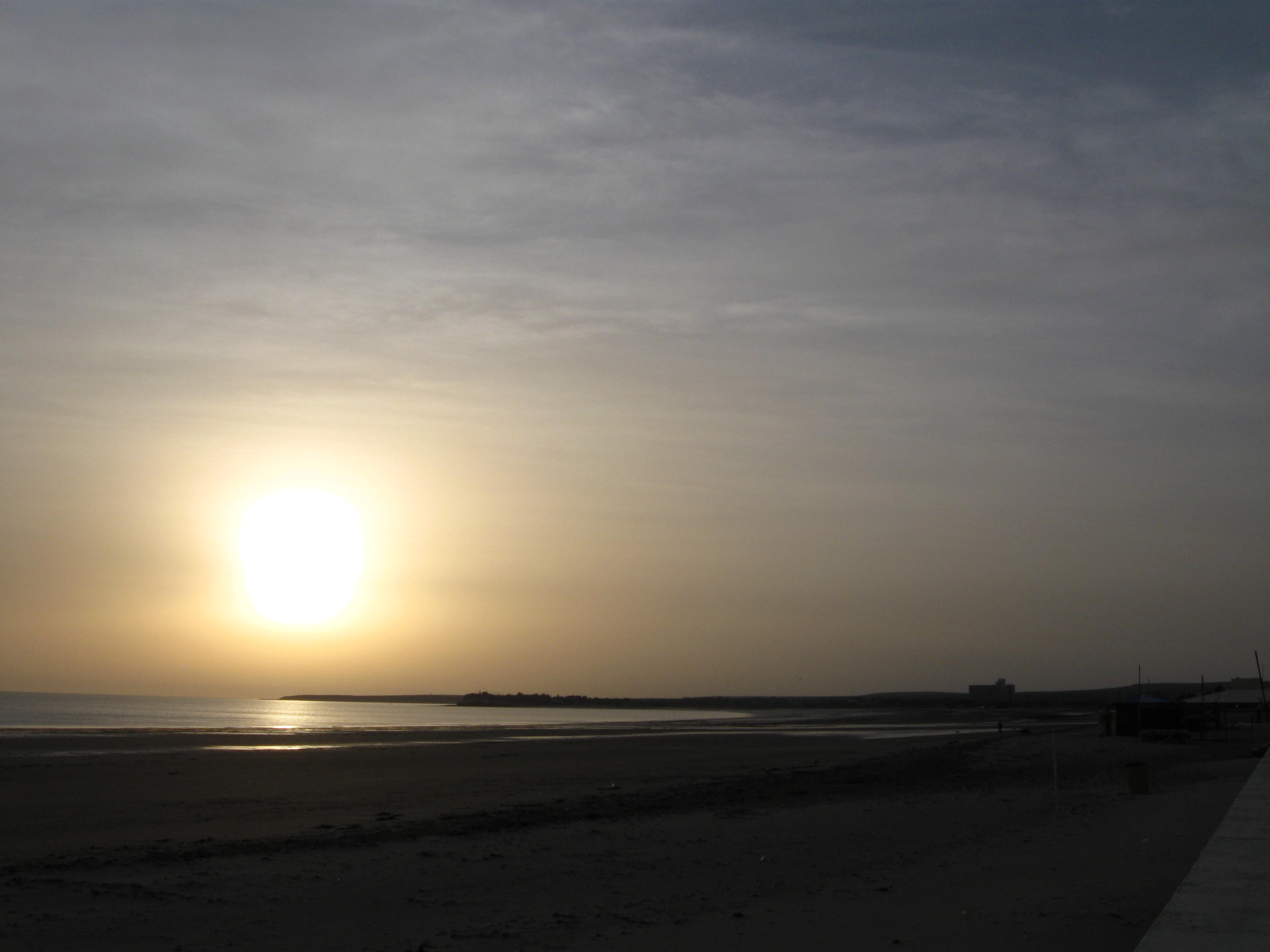
The ride on the double-decker sleeper bus from Buenos Aires to Puerto Madryn is a positive learning experience for me! It’s got lots of leg room, entertainment, food, and as long as one has ear plugs and sleeping mask, one can manage quite fine. We are on Route 3 (Ruta 3), which goes all the way to the end at Tierra del Fuego. The gentle rocking of the bus and distant engine noise seems to aid in sleeping. Most of us sleep through the night, and are up at dawn marveling at the sunrise. Still, even then, nothing to break the horizon. Over fourteen hours and no hills, no ocean, just what looks like sage from horizon to horizon.

After what seems like an eternity or a mirage, billboards emerge, shouting for all to see: “PUERTO MADRYN” in so many kilometers. We learn that the reason we don’t see trees is the area is nutrient poor. Incredibly, everything around us is volcanic ash, devoid of good nutrients. This is why there are no trees. We finally pass through some “painted hills” like in Oregon, though the colors are different. The layers are ash. This means ash deposited here came from the other side of the continent, the Andes!

Finally things descend and the Atlantic Ocean emerges, viewable to the east from north to south. As the road drops, a city emerges into view; it’s Puerto Madryn. Cargo ships lie at anchor offshore, and there’s a long pier with more ships tied up.
Semi trucks are coming and going from the pier with cargo. Industrial sized fishing boats, and Argentinian Coast Guard ships are also docked. As we navigate the town’s roads, we see auto dealerships, restaurants, banks; on the waterfront I see kayak rentals, some kite boarders, and hotels – signs this place is a beach destination in summer season.

It’s about 9:00 a.m. We come to a stop on the waterfront boulevard at the Hotel Costanera. Seems a right place to be, steps from the beach! We’ll spend two nights here. So we disembark, to check in and get right back out because we are headed south, to see a Magellanic Penguin colony this afternoon! We are going to the Reserva Provincial Putna Tombo, the largest Magellanic Penguin colony in South America!
The hotel room is a bit outdated, but at least the bathroom has been recently overhauled. It will be OK for a couple of nights. The “window” of the room looks out onto a narrow interior column of other hotel “windows.” So, we cannot see the beach from here.

Although it’s on the Atlantic coast, Puerto Madryn is situated in one of the bays of the Valdes Peninsula. It was founded by the Welsh in 1886.

So it’s, nestled in the Golfo Nuevo, sheltered from the force of ocean waves. The beach is pleasant, and we would be taking strolls along the sand. The tourist business is year round. In summer (January to March) it’s popular with Portenos from Buenos Aires seeking beach time. In August to early November, wildlife tourists flock here to witness the spectacle of Elephant Seals, Southern Right Whales, Southern Sea Lions and Magellanic Penguins rearing their young.

Well, it’s off to the penguin colony! I’m very excited to see the penguins in action. Having seen so many documentaries I imagine myself immersed on the beach with tens of thousands of squawking tuxedo-clad flightless birds. We are all horrified to learn it’s a two hour ride to get there. O-M-G. I don’t have to tell you what we just finished! But as I was to learn, this is Patagonia, and it’s often a long way between highlights!

The nothing-ness of Patagonia continued until we arrived on a dusty, windy road at the Reserva Provincial Putna Tombo, where the Atlantic coast, with its wind and waves, is in full force. So, if you can imagine, it’s like Eastern Oregon right up to the sandy beach! Soon, something unexpected emerges.

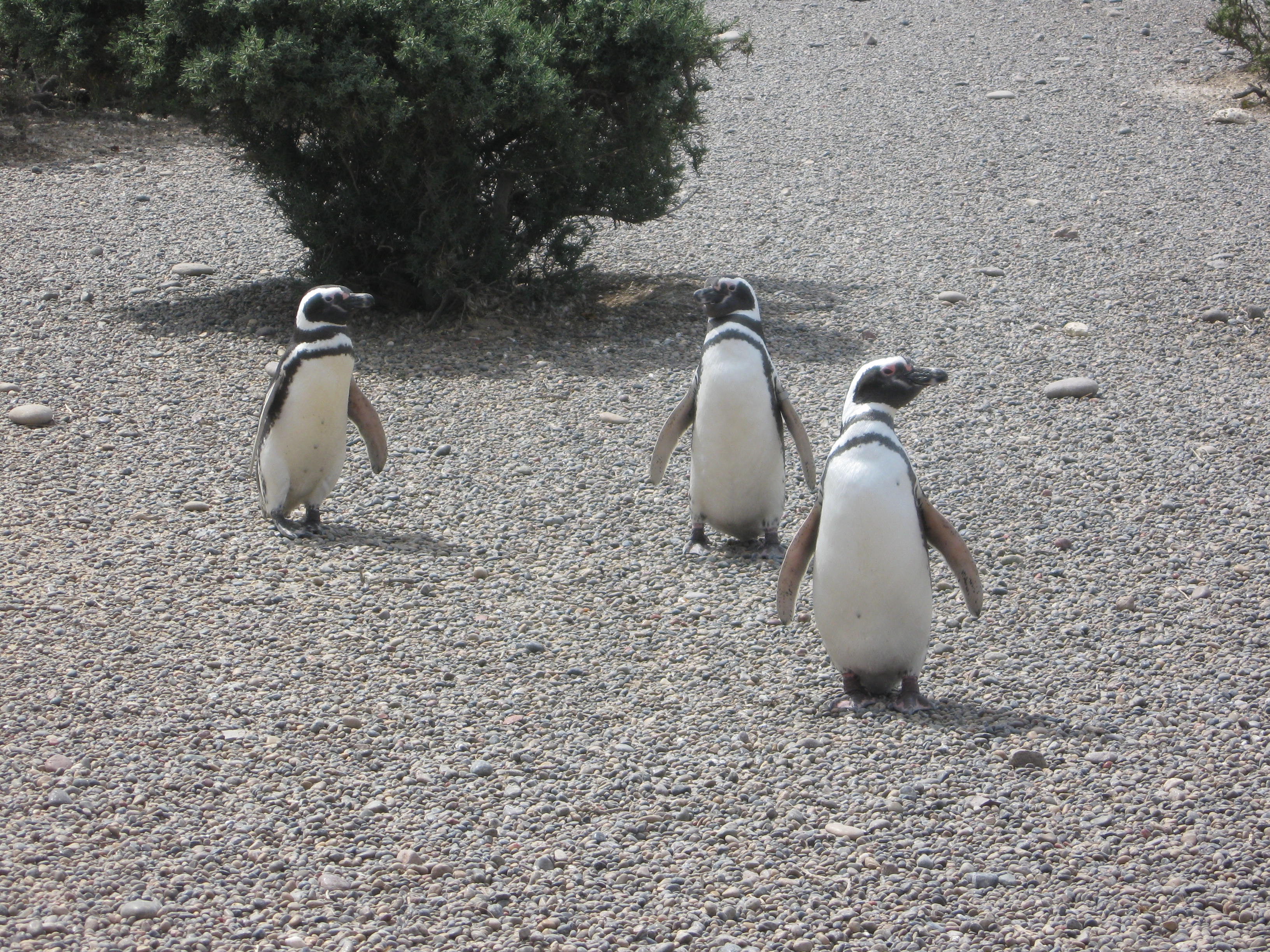
There are penguins! There are penguins walking amongst the growth that looks like sage or juniper. We walk along trails built for viewing. We’re told that right now, the penguins have come in for mating season, paired up, mated, and eggs have been laid. We’ve arrived at the egg-tending part of the reproductive cycle. That means that at any given time, one parent is at sea foraging, and the other is on the nest tending. Here, Magellanic Penguins dig burrows for their nests. I don’t know why. It sure is windy. Maybe that’s why? But instead of a million penguins fighting for real estate on a beach, the penguins walk up to a half mile inland and dig burrows amongst the little hills behind the coast.
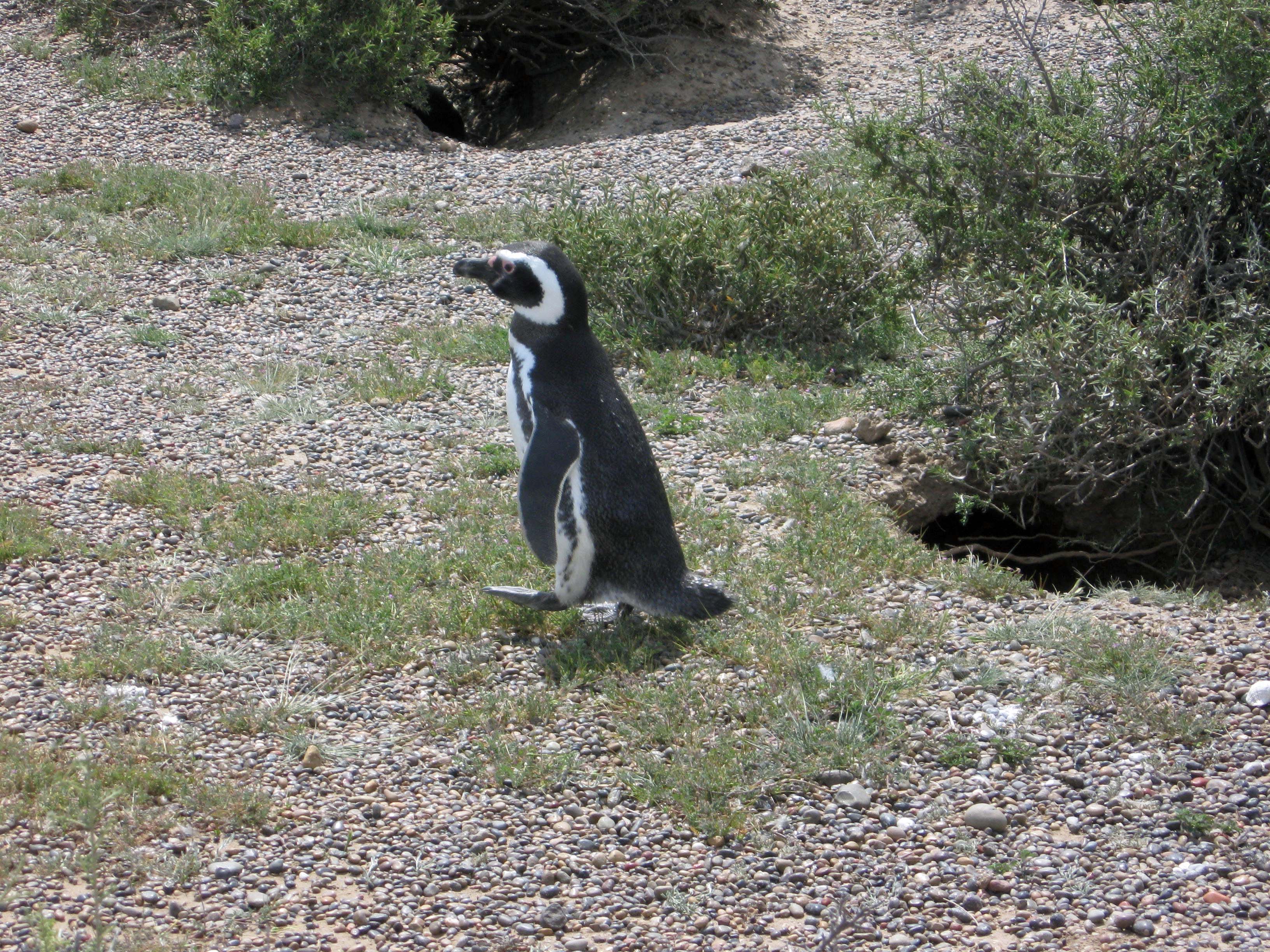
Penguins don’t walk. They waddle. They are so cute!

Check out this waddling video! Penguin finding home!

And here, I’ve got them coming home from foraging at sea. They are all coming home to their spouses.

Got to love these guys! They were not at all bothered by us! They would just stop, look at us, and then go on their way home. We never could figure out how they find home!

There’s never a boring moment with penguins!

They were coming and going all afternoon. We were respectful of their paths. They were here for business…to get to their nests so their partner could go to sea and eat!

Tomorrow, we are to visit Peninsula Valdes proper. We will see the elephant seals, seal lions and other wildlife! Can’t wait!



Buenos Aires – Halloween!

3 12 2011

Monday in Buenos Aires broke clear and bright.  I was now in the southern hemisphere of course, and unlike home in Oregon, days are growing longer, instead of shorter, so morning light comes in early!

Things are going to be interesting, as we spend time in the city but then we are set for a 17-hour overnight bus ride to Puerto Madryn tonight – in coastal Patagonia. Once there we are to simply check in and head out. I wonder how I am going to handle that? Will adrenaline just keep me going?

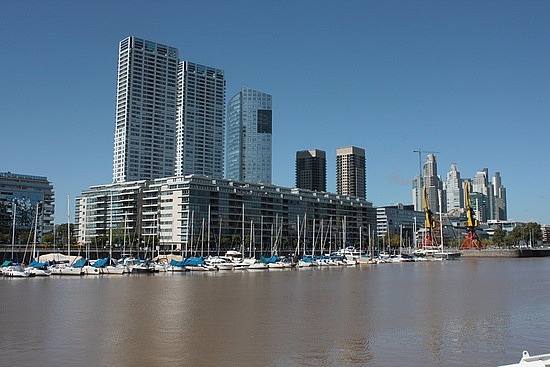
Today we are going to see other parts of the city. We’ll get to see some parks, and the rehabilitated and upmarket Puerto Madero riverfront area, plus the Rio de la Plata, and the cemetery where Evita is buried, a soccer stadium, and take a peek at where Tango is done. Today is Halloween in America, so I am excited to get to the cemetery!

We gather and head out into the city. The weather is unimaginably perfect. Smog-free, smoke-free, cloud-free, no humidity, a light breeze, and 80 degrees! Shorts weather! I ask if this is typical and the answer is no. I’m told that the Chilean volcano sent ashes this way not long ago, obscuring everything. And it can get humid! No matter. Today is incredible!

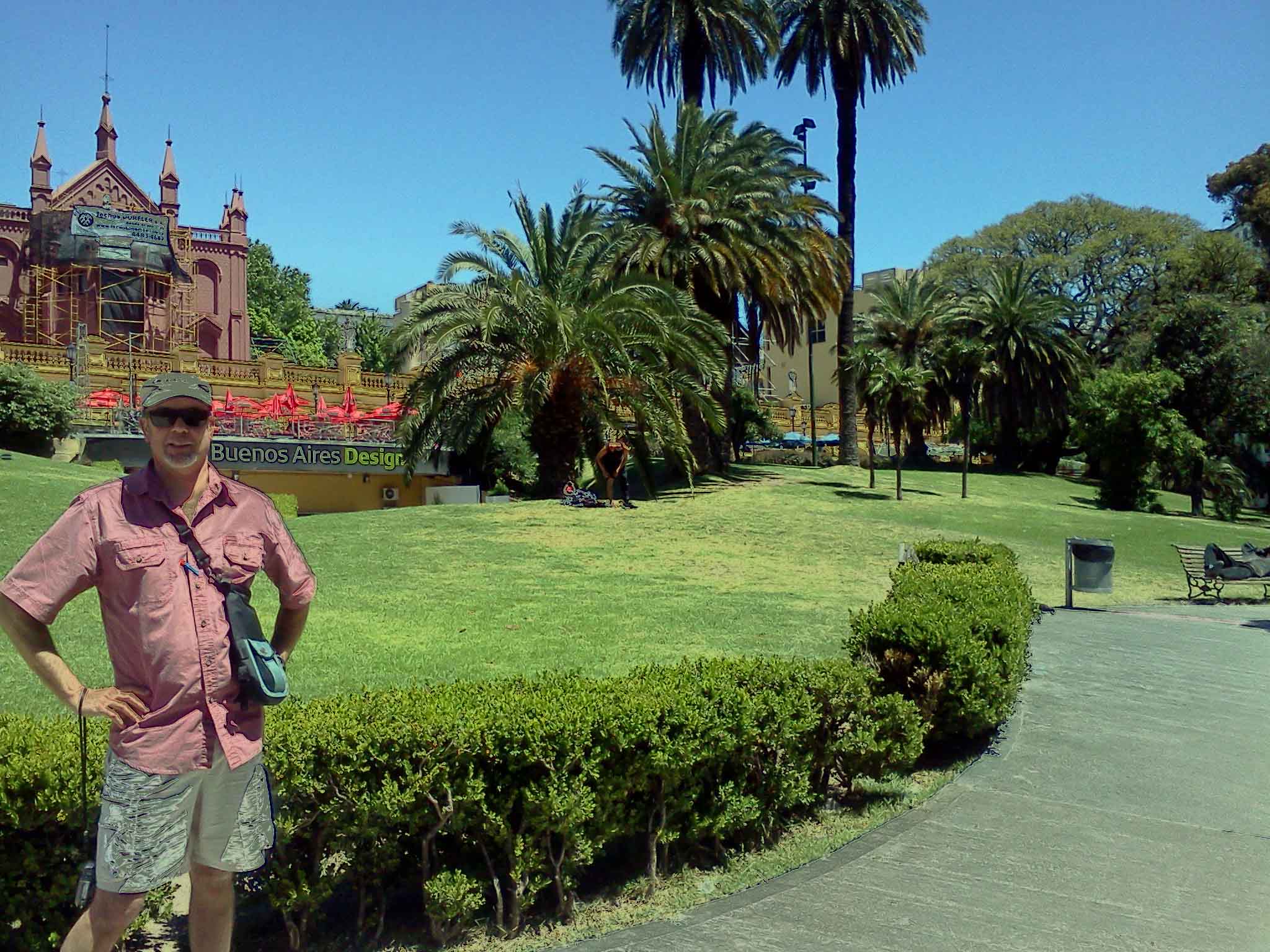
A high quality of life is evident as I see plenty of joggers and cyclists in the parks, one of the biggest is Parque 3 de Febrero, and another smaller one is Parque de la Flur. It’s clear somebody has planned parks into the city architecture. These parks are huge. They have rows and rows of flowering plants and trees, and plenty of lagoons. Birds are attracted – parrots, doves, swans, geese, swallows and swifts. The parks are filled with statues of all kinds.

In fact the city was planned by a French landscape architecht, Carlos Thays. He directed the planting of the thousands of Jacaranda trees that line the avenues. These trees put out beautiful purple flowers in November. We will see them when we return! He also directed the fantastic assortment of other trees I saw, such as palms and magnolias.

We don’t have a ton of time, so we have to see a lot of it by bus. We do stop in the parks, we get to see Puerto Madera, we walk through several of these beauties.

It’s obvious people have a quality of life here. People are out roller blading, or jogging, or enjoying the parks. There are sailboats.

I also notice a marked difference from Mexico and some of the Southeast Asian countries I’ve been to. People here have breeded dogs. Instead of “street dogs,” or what I call “generic dogs,” those light brown dogs ubiquitous in these other countries, in Argentina I see black labs, german shepherds, beagles, afghans, etc. Not only that, I see dog walkers! Imagine that. Things can’t be all that bad, right?

Take a peek at the video of a nice day in Buenos Aires!

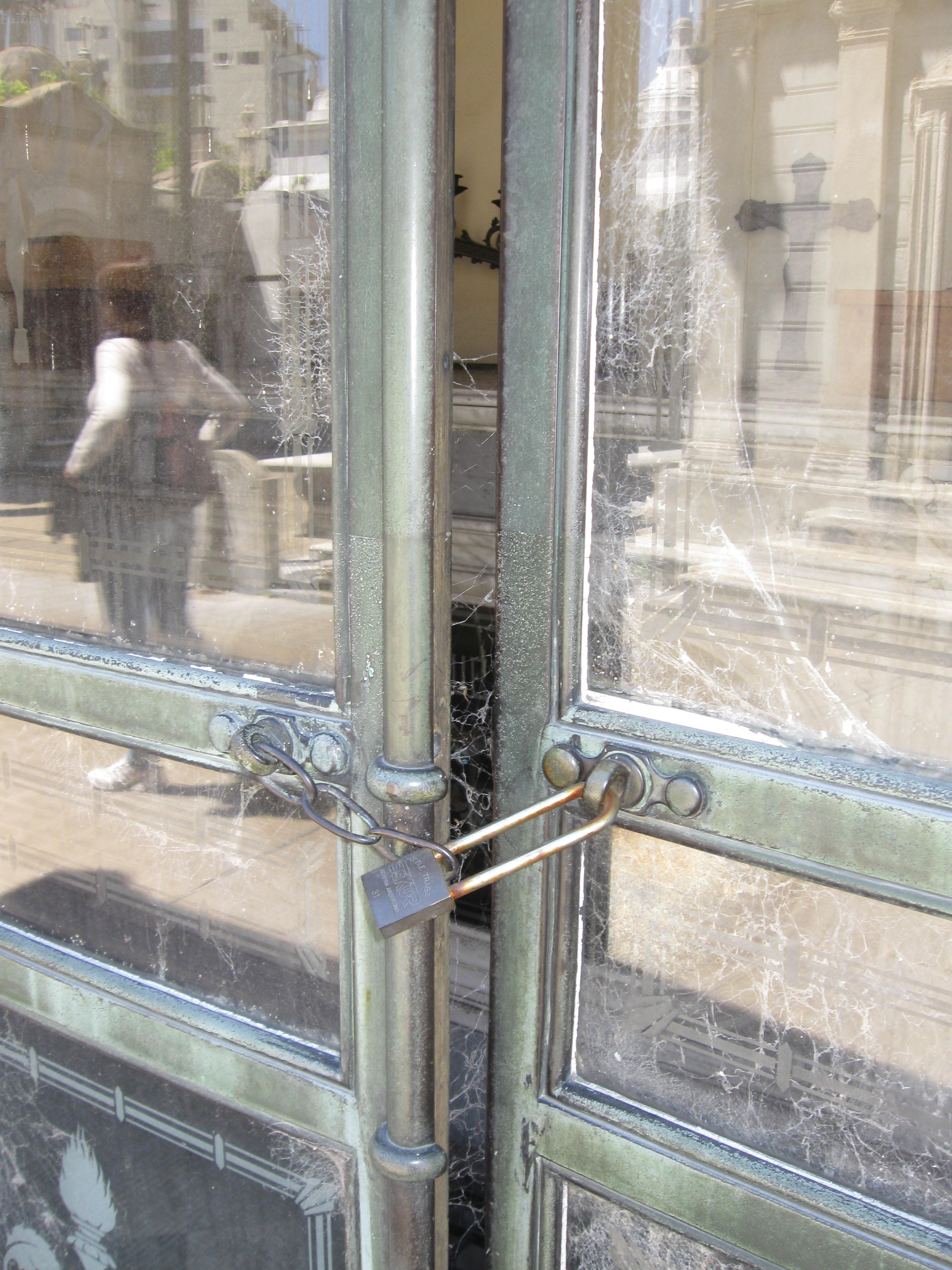
It is Halloween, so we’ve got to visit a cemetery! The cemetery we see is full of mausoleums – above ground. It’s absolutely perfect, and I’m filled with glee that it is Halloween. I scamper around and my fun is only increased by the the discovery that many have coffins visible. Some have glass doors with stairs leading down to the ? underground. Others in disrepair had broken glass, making it look like spirits had escaped.

And many had cobwebs covering the inside, or chains “locking” opened doors, making it look like something was trying to get out! It can’t get any better than this.

Something tried to escape!

So, I just couldn’t help myself. So here’s a nice video of what I saw: .

And of course the obligatory Halloween mausoleum video:

Later I saw some folks trying the tango for gawkers…

Well, that’s it for our time in Buenos Aires, until we return in three weeks!

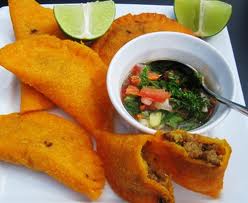
We are about to embark on a 17-hour bus ride. Prior to heading to the bus station, we get take-out empanadas for everyone.

Empanadas...good stuff!Now the empanada is something I can deal with for lunch. They are like mini-calzones.  They can be stuffed with cheese, pork, chicken, beef, onion, all sorts of good stuff!

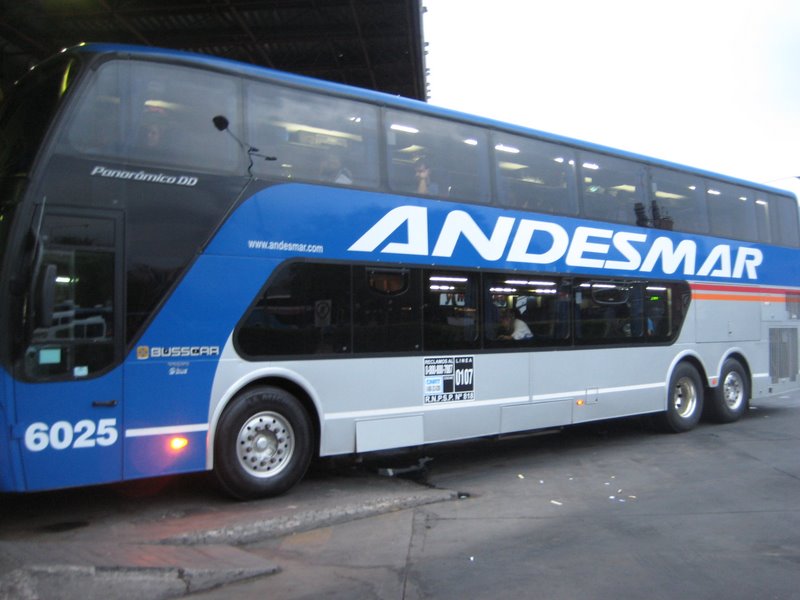
OK. Now we get to the bus station. Bus travel in South America is something else. They have these double decker overnight buses. Ours was such a bus.

The seats almost fully recline. Leg room is almost like airline business class. The bus is equipped with flat screen televisions – we saw at least four movies. If you have earphones, you have awesome sound. And get this! There is a steward! That’s right. We have a uniformed guy who comes around and serves snacks and dinner! And free wine/beer!

So, bus travel ain’t so bad after all. I quickly discover the best seats are 2nd floor in the front – there, you get an incredible view!

So, the journey to Patagonia begins. My partner for this segment is Monique. We talk about work, about our health, about Holland and America. We view “Captain America.” I find that movie infantile. Worse, later they show “The Expendables.” Well, at least they show a comedy in between.

The bus moves through Buenos Aires rush hour traffic. Eventually speed increases, and it moves at the speed limit on a multi lane highway into the Pampas. Ranches (or Estancias) raising cattle pass by one by one. So it is here where the cows are raised!

Eventually, however, the Pampas gives way to what looks to me like Eastern Oregon high desert. This is the Patagonian steppe. The highway becomes one lane in each direction. There are no vehicles visible ahead. There are no hills. This nothing-ness – this is something we will see for the next several days!

Except, however, for the Atlantic Ocean!


Buenos Aires – First Impressions

1 12 2011

We had Sunday afternoon to ourselves to explore vibrant Buenos Aires, a city of 13 million situated on the muddy colored Rio de la Plata. Residents refer to themselves at Portenos, or “people of the port.”

It was a warm, sunny late spring day. Saskia gave us our roommate assignments and we settled in. My roommate was Christof, from Belgium, and I was thankful as he is a great traveling companion! During the journey he earned the moniker “Universal Translator,” as time after time, he could communicate on a number of linguistic levels. After making acquaintances, some of us agreed to meet in the Hotel Castelar lobby and head out.

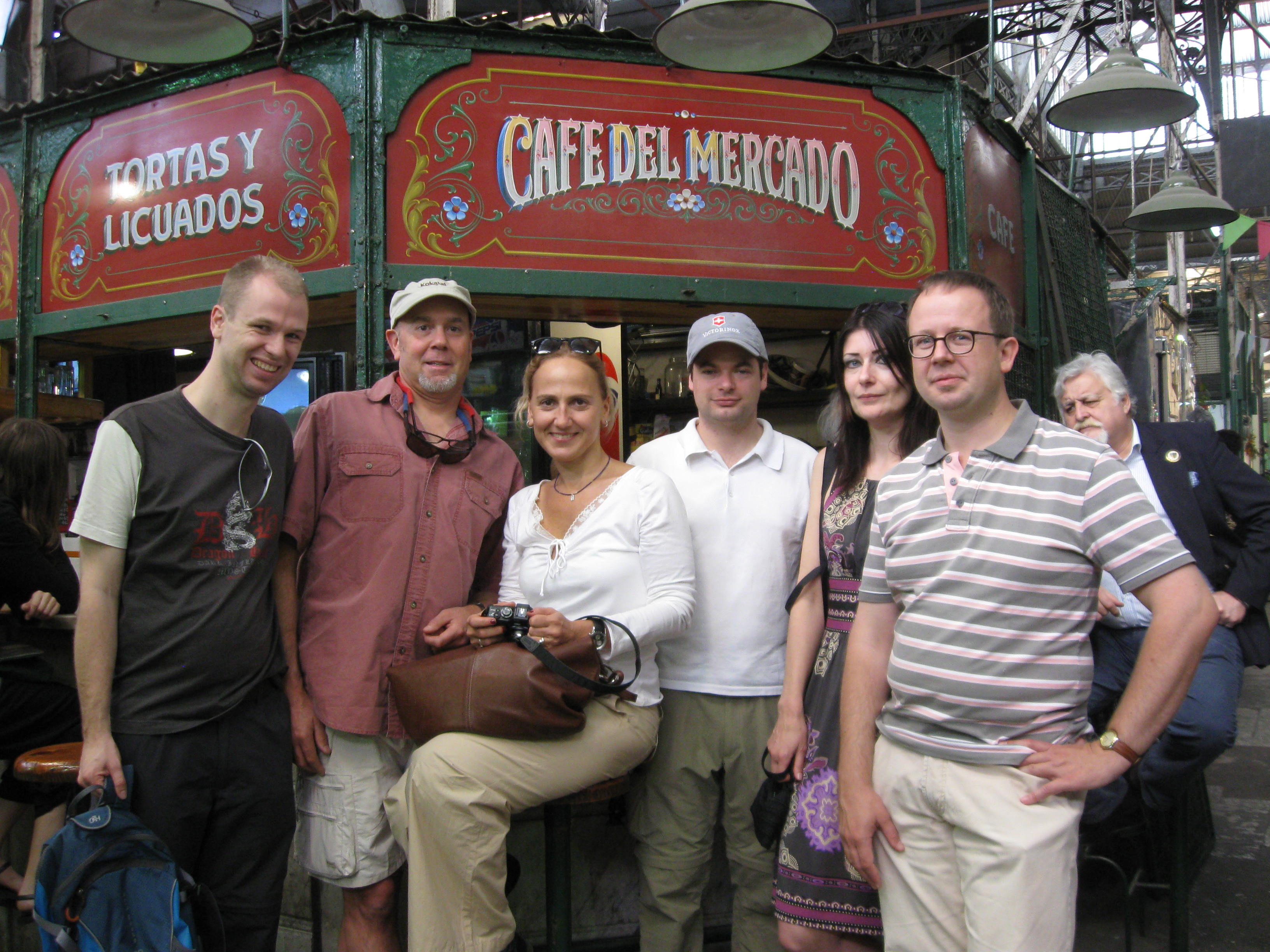
Ivo, Rod, Eray, Elwyn, Angelique and Christof

Those of us that explored that first day would stick together the rest of the trip. We were myself (American), Elwin (Dutch), Eray (Turkish), Christof (Belgian), Angelique (Dutch), and Ivo (Dutch). All single. As a side note, aside from two not-married couples, the whole group was there as singles!

The one plan for the day was to meet for dinner to experience the famous Argentine beef. But for the afternoon, Saskia suggested a walk to a classic Beunos Aires barrio called San Telmo, to check out the Antiques Market.

The area around the hotel had me concerned at first, as did some of the area home to the older French-style government buildings. Signs of political unrest abounded. First story shops on the buildings were not just closed, but armored shutters protected them – and these were mostly splattered with graffiti. All the graffiti and lack of people gave it an apocalyptic feel. One place that was open was actually a political party action center.

I reassured myself it was Sunday. On Monday businesses would open.

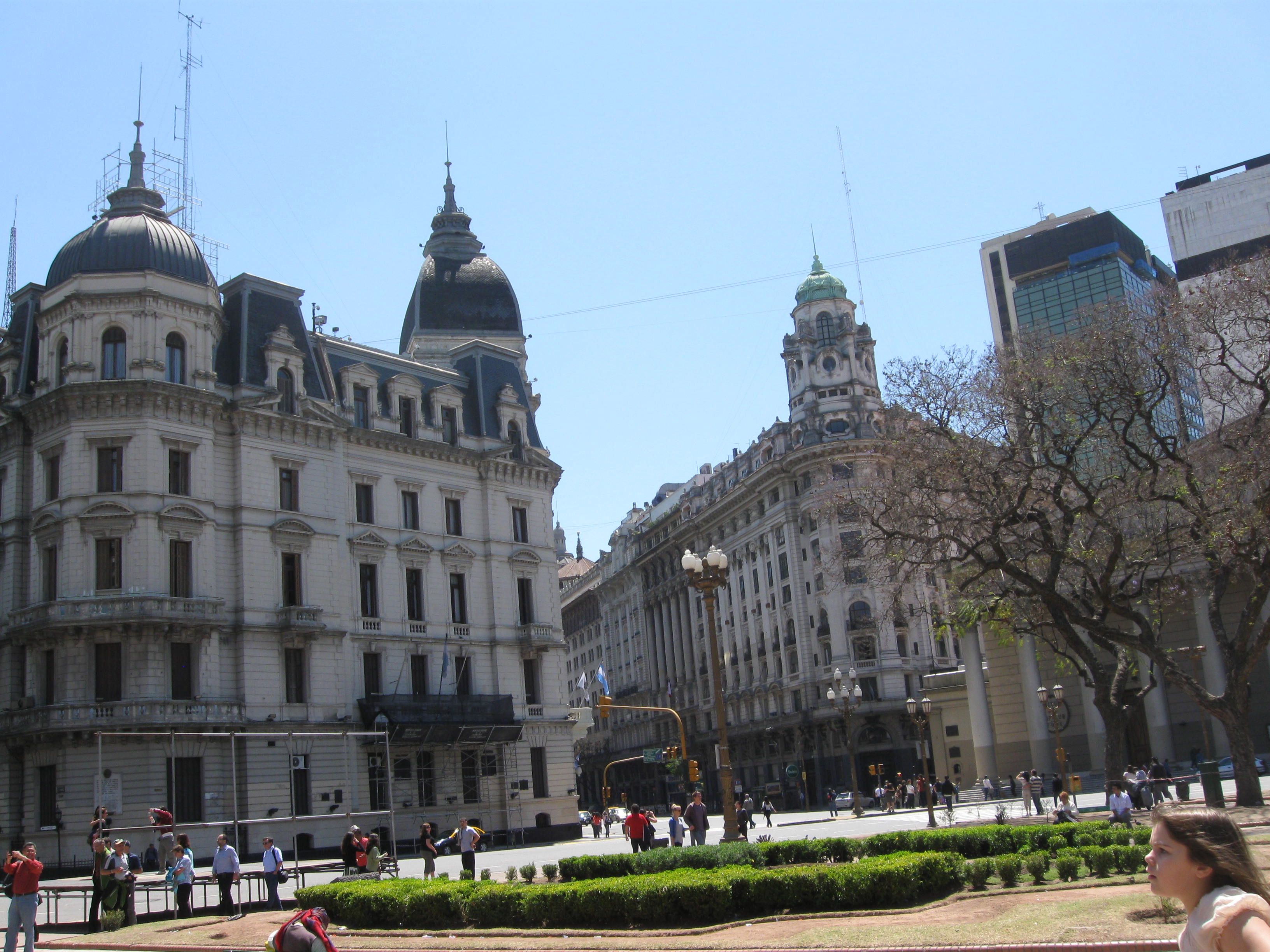
First, we check out the nearby district, which is full of French style architecture and is home to government buildings. On the way we pass some kind of “Occupy Buenos Aires” on the Avenue 9 de Julio.

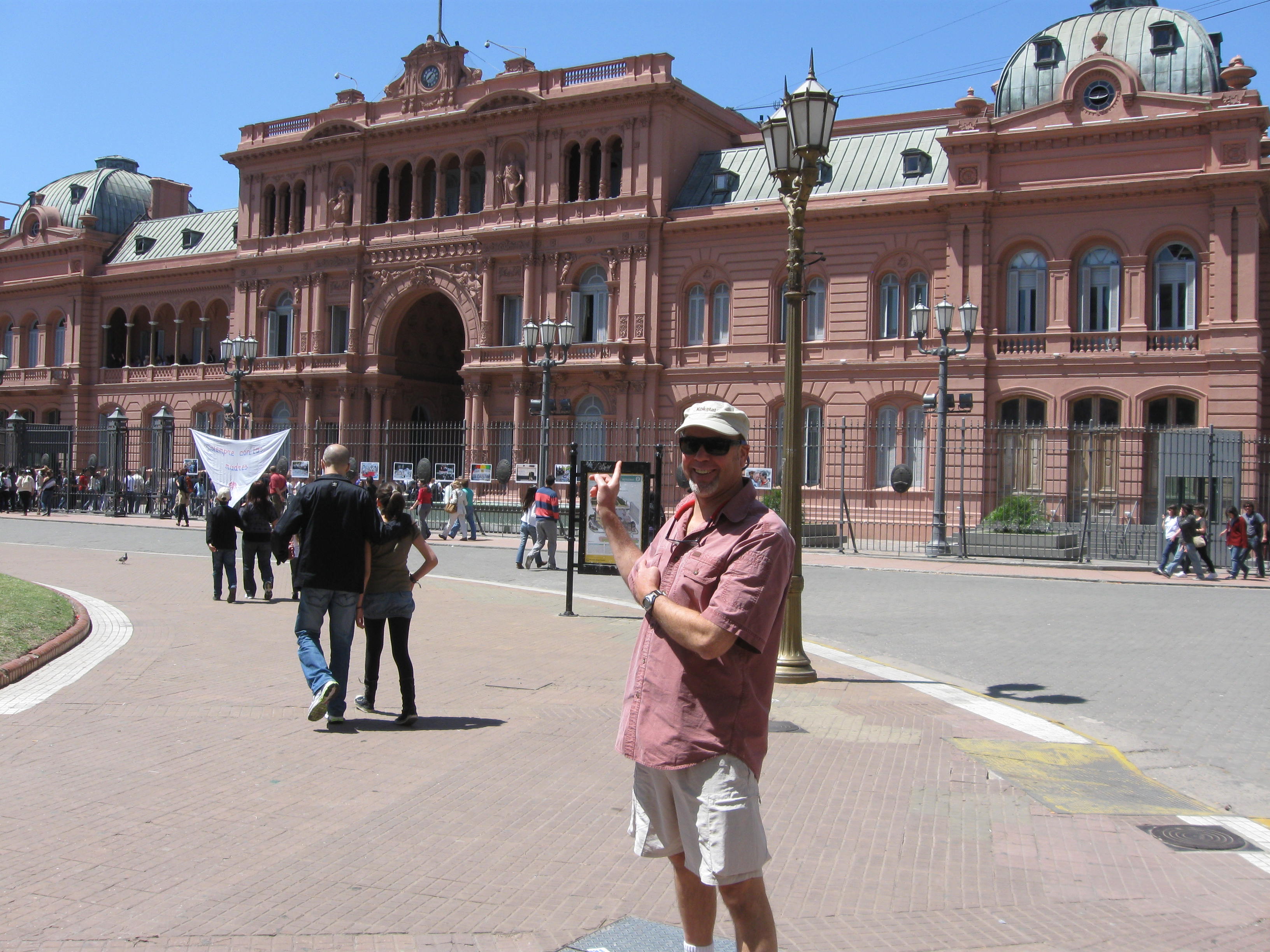
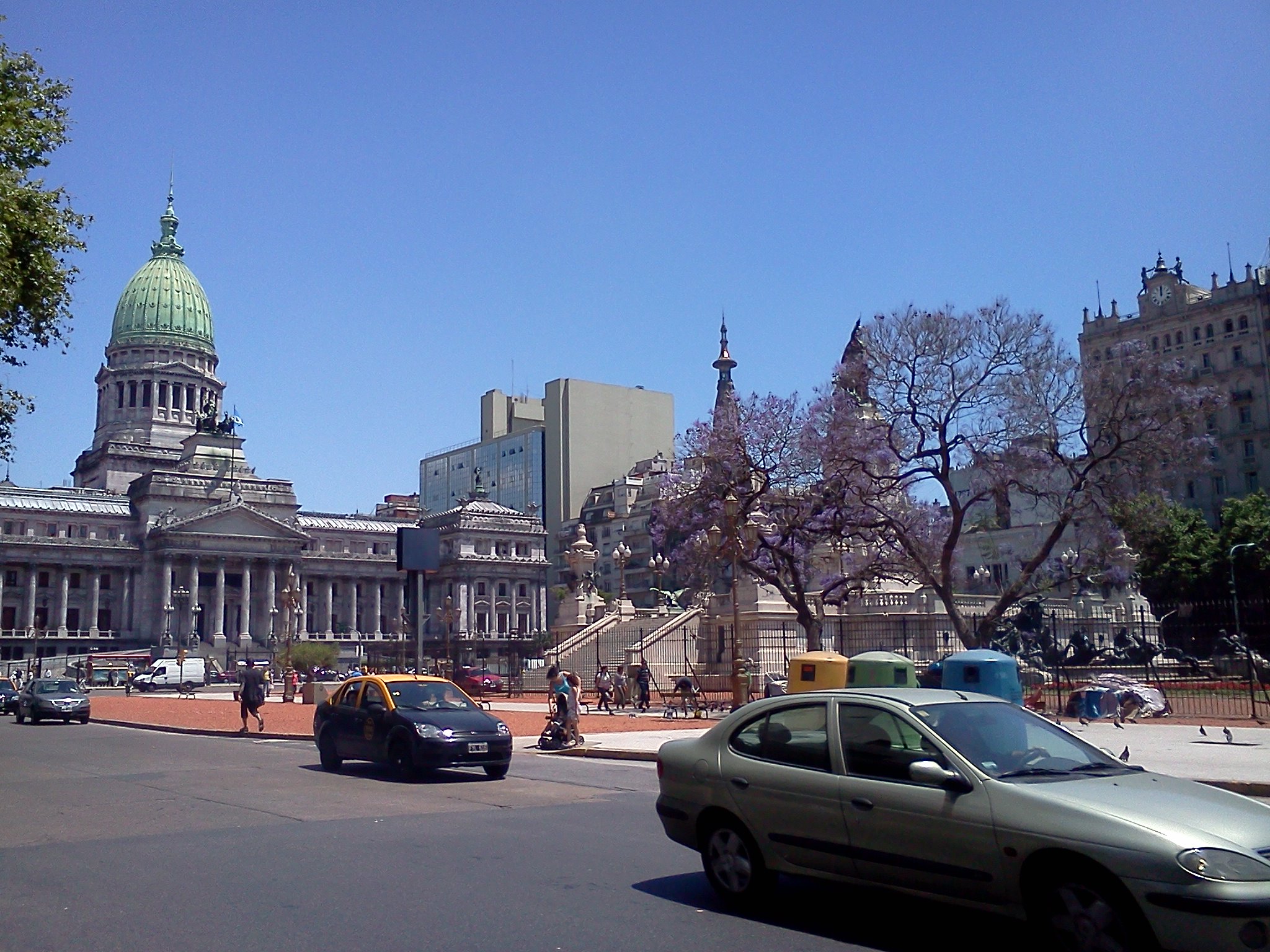
We see the Congress, Justice Ministry, Finance Ministry and the Casa Rosada, or “Pink House,” where heads of state used to live, and make speeches from the balconies. This area demonstrates clearly the ambitions of Buenos Aires a kind of Madrid or Paris in the new hemisphere.

Indeed, one cannot help but feel it is truly a Euro city in America.

The Plaza de Mayo is surrounded by government ministries, and at one end is the Pink House. The area surrounding is called microcentral.

Eva Peron would deliver her famous speeches from the balcony of the Pink House. It’s the official seat of the executive branch of government, though the president lives elsewhere. It is open for the public to tour.

We stepped inside but the wait to tour was too long, especially for an English guide.

Inside, the walls are covered with images of famous, or infamous, Argentine political figures such as Evita or Che Guevara.

"Don't cry for me Argentina!"

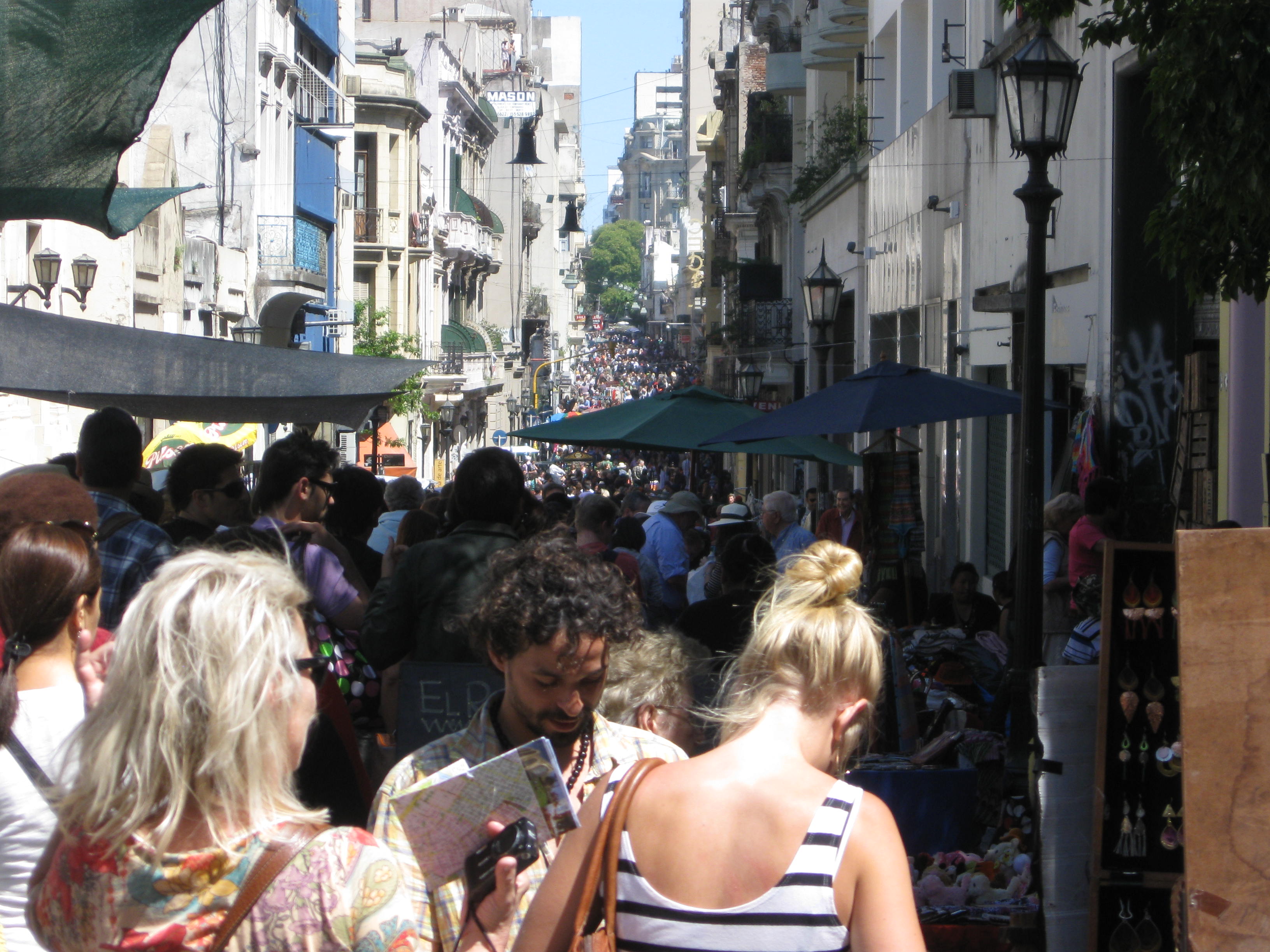
San Telmo is the oldest barrio in the city. In its early days the waterfront was not far from here. I felt like I was in Europe. Narrow, cobblestone streets are lined with southern European style buildings. First stories are usually cafes, antique shops or restaurants with apartments above. Not everything is in good shape – and there is a fair amount of graffiti. Yet it’s got a seasoned feel to it – definitely authentic, tons of character!

Sidewalks are challenging to negotiate anywhere in the city. They are not always smooth, and often riddled with gaps. You need to be looking down as well as forward!

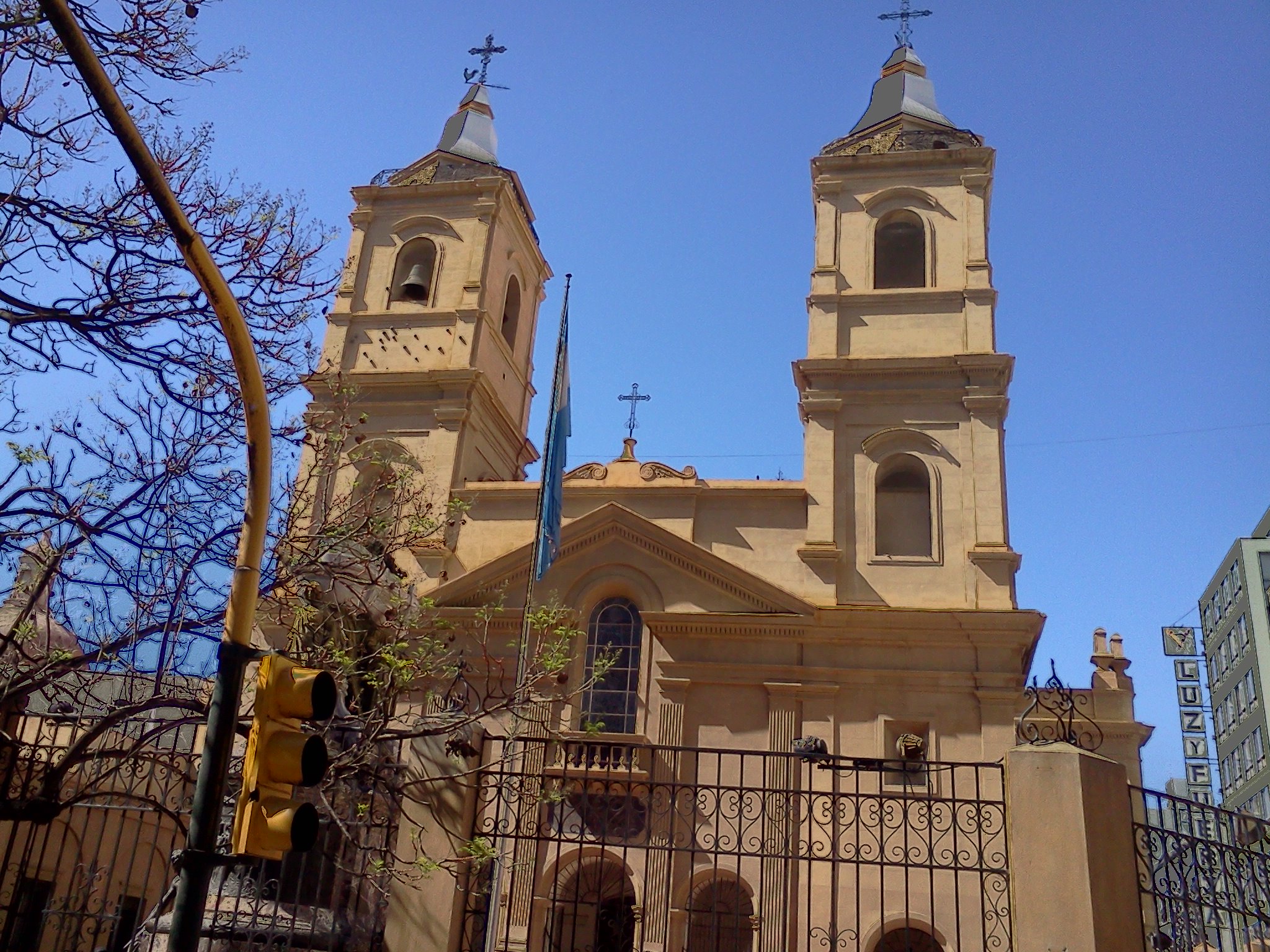
I enjoyed these narrow, cobblestone streets. Tucked in amongst were various churches of varying levels of ornateness.

All along you see lovely European style apartments, but often some are in

bad need of repair. Soon we came to the antiques market. It seemed to stretch forever and I think it’s the busiest/biggest one I’ve ever seen. Although the shops in the buildings sold antiques, the vendors on the streets mostly didn’t offer much more than touristy or souvenir stuff. There were the few selling some old Argentine collectibles, though.

No matter, it was fun to people watch and take in the lovely neighborhood.

People were in a generally gregarious mood! One thing I noticed this first day was something I’d heard about. I’d heard Argentina was ethnically European. This was borne out by what I saw this day and elsewhere. Though everybody speaks Spanish, ethnicity showed the Italian, Welsh, Spanish, and general European roots. Lighter skinned, tall and lots of blonde and redheads! Argentina encouraged immigration in the 19th and 20th centuries and it shows.

TLC needed!

We stopped first for a refreshment at a coffee house inside an indoor food market. Later, we got a table at a cafe on the street near the antiques market. It was here we had our first experience with the Argentine ham and cheese sandwich. I didn’t get one, as I don’t eat ham and cheese. Little did I know this is some kind of national “dish”…we were to encounter it in virtually every corner of the country, it is even served on the airline! I distinctly recall Christof and Elwin remarking, “This bread is awfully dry, and it’s only got one piece of ham and one cheese?” We thought it must be the restaurant, little did we know that IS the way they eat them! I think one of them didn’t even finish theirs and offered it to me but I don’t eat ham & cheese. I ordered a dessert, but the waiter forgot about it. I just held off for the sure-to-be gigantasaourus dinner!

That evening we were to partake in an Argentine ritual – the bife de chorizo – served no earlier than 9:00 p.m. This is a grilled cut of beef, quite huge, most of the time. It does not come with sides. You must order your sides separately. Argentinians consume 56kg of beef per year per citizen. That’s a lot of red meat. And not just the steaks. They consume other parts of the cow as well. They say one reason the beef is so good is because the cows are raised “free,” meaning they roam the flat Pampas region and eat the pampas grass. Nuff said. How do they eat so much red meat and not have all kinds of cancers and diseases? Saskia said studies have shown that one other Argentine indulgence, Yerba Mate, may actually ward off the ills of the un-balanced diet. More on Yerba Mate later!

We sit down and are immediately confused by the menu. The beef comes in various cuts, all written down in Spanish. “Chorizo, Lomo, de ancho, de costilla.” Then there is the matter of how one wants it cooked, but of course the server can’t translate. This is where Saskia came to the rescue, as she knows all the local terms for these issues! When my meal comes the meat is so big, it overlaps my plate. A quarter of it was so raw as to be inedible. Truthfully, I did not find mine all that memorable, except for its size! At the end of the trip, I did have a heavenly steak, however! It was very interesting watching Portenos at the restaurant…passionate, talkative, all indulging in the late-night over eating experience.

A good meal in Argentina is best accompanied with in-country wine. The ubiquitous Argentinian beer, Quilmes, comes in several varieties, all forgettable (click for the Beer Advocate Reviews). For reasons unknown to me, imported Stella Artois seems to be present everywhere, but for this author, who’s become spoiled by the robust packed-with-flavor Pacific Northwest microbrews, it just cannot satisfy. So wine it would be. Argentinian wine is produced in the region of Mendoza, and it’s often Malbec or Malbec blends. It’s delicious, and super cheap! The grapes arrived from France in the 19th Century and spawned a burgeoning wine industry! We did not see Mendoza, but its wineries are certainly hot spots for many visits to Argentina! As an aside, the region is also boasts Aconcagua, at just under 23,000 feet; it’s South America’s tallest peak.


Portland, Oregon to Buenos Aires, Argentina

30 11 2011

Travel on this trip was complimentary, courtesy of United Airlines’ Mileage Plus frequent flier program. My route was Portland, Oregon, through Dulles, Washington, DC, to Buenos Aires. The layover in Dulles was 8 hours. Not one to complain on a free flight, I just hung around the DC airport reading, eating, web surfing, whatever, to occupy myself. My arrival time in Argentina was just an hour later than the Iberia flight bringing the rest of the group.

My dear paddling buddy Jessie picked me up at 4:45 a.m. and delivered me to the Portland, Oregon airport. She remarked, “your bag is small, isn’t it?” And I kind of agreed. I opted to use the same Mountain Travel Sobek bag I got for a 2007 trek and frankly wondered how I managed to fit 12 days of trekking stuff into that bag. But my gear fit into it with room to spare. Still, on this trip, I had the smallest bag by far! My neighbor on the Portland to Dulles segment was headed to Bangalore, India – he was training for Adobe Systems.

The United Airlines flight to Buenos Aires was a Boeing 767. I was surprised they’d use a smaller plane for such a long flight! It was definitely older than the planes I’d experienced on the trans Pacific flights, which were Boeing 747s or Airbus A330s. It had no on demand entertainment. It had old style “tune into the movie that started twenty minutes ago” system. But it did the job. No delays for the start of the trip. I sure wished they’d given us more films and overnight kits like the Asian airlines!

Landing on a sunny Sunday morning, I was due to get to my hotel and immediately catch up with my group…no rest whatsoever!

One indignity Americans suffer is the “reciprocity” tax when entering Argentina via air. It’s a whopping $140 – but it’s good for 10 years. Once clearing passport control I was off to the Castelar Hotel.  From my taxi I noticed differences from the Asian Countries I’d visited previously. People were out exercising. They were jogging. Couples were in amorous embraces in public. They rode high tech road bicycles, clad in brightly colored biking apparel. And the vehicles were mostly European! Dominant makes are Renault, Citroen, Peugot, Volkswagen, Mercedez-Benz, with some Chevrolet and Ford. Toyota and Honda were present, but not in the numbers like in Asia or in the USA. And almost no representation from Subaru, Mitsubishi, Nissan.

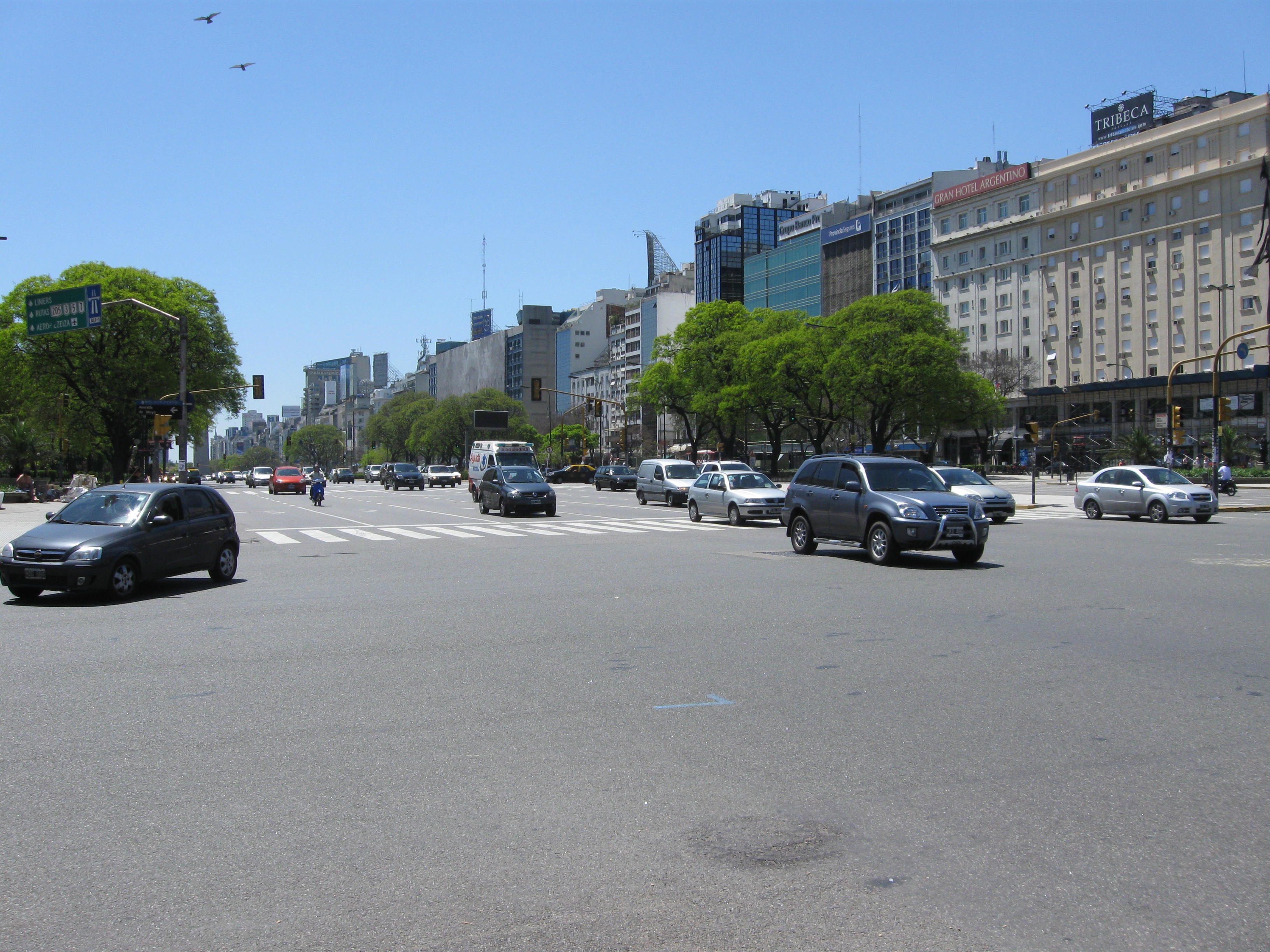
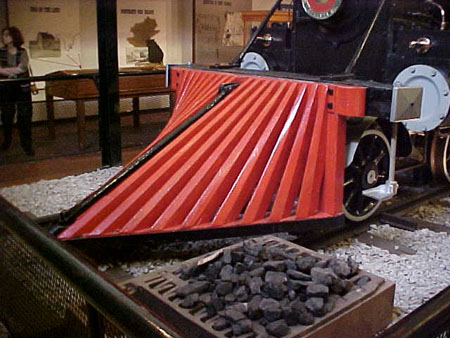
Driving style is aggressive. My taxi driver clung to the bumper of whatever lay ahead, darting around to get to the destination asap! As we entered the infamous 12-lane Avenue 9 de Julio, the largest avenue in the world, I learned pedestrians just don’t have the right of way in this place as elsewhere. When a light is about to turn green, the yellow ‘caution’ light comes on for a second, letting everyone know it’s time to step on the gas! And that they do. Time and time again I’d witness cars drive right up to pedestrians and blare the horn! It’s not like Bangkok, Denpasar or Phnom Penh, where a pedestrian can walk across through the ‘stream’ of traffic and allow it to move around them. Here you risk everything if you step out when the traffic is moving! The only thing missing on cars is a cow catcher. When I saw riot police trucks, I noticed those DO have cow catchers!

Another issue I encountered right away is language barrier. Unlike many other capital cities, English is not commonly spoken in Buenos Aires. Even the concierge at the Castelar Hotel had difficulty with English. But he had been alerted by my guide, Saskia, that I would be arriving. My group had checked in and gone out for a coffee when I arrived, and he did the best he could to direct me to them.

So once checked in, I was right out there on the street in Buenos Aires – all jet lagged but full of adrenaline! Being Sunday most businesses near the hotel were shuttered, and the shutters were splattered with political graffiti. Testament to the turbulence of political and economic life in Argentina! Later on the trip we were to experience this for ourselves on more than one occasion.

So fair warning to those considering a vacation in Argentina: Once in-country, your trip may fall victim to the whims of Argentine politics. Be prepared and be flexible!

I found the group four or five blocks away sitting outside a cafe. They were getting introduced, and Saskia recognized me right away as I strode up. It was a sunny morning, and at that time maybe 60 degrees outside. Across from where we sat was a plaza. At its end was the Argentine Congress building.

As we were all gathered and accounted for and a day yet to be experienced, Saskia had us head back to the hotel to get refreshed, and then spend the afternoon exploring Buenos Aires! It was this day several of us headed out and became travel buddies.


Adventure 2011 Argentina / Chile

28 11 2011

I am a decidedly hooked overseas traveler and could not wait to get my fix any longer! I’ve had some tough times these last couple of years, so I’d put off venturing, but nothing would stop me from exploring in 2011! I had over 100,000 frequent flier miles with United Airlines, which were set to expire. Last time I went overseas was in 2008 to Laos / Cambodia, and that was fantastic. I’m in love with SE Asia and the Himalayan region. I was tempted to return, but I’ve been there seven times – and I’ve never been to South America. So this time, I decided to head directly SOUTH. Time to save my soul and escape my world…to Argentina and Chile – to Patagonia!

Because  for me, getting outside my neighborhood, city, state – my country – seeing life from outside, from another perspective – only that refreshes my spirit!

Honestly, I didn’t have a lot of information, but I knew I’d like to experience the Andes, and probably Tierra del Fuego. Timing was important. In 2011, I worked as a sales consultant and guide/instructor at Alder Creek Kayak and Canoe, and their busy season is summer, winding down with the Lumpy Waters Symposium in October. I inquired with Suzi Elle, one of the owners, about taking vacation and her reply was “anytime after Lumpy!’ So with that in mind, I targeted late October/November for a start time!

It looked like this would be a good time for Argentina and Chile. But it would also be a good time in the Himalayas – prime time is right after monsoon season. Also in the southern hemisphere, I could head to South Africa, or New Zealand. But it seemed the right time for me to see the “other America.” It would be late spring down there. Without a lot of time for research, and wanting to see a lot, I wanted to do an organized trip, so I looked at two companies I’ve worked with, Djoser, out of Amsterdam, and Mountain Travel Sobek, based in San Francisco. I had gone to Thailand with Djoser in 2004 and had a great experience. In 2007 I did an unforgettable 110-mile Himalayan Trek in Bhutan with Sobek. Sobek had a 3-week hiking trip focused on Torres del Paine National Park. I looked into this and really was interested, but I couldn’t get frequent flier flights to match up. So, I looked at Djoser again, and began to realize their agenda might be more an experience I preferred. That is because their three week trip covers much more of Patagonia. They do time in the Fitz Roy Range, and Tierra del Fuego, and even have some days up in the Lakes District, as well as seeing marine life on Peninsula Valdes. It would be more “road time,” but one would get a better overview. Sobek’s trip would be much more in touch with the outback areas of Torres del Paine, away from the throngs of backpackers.

So I inquired at the Djoser USA office in Pennsylvania. They cautioned me that the trip I was looking at was an international group, so I might be the only American. I’d have to be OK with that. I was not worried one bit. Djoser’s groups mostly cater to Dutch, and some other Europeans too. I knew from my experiences with Dutch citizens that they are gregarious, considerate, polite and nearly everybody speaks English. I didn’t worry about any issues. I signed up, and went about calling the frequent flier desk at United. I tried. And tried. “No seats for those dates” was the response for several tries. I began to despair. But one customer service agent took me under her wing, telling me that, “Seats open up, so don’t get discouraged! Keep calling every day!” So I did.

And then it happened. One day I reeled off the same inquiry, dates, times, and the response was, “OK, we have seats on these flights…” I just about hit the ceiling! Hardly containing my delight that I got a FREE flight to South America on the dates matching my itinerary, I booked them on the spot!

I was going! I was going on a trip to Patagonia! We would be seeing penguins, southern right whales, elephant seals, carakaras, guanacos, condors, hike in Torres del Paine, watch tango dancers, bask in the view of the spires of Cerro Fitz Roy, walk on the Viedma Glacier, cruise the Lakes in the Lakes District near Bariloche, and reach the end of the world at Tierra del Fuego!

Here’s a great photo of my comrades on this trip! We were American, Dutch, Belgian and Turkish. A wonderful group…of varied ages and professions!

I was in! So what follows is a story of the trip to the highlights of Patagonia! Stay tuned!