Ushuaia and Wildlife in the Beagle Channel

3 02 2012

Wow! I had the most amazing sleep! I did not awaken once. And today I am recharged! We’re to take a boat from the Ushuaia waterfront out to see islands and marine wildlife colonies in the Beagle Channel. Luckily we got another weather break. Thin clouds but no wind nor rain. The highlights will be getting up close with colonies of terns, cormorants, sea lions and more.

We get to the waterfront early, so we’ve got some time to observe. There are some huge factory fishing ships docked here, and just their size makes me concerned about collapsing fish stocks. With ships like these, towering above the docks, how can Planet Earth’s fish survive? Where is the catch going?

There are plenty of tourists shooting photographs of themselves in front of a sign declaring they’re at the “end of the world.” They’re not – the end of the route is where I hiked to yesterday! There are also some very interesting sailboats. They are private yachts. They are *not* luxury yachts.

These are built for solo circumnavigation with all the overbuilt toughness required to survive the Southern Ocean. These sailboats can capsize, go inverted, and come up righted and survive.

The Argentine Prefectura, or Coast Guard, is busy, too.

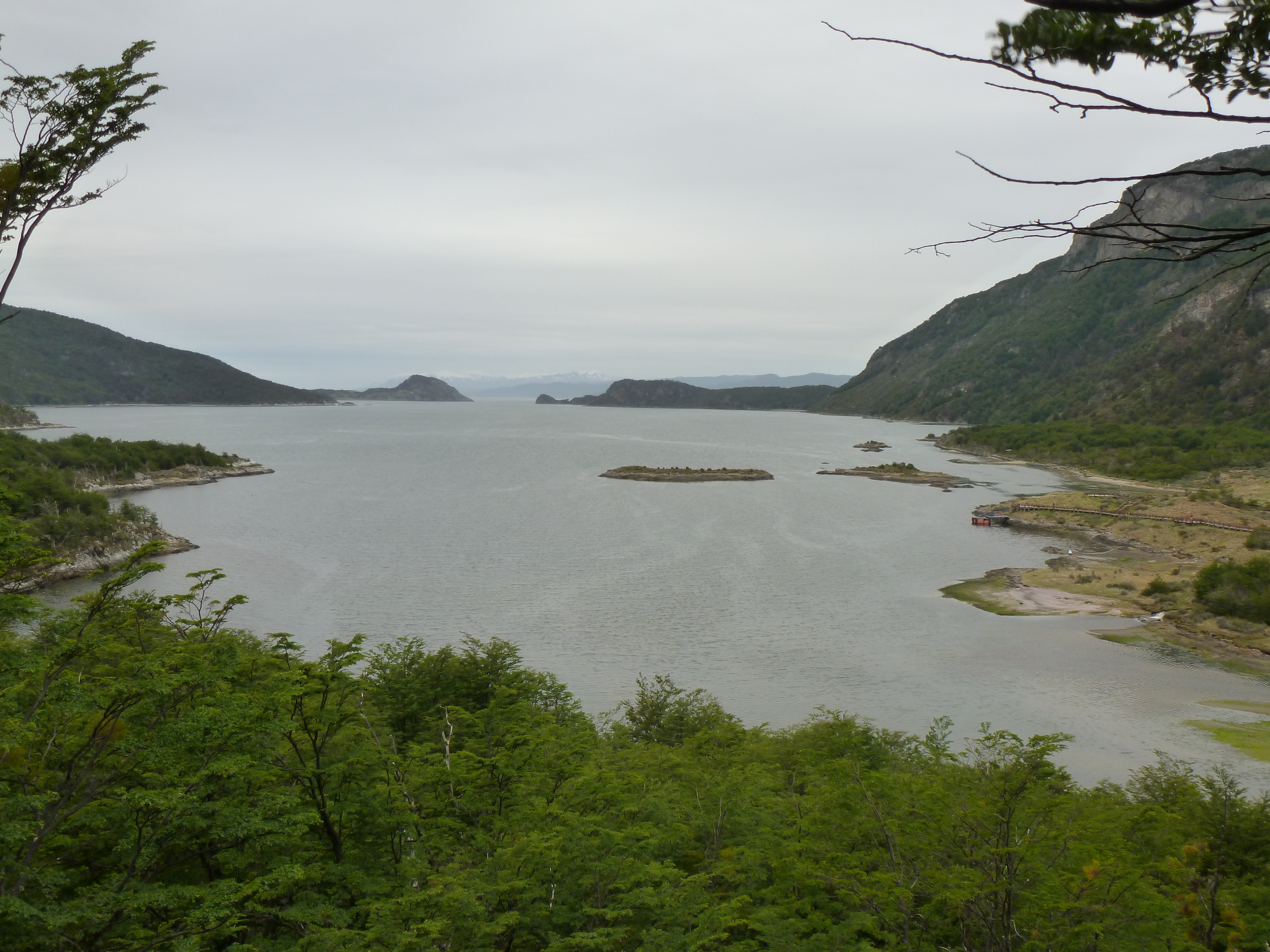
We board our little boat and it takes us out of the harbor and into the channel. We cross, and looking around, I can see some very impressive glaciated mountains to the west that go into the sea. They are part of the Darwin Range, in Chile.

The glaciated Darwin Range

Though they look over 10,000ft high, they are only 6,000ft. It is because that we are at such an extreme latitude that lower mountains can have such impressive glaciers.

Looking back at the city one can see the shanty town creeping up through the forest behind.

Crossing the channel, we navigate amongst some islands home to marine animals of varied species.  We land on one of them and take a quick hike. We see cormorants nesting, and even skuas. Skuas are the bane of nesting birds. Skuas, which look like brown, oversized seagulls, live by scavanging the weak, young, and infirm. They’ll eagerly snatch a chick from a distracted parent.

Looking overhead, I notice the sun is far to the north of 12:00 high. That shows just how far south we are! Wow. We depart for several other island colonies. Each island is home to a species.

On the way we see one or two Southern Giant Petrels, another scavenger.

Giant Petrel

One colony is a sea lion island. I’ll never forget the noise, and the smell. They belch, burp, and make the mose grotesque gutteral noises, as well as bark. There are hundreds, with calves, and bulls making all kinds of noise. It smells! It smells because they eat fish!

Skuas and seagulls are making the most of the leftovers, as is another bird I’ve never seen, which is called a snowy sheathbill. This bird is all white.

We move on to a colony of cormorants.

A snowy sheathbill

They are super busy! There must be a thousand of them. And, they are flying back and forth building nests, bringing food to chicks, and so forth.

The cormorants are black and white, and I’m tempted to call them flying penguins. They make these nests that look like cereal bowls attached to the rocks. These guys squawk incessantly!

Here too, opportunistic scavangers are working the colony hard. Parents are on guard defending against attacks from the hungry predators.

Then, it’s on to the shrieking tern colony.

Like the cormorants, the terns remind me of an aircraft carrier. Lots of  “planes on deck,” and others coming and going.

It’s non-stop buzz of activity!

I do have a couple of videos, which I will show you.

The terns are really pretty, I think.

We get back to the Ushuaia harbor in time for an afternoon exploring the city, and lunch.

Tonight, we depart for Buenos Aires (unless there is another Airline Strike). Elwin, Ivo, Echbert, myself, and Flores head to town in search of lunch. Ushuaia is a tax-free zone so one would think the shopping would be good. Shopping turns out to be a let down. Prices are too high and there are no bargains to be had – they are obviously expecting lots of tourists – especially the ones from cruise ships. We pick an “Irish Pub.” The Irish-ness of the establishment stops right at the front door. While they do offer Guiness, the food isn’t Irish. I see a hamburger on the menu but instead try for what they call a “steak sandwich.” And again, I’m faced with meat on a dry bread / bun or something. While not satisfying, I guess it contained some nutrition. Lunch completed, we wandered around town. The parts Elwin and I visited were nothing worth blogging about. Touristy shops, some liquor stores, hostels, and up back on the hill, some strip clubs. We went down to the water to watch the activity – pass some time.

We only have two days left in Argentina! I wonder how Buenos Aires will have changed since we left? It’s 1,266 miles north to Buenos Aires. We’ll be wearing shorts and t-shirts again! I was told the Jacaranda trees will be in bloom! Looking forward to seeing the beautiful avenues!


Ushuaia and Tierra del Fuego Argentina: We Made It!

2 02 2012

This morning we get the GO signal! Aerolineas Argentinas has seats for all of us on a plane headed to El Calafate! That plane will continue to Ushuaia! For some of us, reaching the most southern place on Planet Earth outside Antarctica is a highlight. It turns out that yesterday a plane did depart Buenos Aires and go through El Calafate, but we did not get seats on it, because there were not enough available to accommodate our entire group.

We’ll arrive in Ushuaia in early afternoon and because sunset is past 10:00 p.m. we’ll have plenty of time to get in a hike at the bottom of the world!

As the plane nears its destination, the terrain appears out of the clouds, and it’s very rugged. Snow capped valley after valley flows below us, then giving way to a fjord. A factory fishing boat is plying the waters, no doubt headed toward Ushuaia. This is the Beagle Channel. One more turn, and Ushuaia reveals itself. It’s a city of about 60,000 carved out of mountain and sea. There is a ski area above, and one part of the city appears to be literally climbing into the forest above – looks like people are simply cutting the forest and plunking down any shanty as a land claim.

Our hostel is a big one. Christof and I get our keys and head to our “room,” which is in fact like a condominium! It’s by far the biggest of this trip. It is three bedrooms, separate bath, a living room, separate kitchen, wow! Huge! Not only that, the living room has a panoramic view of the city and mountains behind!

We gather in the lobby for our activity, which is a hike “to the end of civilization.” That is, to the southernmost continental place before Antarctica. A 45-minute minibus ride later, we are there ready to hike.

The hike winds up and down through trails with views of the Tierra del Fuego landscape. To the east and west, the sky lightens, meaning it’s good weather. Overhead, it’s cloudy. But, it’s not raining. It’s not windy. That is good weather down here!

Here and there we see evidence of the Indians that used to live here. They lived by foraging the clams/mussels from the seabed. They discarded shells, and these shells became mounds we see all throughout our hike.

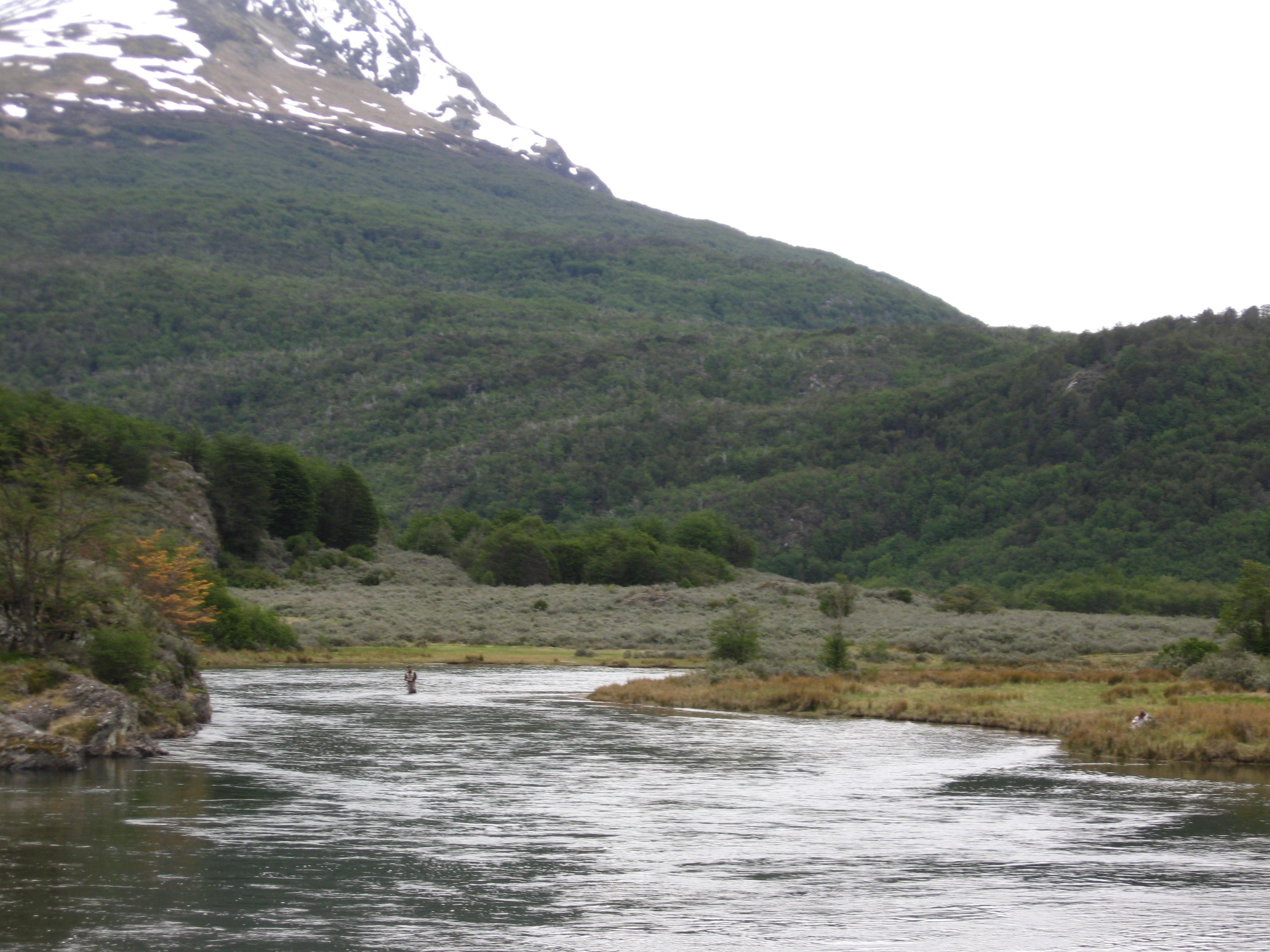
There are also freshwater rivers reaching the sea here, and there are fly fishermen casting these streams.

All along are views to the east and west. It’s not far to the Atlantic. Not far to the Pacific, either!

Today I am the first to reach the end! I actually cheated. Twice. The trail was so close to the road I hitched a ride for maybe 3/4 of a mile. The driver let me off at a cut-off trail. Taking this trail, I cut an hour off the hike!


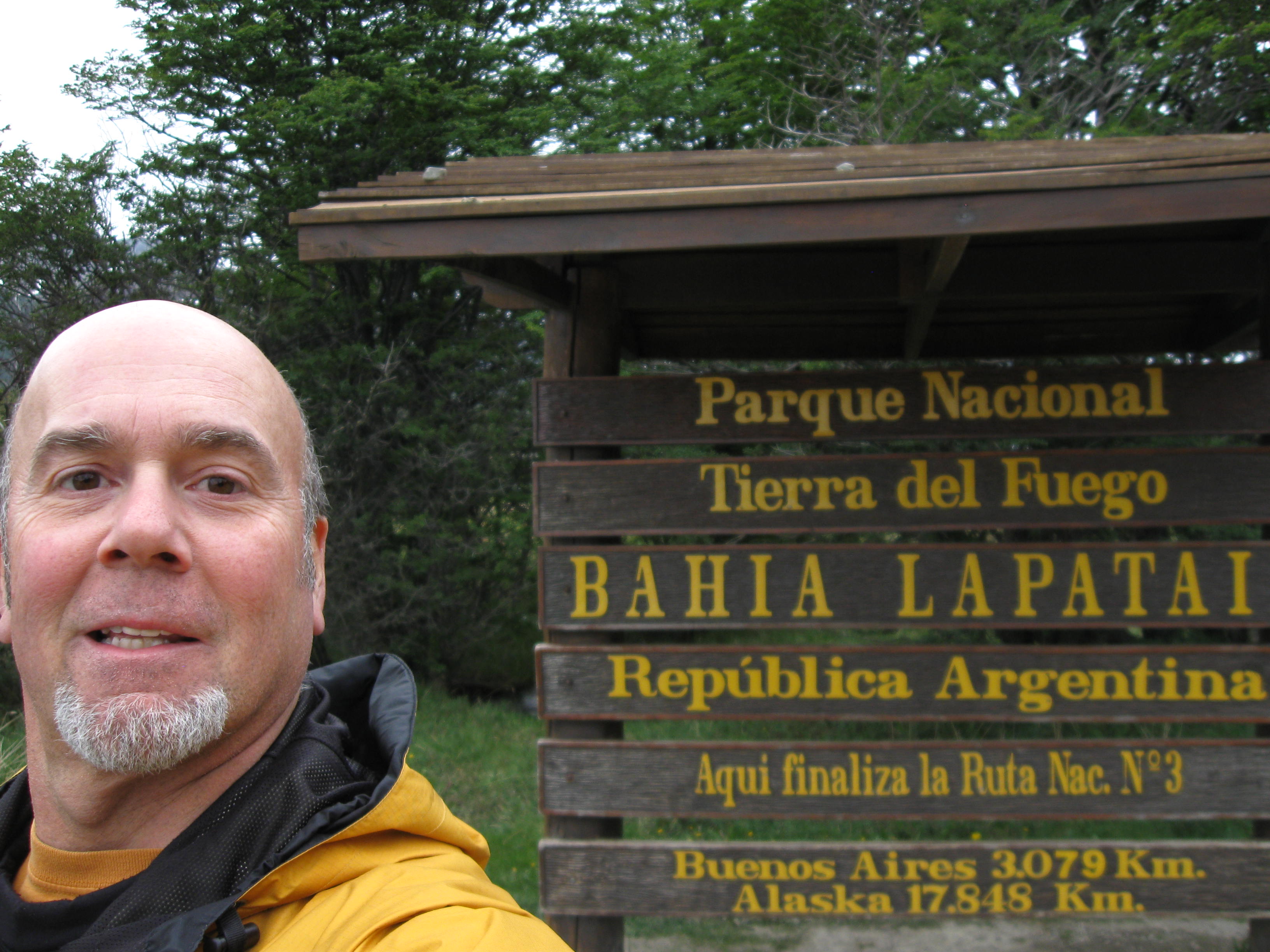
At the end of the trail, and there is a sign commemorating the place. Over 17,000 kilometers from Alaska! This is the END of Argentina Route 3.

Well, I’ve made it. I am at the bottom of the Americas!

I wait around and check out the decked walkway going all the way out to the end. There are some local ladies down there sharing a bottle of bubbly celebrating something!

Other then them, though, the only company I’ve got right now is some Patagonian geese! They are really interesting…they always are seen in “married pairs.” And they don’t ever seem to mind people being nearby.

Yap and Angelique at the end of civilization!

Ahh-familiar faces! Everybody finally shows up…
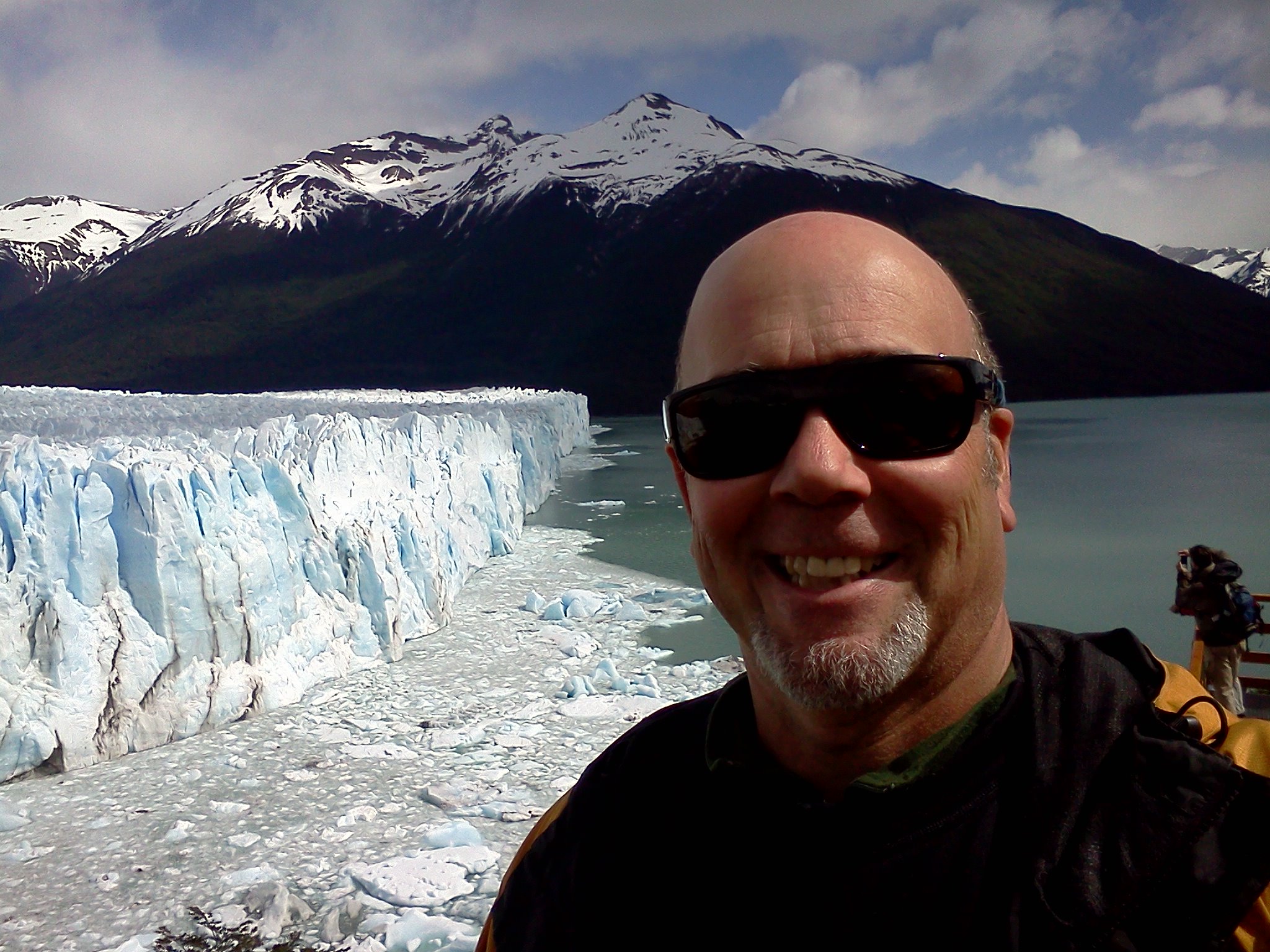
Everyone spends some time in thought, thinking about where we are on Planet Earth, for this is truly the southernmost continental place outside the poles. This is several hundred miles and a major latitude parallel below New Zealand. MUCH farther south than Cape of Good Hope. If you have a globe, go look at it now. At this spot, Antarctica reaches up toward Tierra del Fuego.

This is close to Cape Horn. Cape Horn is one of the most notoriously stormy places on Earth – before the Panama Canal was built, countless clipper ships were lost rounding “The Horn.” For here, the Southern Ocean, the most stormy on Earth, gets squeezed between Antarctica and South America. The Southern Ocean is famous for ceaseless storms, 70-ft seas, and…icebergs in between.

Tomorrow, we are to take a boat to explore islands, and see wildlife living on islands in the Beagle Channel.

It’s past 8 p.m. and still very bright outside. We board our van, which takes us back to town. Although most are going out to eat, I am utterly spent. I spend maybe an hour watching TV in the room, and then sleep like a rock all night….


Hiking to the Foot of Cerro Fitz Roy

25 01 2012

Cerro Fitz Roy, front and center. Spectacular!

Today it’s windy and bright in El Chalten. I sip coffee in front of the picture window of the Aylen Aike hostel watching Cerro Fitz Roy. This morning the tower is sprinkled in dazzling sugar white. And, it’s obvious why it’s also called Cerro Chalten, which means smoking mountain. There’s a constant cloud drifting off the top. But the sugar melts as the sun warms the peak, revealing the 11,090ft pure granite face.

Today, it’s going to be an all-day hike. Leaving about 8:30 a.m., we won’t be back until past 4:00. We’ll head on a different trail which will take us all over the plain below these spectacular peaks, with an option to do a final, steep hike to a lake at the end of a glacier.

Box lunch in hand (less the ham and cheese I removed), I join Echbert, Saskia, Christof, Eray, Elwyn and Floris as we walk past the north end of town to the trailhead.

At the beginning of the trail there is a group of maybe twenty hikers and a guide. They are partly already on the trail, so we hike with them. But we are much faster. This first part of the trail is a steep climb. When they stop for a break, we make our move and go on ahead. There’s no looking back. We want to have the experience to ourselves. We wind our way up a slope with a view to the north, looking up a river valley. Up above Andean Condors ride the air currents. We can see their nests clinging to the steep cliffs above us.

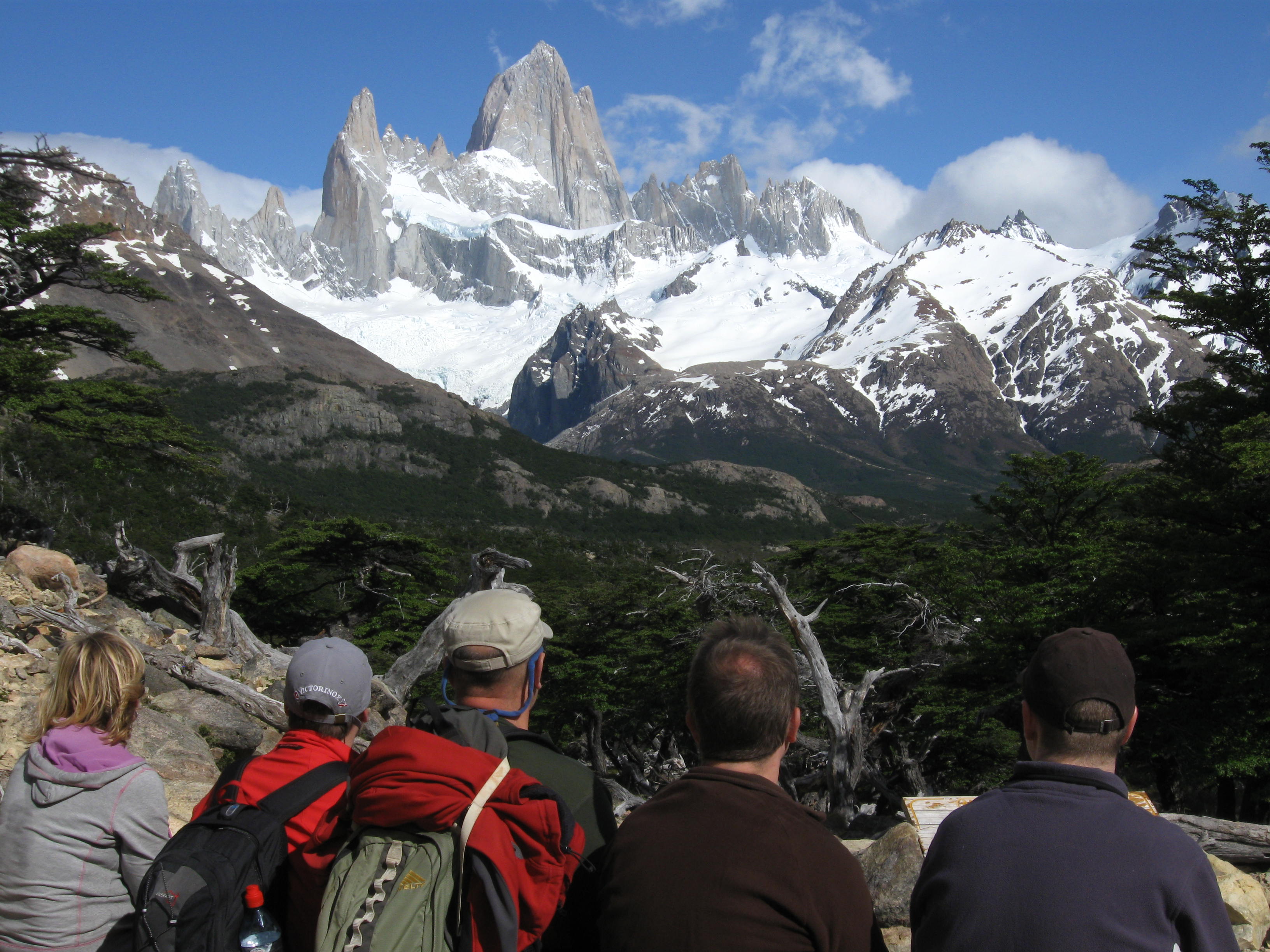
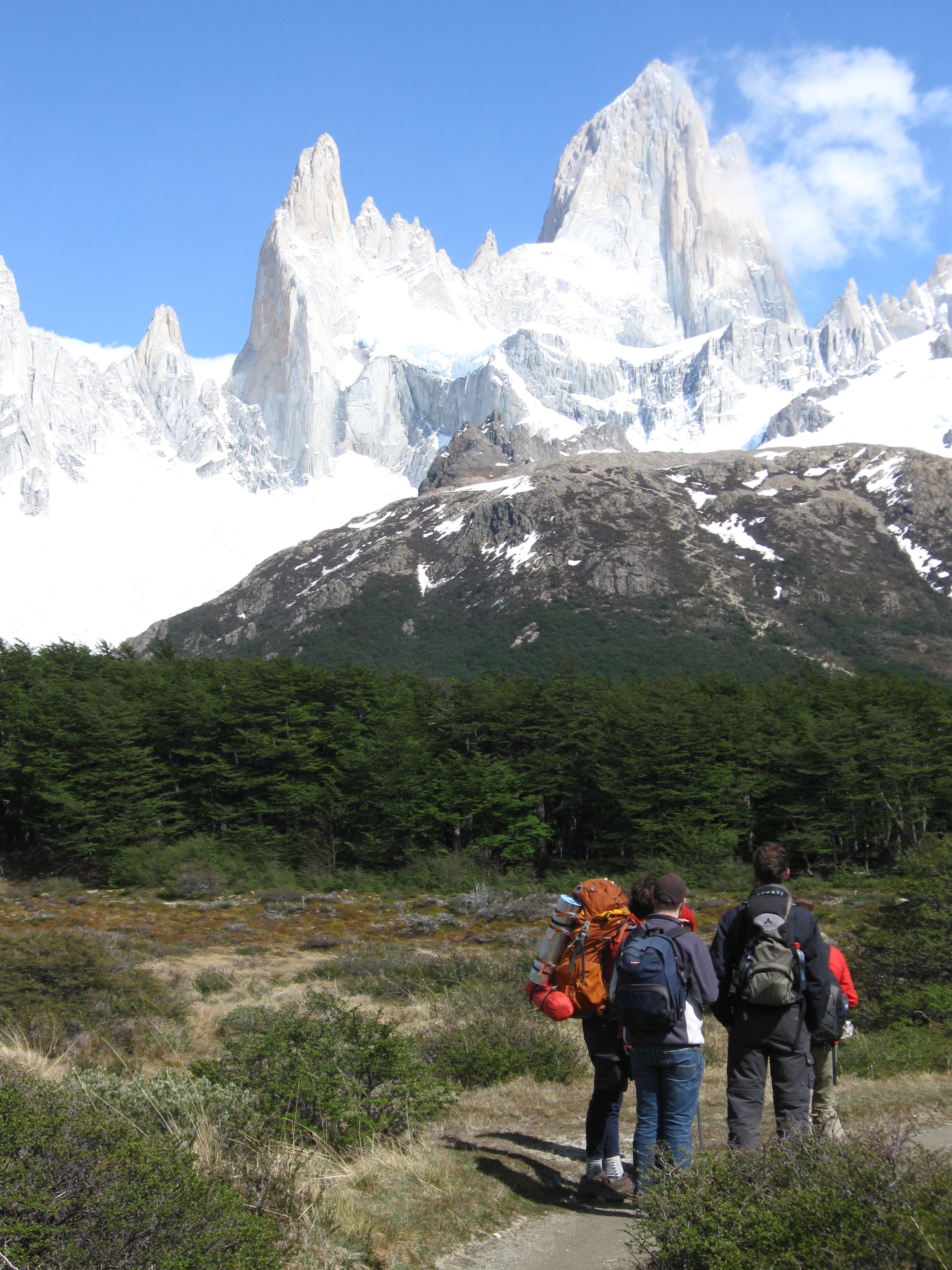
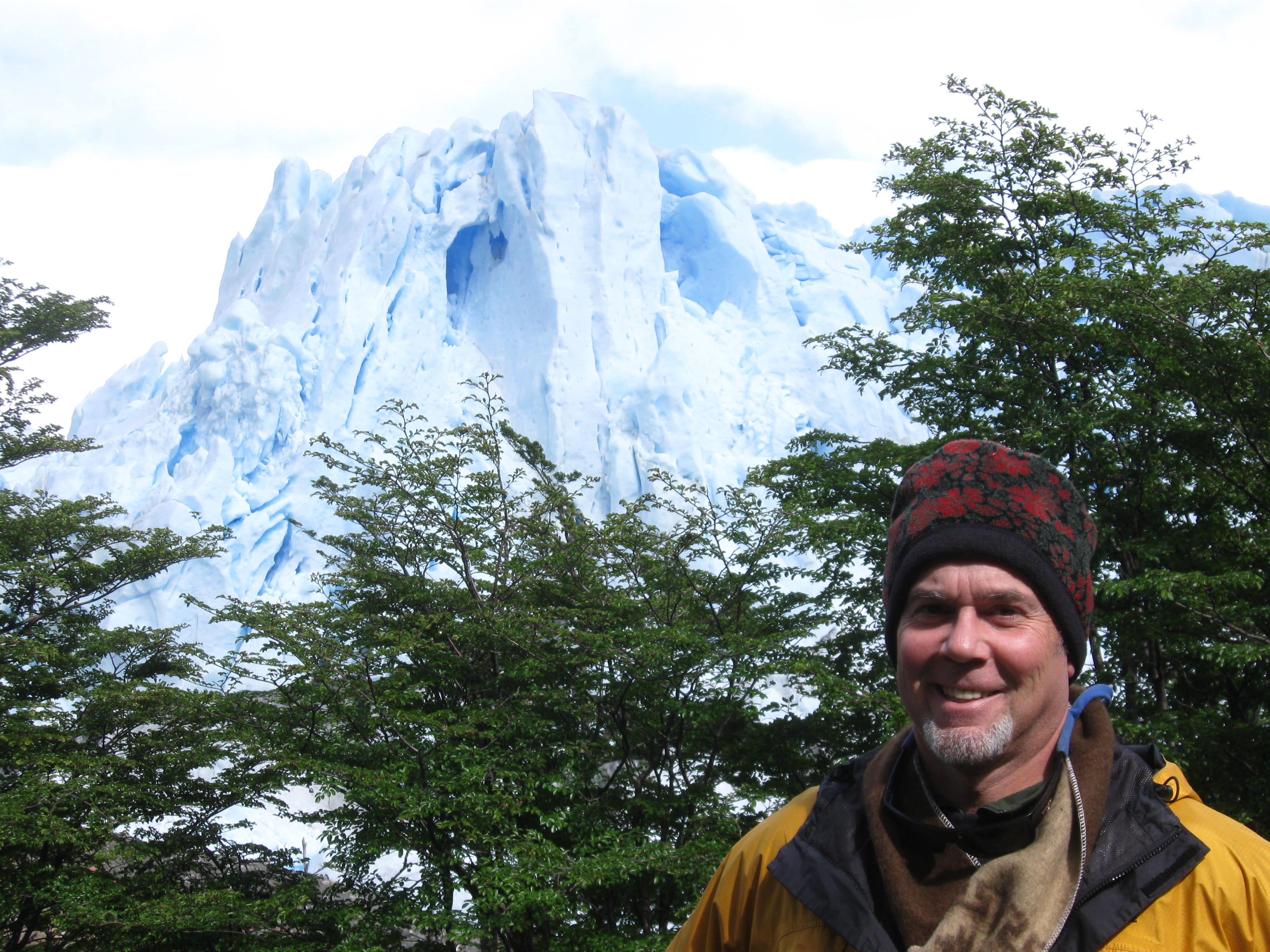
Llamas on the plain belowThis trail is rapidly becoming my favorite of the trip because of the vistas all along the way. Plus, after our steep climb it becomes a rolling up and down trail. These trails of Los Glaciers National Park are superbly maintained and marked. It’s not long before a a view comes into focus with shark toothed Fitz Roy mountains. Below this magnificent spectacle is a gorgeous relatively flat plain, several square miles in size, filled with creeks, meadows, flowers, trees. To the right side of the mountains flows an electric blue glacier. It’s unlike any I’ve seen in that the whole thing is electric blue, not just parts. It stands in contrast to the gray rocks it cuts through.

Passing us by is a United Nations of hikers. I even recognize some of them from Torres del Paine. Some of them are day hiking, and others are laden with backpacks. One of the best things about this region is that one can do fantastic day hikes and stay in town. Wonderful.

After several hours, we reach the base of the steep final assault, which is a 500ft high glacial moraine under Cerro Fitz Roy. Here is the final assault. Saskia says we don’t have to do the final part. Floris, part of our group today, did not complete the Torrres del Paine hike due to asthma. But he made it here. I want him to enjoy the outdoors as much as I do. He doesn’t want to do the final assault. So I decide to stick with him and we offer to wait for the others to go up and return.

This seems to be a gathering place for many hikers. So, we will have a relaxed lunch here, enjoy the beauty, and wait for the others. The day has become warm and many folks are have shorn jackets, some are in shorts. It’s a nice spot. There is a sign that says, “The water in the streams is potable.” Wow! That is a big difference from home. So we fill our water bottles and go ahead and drink.

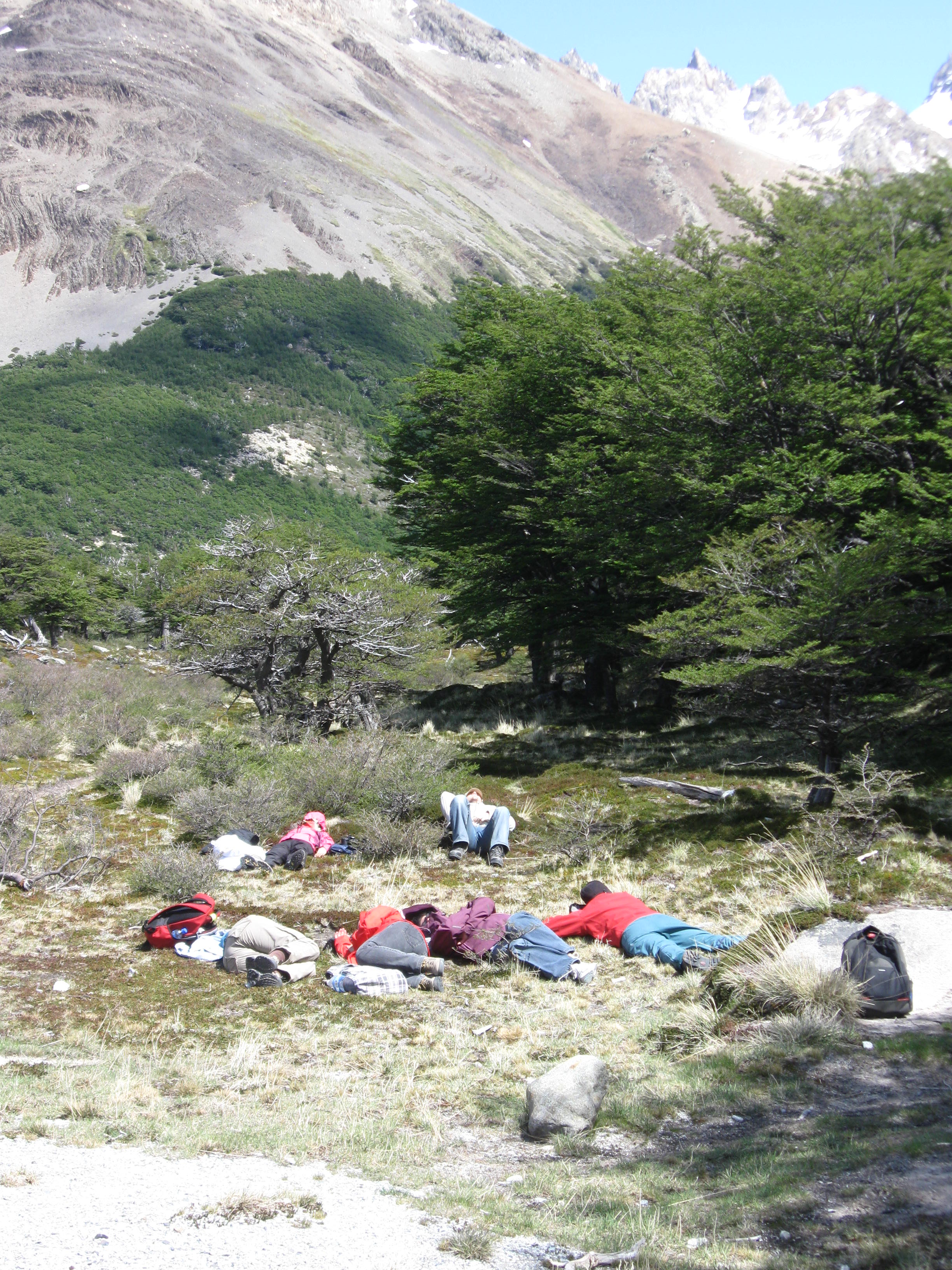
Floris and I spend about an hour here, and after another twenty minutes we decide to hike back. The trail meanders all over the plain, past many little brooks, some clear, some stained brown with some kind of algae-like growth. I think there is perhaps a warm spring in here causing this growth. We come across a cluster of hikers all taking a nap in the sun!

We come to a fork in the trail. One path leads the way we came, but the other goes to Lago Capri. Thinking it might take some time to get there, we prepare for a longer hike.

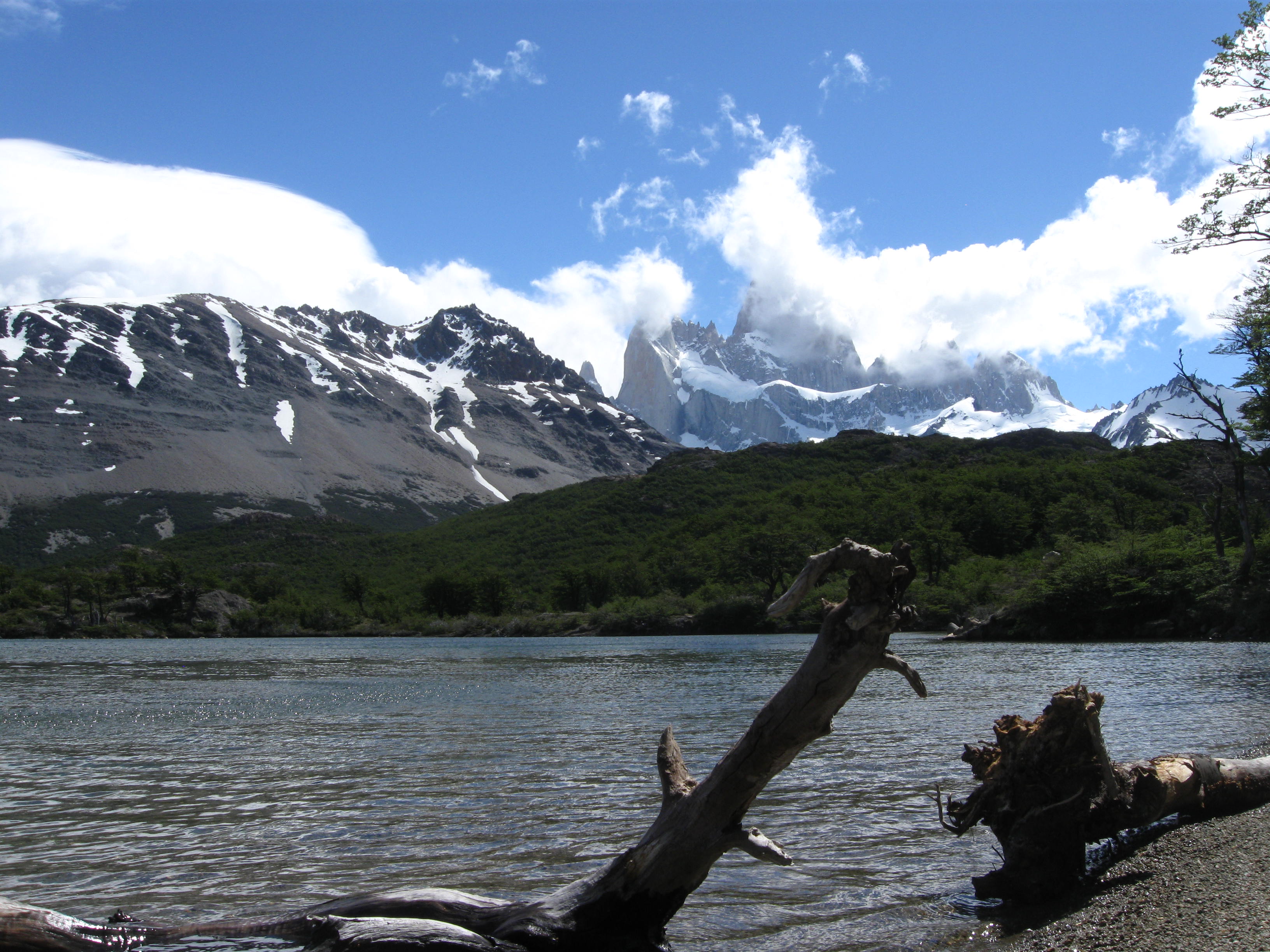
Floris and I hike on. Much to our surprise, we reach the lake very quickly, and it’s a beauty! Much larger than I expected. And it’s not glacier-fed. So, instead of a misty blue milky color, it’s crystal clear. And what a view of the peaks!

It’s even got a thin beach, and some other hikers are relaxing on it taking in the view. Alongside the lake there’s a sweet campground. Super beautiful.

Back in town, it’s a wind tunnel again. It’s a constant 40mph with gusts rising to 65mph! I have to hold onto everything to keep stuff from blowing away!
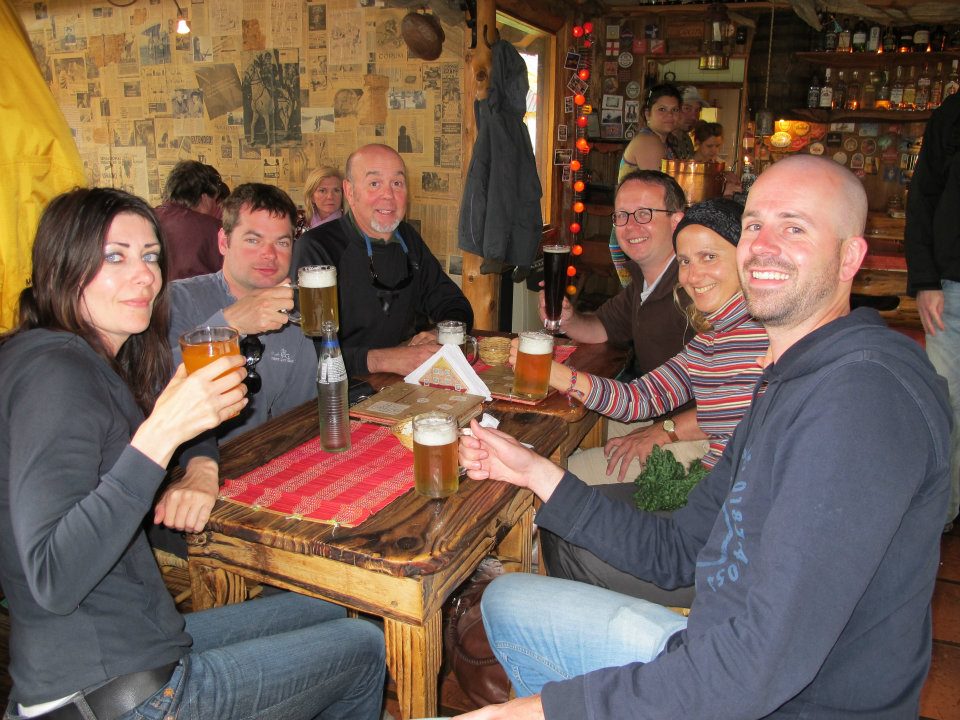
El Chalten sports a few restaurants catering to the hikers that come here, and one of the most popular is the brewery.

So today, after cleaning up at the hostel, we head to the brewery for a late afternoon beverage and a bite to eat.

I’m super pleased because I can get a fulfilling salad here! It’s brimming with yummy veggies my body is craving for!

We’re discussing the next phase of our adventure. Tomorrow, we’re going to the end of the continent – Tierra del Fuego and the southern-most city in the world, Ushuaia!


Walking on the Viedma Glacier

21 01 2012

Last night we partied! It was Patricia’s birthday and the hostel was festooned with festive decorations. We had cake and champagne. Then everybody hung out and either played board games or watched videos. Meanwhile the wind outside howled, and occasionally whistled through any cracks in the insulation.

The Patagonian Ice Cap (left) feeds the Viedma Glacier

The Viedma Glacier is our destination today. We all get those box lunches, and this time I just toss my ham and cheese in the waste basket. But it’s got empanadas too, and I like those! We’re up and out the door by 9:30. We head down to a marina on Lago Viedma.

Lago Viedma is another huge glacier-fed lake that sits right out in the high desert. It’s 50 miles long, and is dotted with blue icebergs borne from the Viedma Glacier.

We are to board a boat which will take us around a point and into the lake, and then to the snout of the glacier.

Then, we’ll disembark for a few hours walking on the glacier itself!

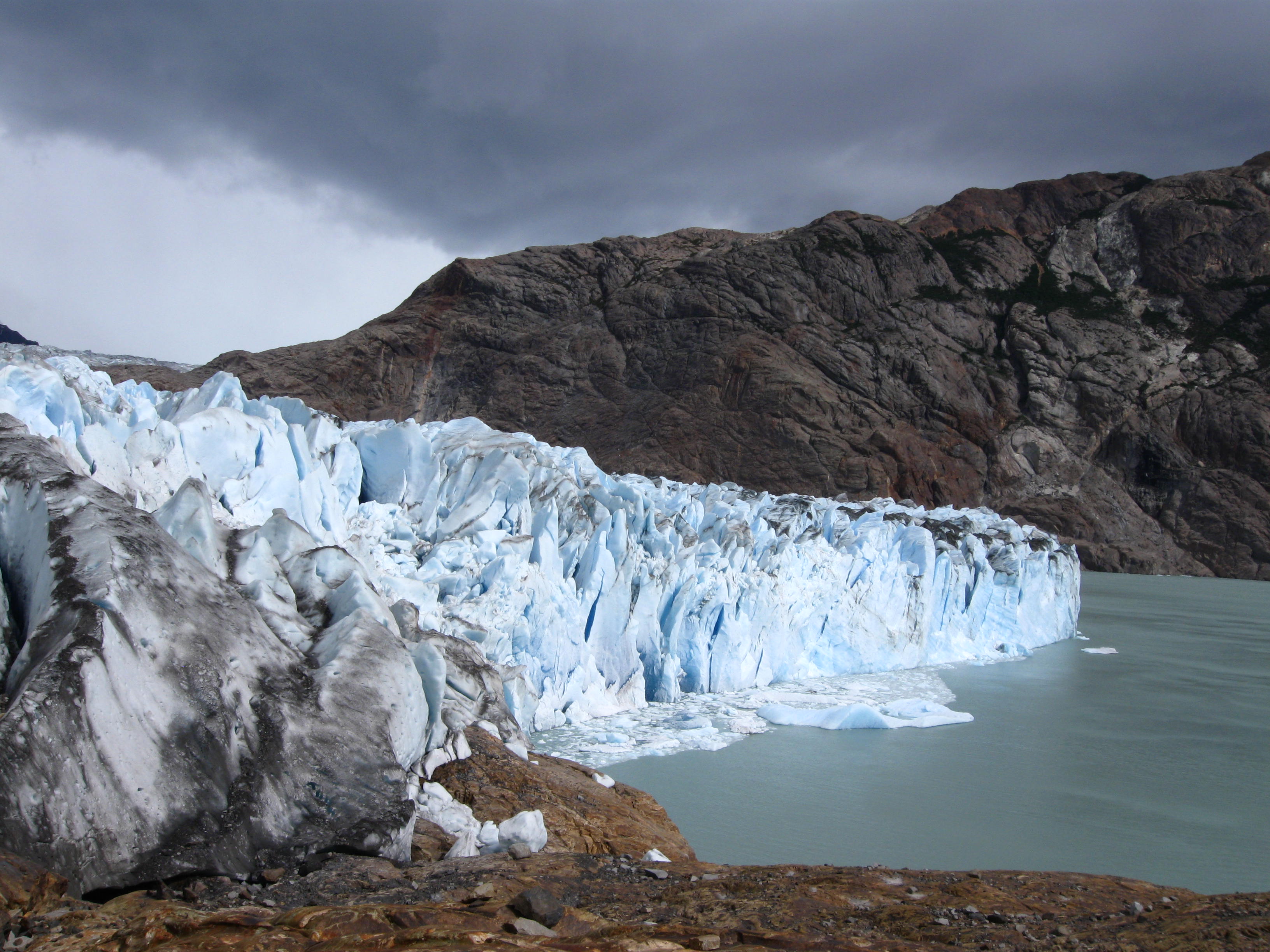
The Viedma Glacier is the largest in Argentina. It doesn’t look as large at its snout as Perito Moreno, but above, it’s a bigger sheet of ice.

While it’s sunny back in El Chalten, here out near the Patagonian Ice Sheet, the weather’s so different. It gets even windier, and stormier. The lake is punctuated by beautiful indigo ice bergs. It still seems weird to me to see ice bergs in a lake! But here they are.

As we round a point and the boat swings west, we’re no longer protected by the land, and we face directly into the wind racing down the Andes. The sea state instantly changes into a storm, and the captain races the engine to push through the waves. Many of us had been up above on deck enjoying the weather, but we’re ordered to stay inside now!

As we near the glacier, many more icebergs come into view and of course the glacier’s snout. I am told that boats do not get close to this glacier for views, because instead of calving from the visible end, this glacier has an underwater shelf where it calves, and massive ice sheets suddenly shoot up from below. No boat wants to be on top of one of those!

A berg near the glacier's terminusThis should be really interesting – walking on the ice. Others here have done this before, but for me, this is my first time. I’ve used crampons climbing mountains in the Cascades but nothing like this river of ice.

So I’m pretty excited to give it a try.

We disembark and walk up the rocks near the end of the ice. This glacier has retreated, unlike Perito Moreno.

We are told the ice was moving over these very rocks 20 years ago. The rocks are all smooth. They have streaks across them and deposits ground in. These streaks are scours called glacial striations. They are where rocks embedded in the glacier cut down on the bedrock.

Our guides meet up with us and we get lots of information on the glacier, the ice cap that feeds the glacier, climate change, and about the upcoming hike and equipment we’ll be using today.

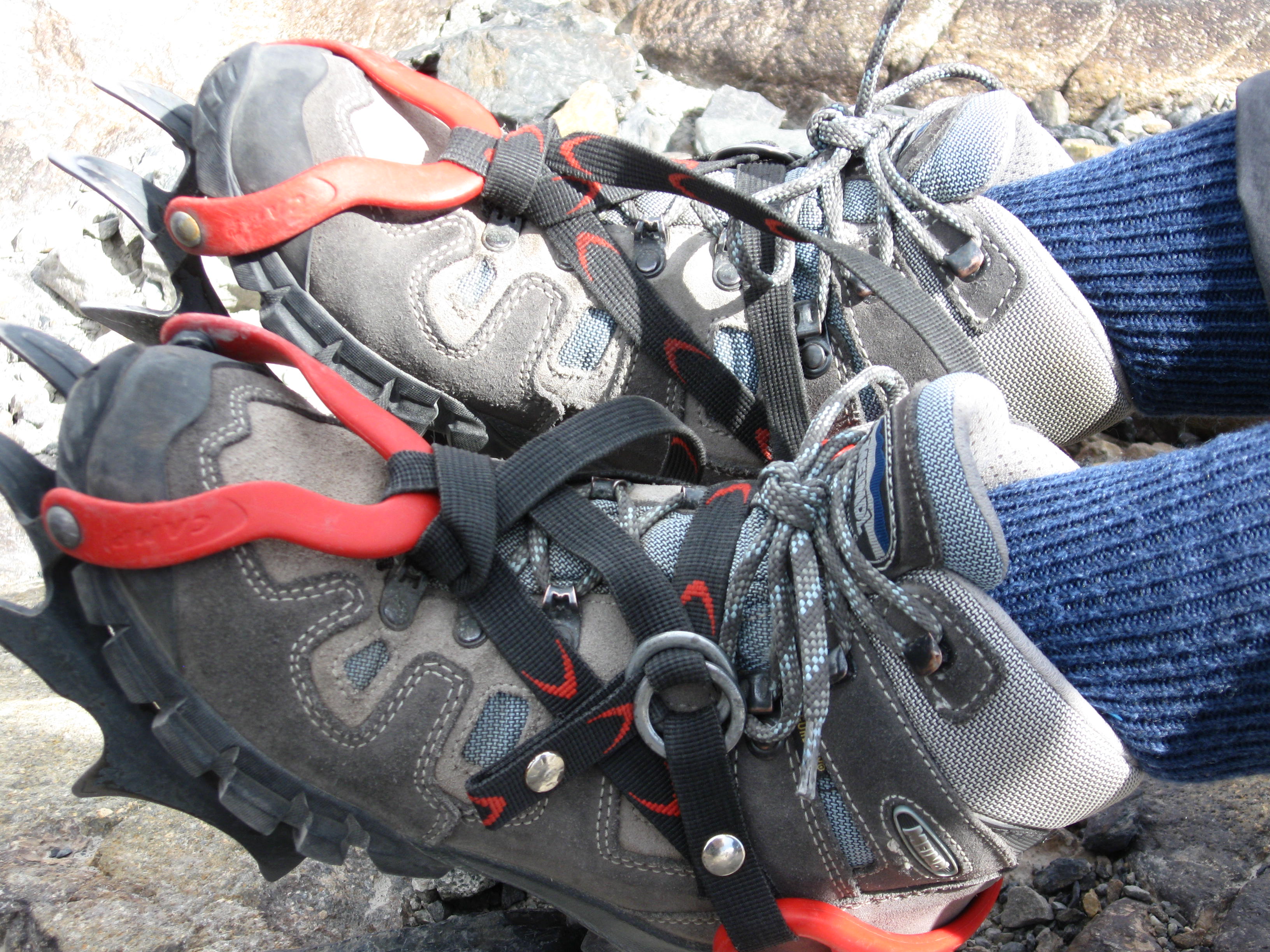
The main piece is crampons.

You wear crampons over your other shoes, and it’s best to put crampons on over hiking boots.

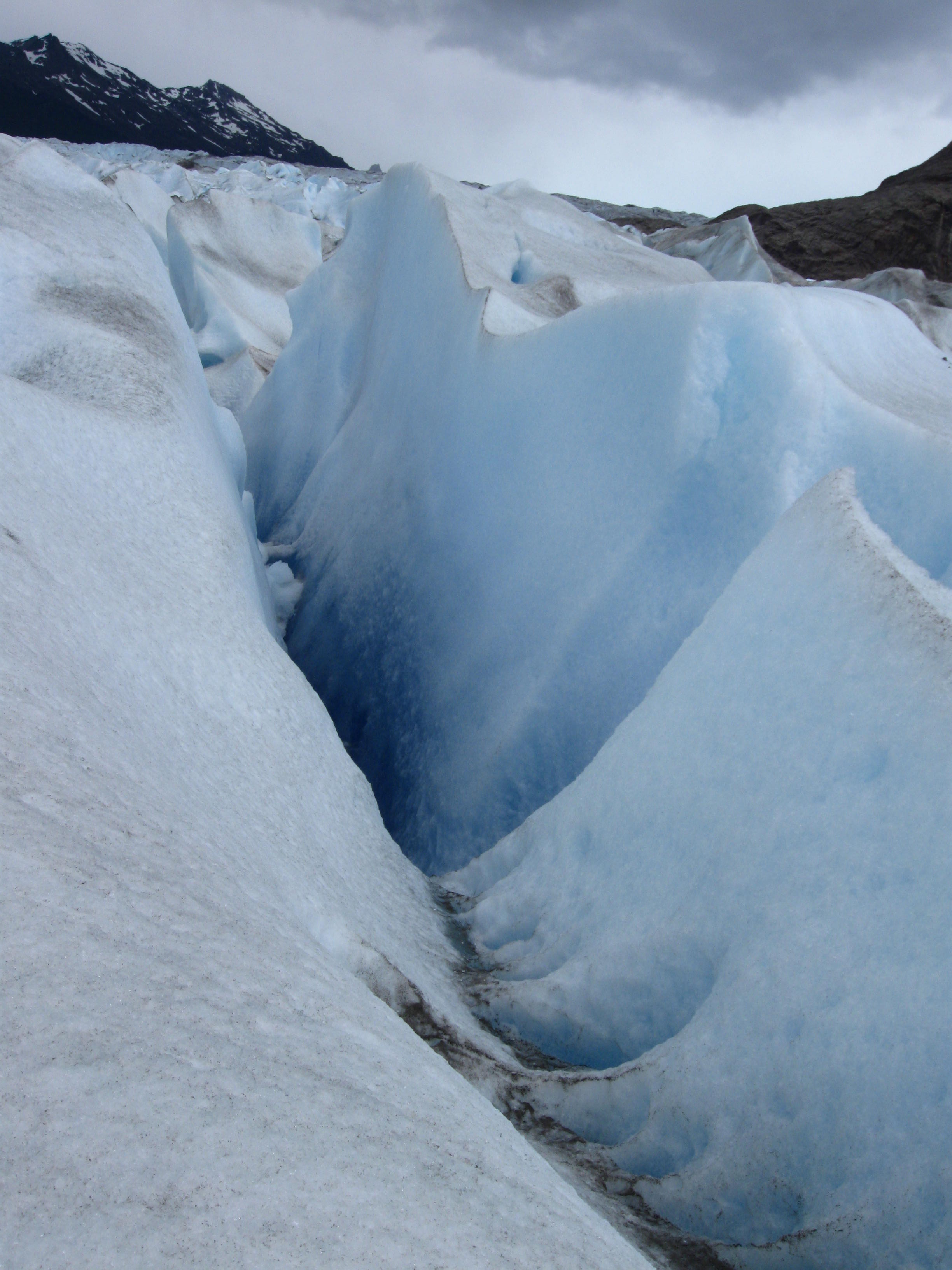
The ice today is a bit slushy/wet. It’s full of grit from its journey scraping along, plus winds carrying dust that has settled on the ice. The ice has cracked into thousands of vertical spires of ice. It looks un-hikeable, but we’re about to find out it can be done.

Our guide! Super cute.Crampons securely tied on, we head out onto the ice. These shoes bite into the ice, giving a firm grip. It’s a bit disconcerting to see the rivers of water gushing everywhere and the deep cracks. One slip and it looks like you’d be lost forever!

We climb all over and we’re not the only ones up here.

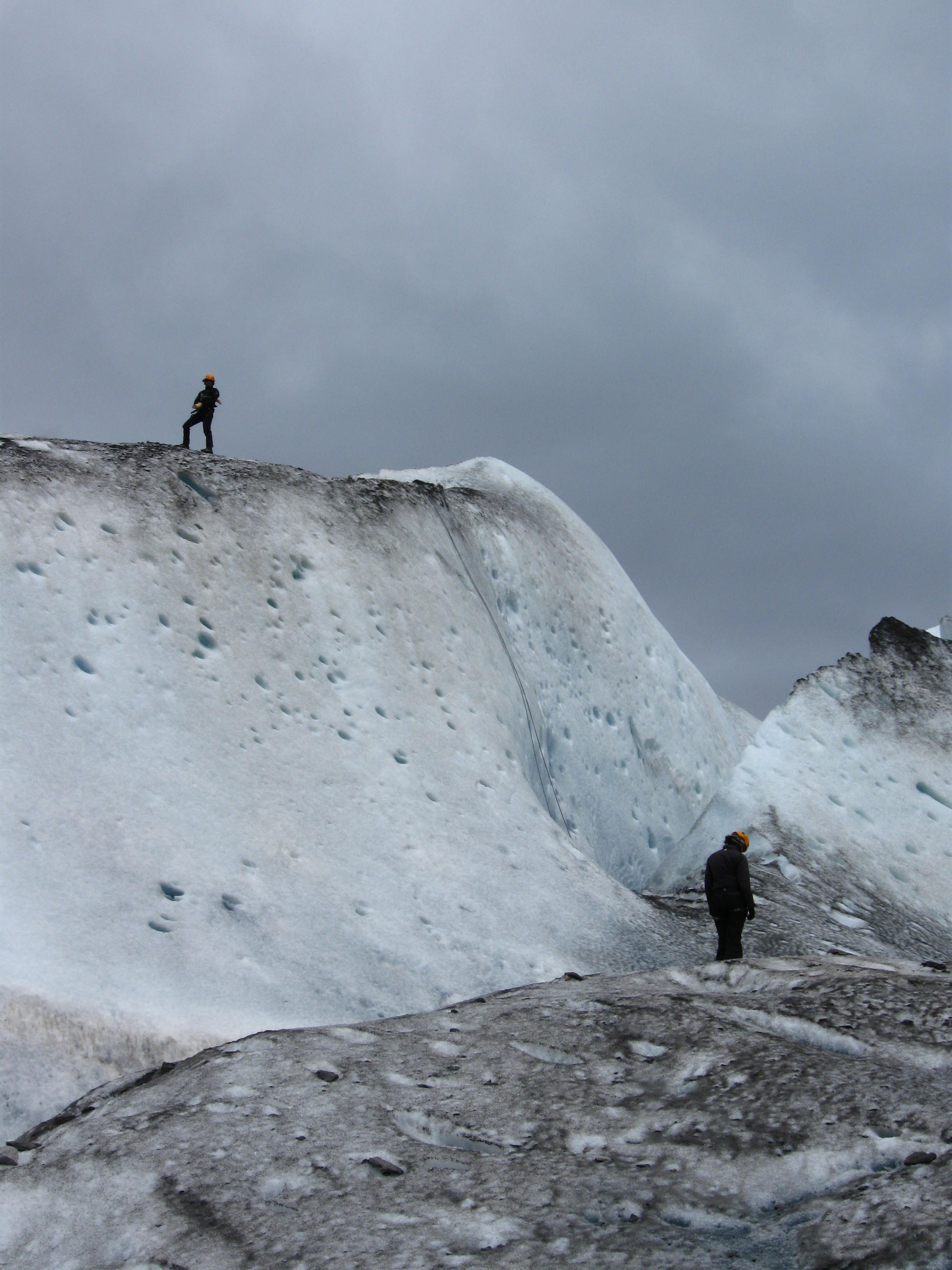
There are others learning how to use ropes to climb the ice walls. It’s interesting to watch them. We climb up and down “trails” the guides know.

We walk all over, and after a time I realize how easily one could become lost out here.

You lose track of your trail, and everything looks the same.

The ice flows up and down, and you feel like you are walled in. I’m super thankful we have the guides here. They are really professional; they guard any spot where you could slip and fall into a cravasse.

The guides take us into a dead end, and I kind of wonder what’s up.

They start digging holes into the ice. Then, their true plan is revealed…they have a little celebration in store for us.

They pull out some Bailey’s Irish Whiskey from their packs. We are treated to a toast of Bailey’s on glacier ice! Very nice.

Glacier ice and Bailey’s!

This was a fine hike.

Some said they wanted it to last much longer, but I found it a good introduction.

After all, I’d never done this before.

I felt satisfied with my first time on a g00d sized glacier! Up close these are really fascinating natural phenomena. After all, the ice we’re walking on is hundreds of thousands of years old.

Certainly something to celebrate!

With the Bailey’s finished we lumbered back to our starting point, to lunch on those ham and cheese sandwiches (except myself, of course). Then it was back to the wind tunnel (El Chalten).

Tomorrow is the big hike to Cerro Fitz Roy! I’m stoked to tackle it! I’m really enjoying being in the moment, taking each amazing day as it comes! Bring it on!


To El Chalten and The Fitz Roy Range

15 01 2012

Cerro Torre

We depart El Calafate on a public bus. It is several hours on the road to El Chalten. The route takes us along Lago Argentino and then Lago Viedma. I am overwhelmed with the sight of the steppe, these enormous lakes, the emptiness, and the mountains visible north to south for hundreds of miles. It’s not something we’re used to in North America. As before, it looks like the American West, so desolate and dry. Except for no vehicles on the road.

El Chalten is a frontier town. It was established in the 1980s by Argentina to resolve a border dispute. It sits underneath two of the world’s coveted climbing prizes, 10,262 ft Cerro Torre and 11,070 Cerro Fitz Roy. These vertical fangs are renowned for vertical difficulty combined with abominable weather. They’ve claimed a lot of lives. The town is renowned as one of the windiest in the world, and we are about to experience it for ourselves. It’s not cold right now. But the wind is supposed to be epic. It sits at the gateway to the north entrance to Los Glaciers National Park. El Calafate was at the southern end. It contains world class hiking and opportunities to climb on the Viedma glacier, largest in Argentina. We will do it all!

All during the drive I keep an eye peeled for the Fitz Roys. Something catches my eye, and I cannot believe it! I am seeing a river of ice which ends in the desert. It is the Viedma Glacier! I never imagined anything was possible. It makes its own lake, but everything around it is desert! Click on the image to see all of it.

And to the right of the glacier, this sight also made my jaw drop! It is the Fitz Roy Range! We will hike it!

For the umpteenth time in as many days my eyes tear up with what I am seeing. I just cannot imagine. We get closer. The road stays empty. This afternoon, we will be hiking in these incredible mountains!

El Chalten (Cerro Fitz Roy) front and center!

We reach town, where it’s windy beyond belief! The entire town seems to be under construction. It’s a magnet for adventure travelers. Wind blown backpackers can be seen walking the streets. We stay at the Ailen Aike hostel, six to a room. It’s got a small common area with flat screen TV, a bar, and tables. The whole time we’re there, the wind is moaning, trying to lift the roof off!

It’s mid day. We hit the trail for Laguna Torre.

This trail is perfect for an afternoon. It climbs steeply out of town, but after the first mile, begins a more rolling climb, much more tolerable. The wind up on the trail isn’t so bad.

In fact the sun is out, and things are pretty nice! But up above, Cerro Fitz Roy is in the thick of a maelstrom. Its other name is Cerro Chalten, meaning smoking mountain. The wind runs vertically on all sides of the peak, creating a constant cloud which blows off of it. It looks like it’s smoking!

I’m sore from the climb at Torres del Paine. We have a big hike in two days, and I don’t want to overdo it. So my plan today is to get to the first viewpoint, lunch, watch the mountains, and head back to town. The others are going to go all the way to Laguna Torre, to the lake where a glacier ends. This way it’s like a workout.

This is a truly lovely park. And not as busy as Torres del Paine.

Yours truly, on the trail

There are glaciers cascading down from the mountains. And of course pretty azul colored rivers flowing from them. There’s also a small plain below everything, which looks great for walking.

We reach the viewpoint and have lunch.

The others depart and I stay put watching the scenery.

What is apparent is the violence of the winds aloft. There is a stationary cloud behind the peaks – It’s formed by the permanent ice sheet above. The unpredictable, violent weather here is driven be four factors: 1) Latitude – we’re not far from Antarctica; 2) the bottom of South America is not all that wide – we’re simply a giant finger in between two oceans, so the trade wind blows across; 3) factors 1 and 2 combine to create the ice sheet, which makes the air so cold above; 4) the desert is lower and drier…so the cold air rushes downward off the mountains to the desert all the time.

As I sat watching, an upside down atomic bomb mushroom cloud explodes downward over Cerro Torre! Holy cow. I wouldn’t want to be on ropes climbing! Here is a video I took as I was watching Cerro Chalten. In it, you can see the cloud moving downward over Cerro Torre, if you look carefully!

After an hour, the wind begins to pick up so I decide it’s time to head back. I think I’m walking a good pace. But then, I hear some footsteps behind, and it’s a woman jogging down the trail! Down she runs, at a good pace, dodging the rocks, and passes me by. My goodness! She made me look like a slug!

After two hours I reach the top of the beginning of the trail. From here, there is a good view of El Chalten.

I think that part of the reason it’s so windy in town, is that it’s in a valley. The wind must get funneled through there!


Perito Moreno Glacier, Argentina – My First River of Ice

11 01 2012

From Torres del Paine we head into Argentina, across the empty Patagonian steppe to El Calafate. It’s the lodging headquarters for those visiting the Perito Moreno Glacier. El Calafate is the biggest town for hundreds of miles around.

We stay in the centrally located Calafate Hostel. Its guests are all visiting the outdoor spectacles in the area. Lago Argentina, a 1,640-ft deep, twenty mile wide glacial lake sits to one side of this town. This lake is as deep and much larger than Lake Tahoe. It is 566 sq miles in surface area, and Tahoe is 191.  This morning, we head to the dining area and things are not going well. The coffee is just about un-drinkable, the milk is hot. There are not enough coffee cups or cereal bowls or anything. Yaap complains to the staff. And again, the fruit is canned. I make up my mind to bring my own stuff tomorrow, I cannot stand it. I love breakfast and this is hard. Still, a surprise! An attractive young woman comes to sit at my table. We introduce ourselves, and she is from my home town in NY! Her name is Andrea, she works in Australia. She’s really excited to see the glacier today and will be on my bus! We talked all the way to the glacier.

I’ve never seen a glacier of this magnitude. The Southern Patagonian Ice Sheet feeds 300 glaciers in Argentina, including Perito Moreno. This is a famous glacier because it moves 10 feet per day, and calves ice bergs all day long. It’s also got viewing decks built along its face so you can see it up close. Saskia, our guide, says it’s really exciting to watch.

So without further adieu, here are some nice photos of this magnificent force of nature!

This is the left half of the mile-wide glacier terminus.

The terminus of the glacier is three miles wide, and 16 stories tall. It dwarfs tourist boats coming to view it. It’s one of three in the world that is growing. It’s 580 feet thick. It’s a sky blue color! Riddled with dirt. The front is 16 story tall saw tooths of ice. Utterly un-walkable. We take walks all along the decks built to people can view. It’s incredible how tall the wall of ice is.

I can see down more than 100 feet and yet the glacier towers above me.

A view along the north side of the glacier shows how wide it is. On the viewing platform there are places to sit. Many are having lunch, some writing, but most are watching the glacier, because this one is known to send off ice bergs all day long. I sit down and wait. I can hear explosions all around. Those are cracks in the glacier which appear as it moves over the ground.

Several times I see ice falling off the glacier, and it slams into the water, as if in slow motion, and then bobs up only to reveal maybe 10% of itself once it floats. Ivo was able to catch one of the moments with a fast action camera, and put together this compilation! Enjoy! It’s fantastic.

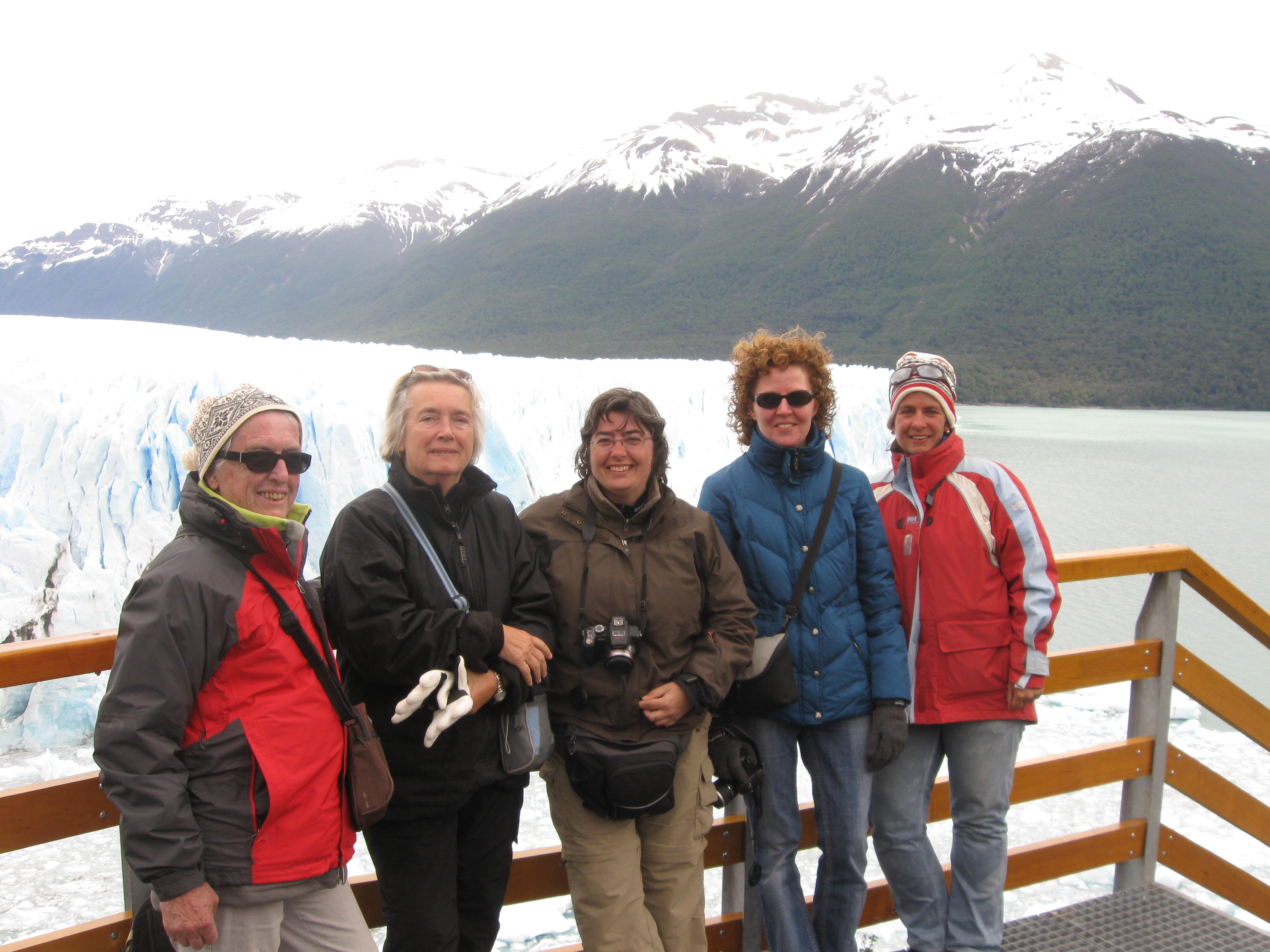
Ans, Margaret, Monique P, Anne Marie, Monique

The ice field behind the glacier, and the glacier itself, make their own weather. Several miles away from the glacier, the weather turns sunny again. In the days to come we’ll see again and again how the ice sheet affects this part of South America.

The lake, which is probably a hundred miles long,

is peppered with ice blue glaciers from these glaciers.

Amazing!

At the parking area, I see some friends from Bariloche! It’s Matt and Rob, our British friends who are doing the walking tour! They took a ride down here, but plan to walk back to Bariloche. Nice to see them!

After we get back to Calafate, we stroll the town in search of dinner and a drink. It takes a while, but we find an outdoor table in the sun. Of course, it’s popular, but we manage to grab a table. As this town is a magnet for the outdoor seekers in Patagonia, it’s got visitors from all over the world.

We meet two guys at the next table, who are from Reunion. If you know where Reunion is, you are a geography buff! It’s off the coast of Madagascar, in the Indian Ocean!

Enjoying a cold one after a day outdoors